
Initial decision; Seitz wins by one ballot being thrown out

The initials are supposed to be on the ballots before they ever go out the door of the Dubois County Clerk’s office.
Everything is done in a bipartisan way; a Democrat and Republican verify the ballots used by the travel board or as an absentee ballot. They ensure the ballots are clean and valid; that they have not been marked on before they are sent to the voter whether that is by mail in the case of an absentee ballot or with the travel board.
If they both agree the ballot is good, they both are supposed to initial it.
A ballot with only one set of initials is what determined Jasper Mayor Terry Seitz will remain in office for another four years.
What could have caused this?
Maybe this scenario. The two representatives were signing a stack of ballots before they went out and one of them finished checking and initialing. They then handed the stack to the other representative who then went through and signed all of the ballots. Except maybe two were stuck together. So, one in the stack didn’t get the two sets of initials from each representative.
It still went out the door and was used as an absentee or travel board ballot. When it came back, it was locked in a safe that can only be opened by two separate keys held by a representative from each party. It stayed there until it was taken out to be scanned with the rest of that precincts ballots.
That is all speculative and voters likely won’t ever know how or why one ballot was missing those initials. And, if there had never been a challenge to the 1,856-vote tie between incumbent Republican Mayor Terry Seitz and Democrat Wayne Schuetter, the ballot probably would have never been questioned.
Friday, though, it was this ballot that decided the election.
The three-person recount commission — Republican representative Merrill Osterman, Democratic representative Art Nordhof Jr. and mechanic Jefferson County Clerk Karen Mannix, a Republican — heard arguments on two other contested ballots before coming to this one.
In those challenges, commission member Art Nordhoff Jr. was the lone naysayer on allowing the ballots to remain valid.
Schuetter’s attorney, William Groth, challenged both ballots for having light or possibly erased marks in the bubble for mayor. Both were votes for Seitz. The two to one vote by the committee allowed them to stand.
Osterman and Mannix agreed on both counts that a mark was a mark and they weren’t there to attempt to determine the intent of the voter.
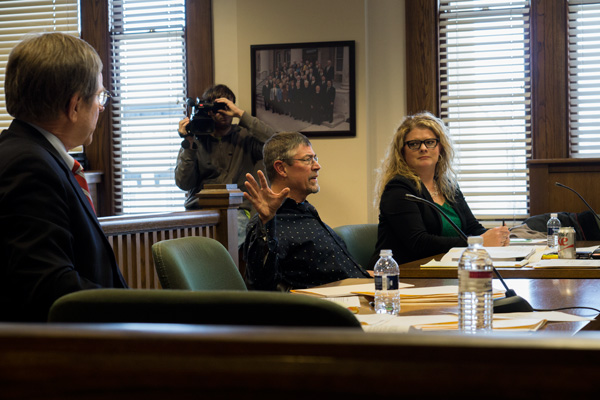
When the group got to a ballot cast in Bainbridge 6S, Groth asserted this was the ballot that could decide the election. “If you decide to not count this ballot, you will have broken the tie. And, you will have broken the tie based on a ballot which has every evidence of being valid,” Groth said. “You have to decide as the commission whether you want this election to turn on a clerical error. It is no fault of this particular voter, who was clearly a Schuetter voter. I would submit you have the ability to count this ballot if you think it is a valid ballot.”
At this, Seitz’ attorney, David Brooks, told the commission that Groth was asking them to ignore the law. He explained Indiana Code states that if the ballot is not endorsed with the appropriate initials, the ballot is not valid.
“He is making a bad-faith argument,” Brooks said.
“I resent that,” Groth cut him off.
Brooks continued. “He is telling you to ignore the law,” Brooks said. “The law is crystal clear. Not only did he make this kind of argument to you, he made it to the Indiana Supreme Court and it ruled against him.”
Groth exploded and told Brooks to quit personalizing the issue. “You make ad hominems all the time. I am representing a client and you are representing a client,” he said.
Mannix, attempting to derail the two attorneys’ debate, asked the two to return to their arguments regarding the ballot.
“This is as clean an argument as you can ever see,” Brooks continued. “The Indiana Supreme Court has already ruled on it and it can be count. Period.”
With that, Osterman stated there was a system of checks and balances. “I am not an attorney, I believe this is a check and balance that must be in place for voter integrity,” he said.
Mannix added the state statute is clear. “There is no room for error,” she said reading from the statute. “The whole ballot may not be counted unless the ballot is endorsed by; one, the absentee board or two, the election board.”
Nordhoff, who is an attorney, pointed out that they are making a decision that could be violating the voter’s rights according to the Indiana Constitution. He did not dispute what the state law said. He said the state Constitution states that a United States citizens who is at least 18 years old, registered to vote and is a resident of a precinct for at least 30 days, may not be disenfranchised [not allowed to vote] if they are entitled to vote in the precinct.
“I worried about this thing all weekend because I heard you all talk about it,” he said. “Because someone goofed at the polls, we are going to disenfranchise this voter. That is not fair. They filed an application. They got it. They sent it back in. They did everything they were supposed to do.”
Brooks argued that the Indiana Supreme Court is the “ultimate judge of the Constitution” and they have ruled that statute “can and should be upheld.”
“Legislature cannot go contrary to the constitution,” Nordhoff retorted. “I think it is their constitutional right to vote and I don’t think some screw up by the voting staff should take away their right to vote.”
Both Osterman and Mannix said they were voting by the law.
Nordhoff stated he was voting by the Indiana Constitution.
Mannix continued to debate Nordhoff who simply looked at the three attorneys representing the two sides in the case and announced “Two to one.”
The decision threw out the ballot for Schuetter making the election to sway to Seitz 1,856 to 1,855.
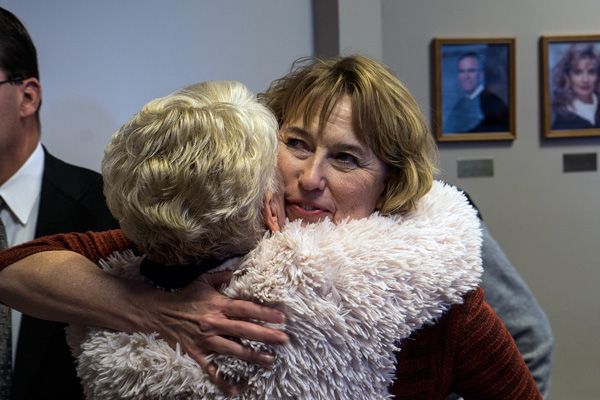
After the decision, the attorneys closed their arguments for any further questioned ballots. One remaining ballot contested due to erasure marks would have went against Schuetter as well.
Schuetter, who can appeal the commission’s decision to special judge Dean Sobecki, attended the hearing. “I will meet with my advisors and make a decision on next steps,” he said after the hearing.
He has a press conference is scheduled for 9 a.m. Monday at the Jasper Train Depot.
Mayor Seitz issued a written statement that included the following quote.
“Since Nov. 3, I’ve learned a great deal about election law and a little about Indiana history, including the fact that a tied election is very rare, especially when nearly 4,000 votes were cast, continued Seitz in the statement. “I want to thank my wife, Deena Lewis, and my daughters, Kristen Ruhe and Lori Werner as well as their families for being with me every step of the way.” Seitz said he extends his best to Schuetter and expects him to continue to serve as his appointee to the Jasper Utility Service Board.”

Strictly from reading this story, I ask: If a voter’s ballot is not counted for some reason after the legal process of the actual act of voting, does that mean they haven’t voted? Isn’t there a difference between voting, which the voter clearly did, all quite legally, etc. – and the vote actually counting, which because of the law requiring two signatures to be valid and counted, etc., it was not? Sounds like this is the scenario – that the voter was NOT disenfranchised from voting as was indicated (that he was) by Mr. Nordoff, but because of following the law the vote could not be counted.
The problem is the vote actually happened by a registered voter, but attorney’s have chosen to use a technicality of the law to not count it. Therefore the reality is the election was a tie, the vote goes to the council, and we all know Wayne Schuetter would win as Mayor under council vote.