
Renewing the stones’ stories

Folks would have faced a heart-shaped stone with illegible scrapes on it eventually; time forever removing any trace of a six-year-old named Leo J. Osborn who lived in Jasper at the turn of the 20th century.
The stone, found in the Enlow Cemetery located between the Jasper Riverwalk and Jasper 8 Theater, is one of several the City of Jasper has authorized Josh Dodd to restore with skills he learned on a month-long apprenticeship in Pfaffenweiller, Germany.
Through a collaboration of the Jasper German Club, Sister Cities of Jasper, and the Dubois County Community Foundation, Dodd received a sponsorship to work with master stone carver Michael Eckert in Germany to learn the skills necessary to restore the monuments. Without which, the few lines marking the existence of young Leo Osborn — born December 1, 1910, died January 17, 1917 — would be lost forever, as Leo doesn’t appear in any other records of the cemetery.
“Sometimes I wonder about the stories, what happened to this person,” Dodd ruminates about his work during a session at the Dubois County Museum where he will be working on grave markers Wednesdays from 10 a.m. to 1 p.m. The public is invited to attend the sessions in which Dodd explains the process involved as he works.
Dodd, 30, a Jasper High School art teacher, is a Haysville native who graduated from Northeast Dubois before attending the University of Southern Indiana. He returned to Jasper about four years ago, leaving a teaching position he held in South Carolina to teach painting and art history at Jasper High School.
About three years ago, members of what is now the Jasper Stone Carver Group — comprised of Dodd, Matthias Hilger, Bob Dilger, Bill Schmitt, Nathan Schmitt, Jim Welp, and Stan Jochem; none of who are stone carvers — asked Dodd if he would like to go to Germany to learn the skill renowned in that area of Germany. According to Dodd, they approached him due to his art skills and the hopes he could interest his students in stone carving to continue the tradition.
“Things fell through,” Dodd said. “But, the opportunity came again last year.”
Dodd traveled to Germany with his wife Megan and sons, Ryker and Beckett —who was 13 days old at the time. Megan’s mom, Melissa Wagner, who covered her own travel expenses, accompanied the family also.
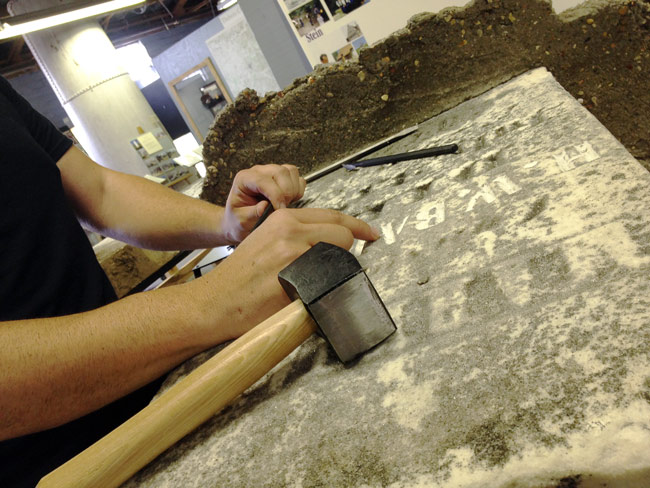
Tink, tink, tink, tink and then, tonk; the hammer taps out a series of hits accented with the final blow. He then adjusts and resets his chisel before another series of short blows. It is fast but Dodd takes care to never destroy the history he is working on. “It’s fairly tedious work. I am working on a ‘K’ right now,” he explains. “the whole upper part of it is gone so I have to kinda make it up on my own so it matches the bottom.”
It appears to be a fairly simple process but the skill is apparent in the short gentle strokes of the hammer and chisel used to clarify the individual letters and numbers. Hopefully, the renewed face will be legible for a couple of hundred years.
If the stone is too far gone, he won’t work on it. He would rather not guess what the intricate letters were meant to reveal about the individual buried beneath and take a chance at changing their history.
The thirty days Dodd spent in Germany taught him the specific skills he needed to work on this project. “In Germany, they probably wouldn’t let me touch a stone,” he joked.
According to Dodd, apprentice stone carvers work with a teacher for three years before they are given a master project. “Then they are sent to another stone carver to complete the project,” Dodd said. “When they have completed the project, then that stone carver will judge whether they are ready to become a stone carver.”
Although it was only a short period of time, Eckert put Dodd through a Mr. Miyagi-esque series of tasks. Instead of waxing on and off as Ralph Machio did in Karate Kid, Dodd was given a large stone that was about five inches thick and told to begin to chip away at its face with no other instructions; just chip.
He admits now there were moments while he chipped away the inches of the stone face in which he wondered what he was learning.
“I thought, ‘man, what am I doing? He’s not teaching me anything,”’ Dodd said of his experience. “I am was just beating this stone.”
But after awhile, Eckert put Dodd to work fine-tuning the relief, leveling it. “He put a t-square on it and told me to do it again and again,” Dodd said. “And after several times, I finally asked him when would it be finished.”
According to Dodd, Eckert held his thumb and finger up and said, “You have about this much left, so until you get it level or we run out of stone.”
Finally, Eckert deemed Dodd ready to begin learning how to work on the letters carved in the stone. “It was important, it taught me a lot,” Dodd said. “I learned that if I hit this big chunk of stone here, it would break here. It taught me to see where the stone was weak. It taught me finesse and patience.”
The 30 days spent learning put a toll on Dodd’s body. “My right forearm was numb for two months after I got back,” he said while he pointed out a groove now worn into his pinky finger where he holds the chisel as he hammers.
Dodd continues to refine his skills through practice in his own studio and watching the videos he made of himself while he was learning in Germany.
The hope of the group is to increase interest in the craft of stone carving and to reach out to more people interested in having their ancestors’ grave markers renewed. Those interested in the Stone Carvers Group or in having a marker restored can contact Dodd by email at jdodd@gjcs.k12.in.us.
“It hit me that it was almost gone, any record of that little boy being there, had that stone eroded to a point where we wouldn’t have been able to read it anymore,” Dodd said about Leo’s marker. “No one would even know he existed. It is rewarding in that I am keeping the memories of those people alive.”

Fantastic story! I’ve found family headstones through “Find a Grave,” in places no longer maintained as cemeteries. The steps Dodd followed to employ his skills will benefit people he may never meet. Awesome.
Re-carving inscriptions is an absolute last resort. it does irreparable damage to historic stones, destroying their original artistry and beauty — and destroying the historic significance of the stone itself. There are other approaches if a family wants to ensure
that the grave continues to be clearly marked, such as setting a new
stone horizontal on the ground. The article mentions preservation and “renewal” (or restoration) but not conservation, which would be the closest description of the hatchet job being done to these century old markers.