
Regional Wellness Center taking shape
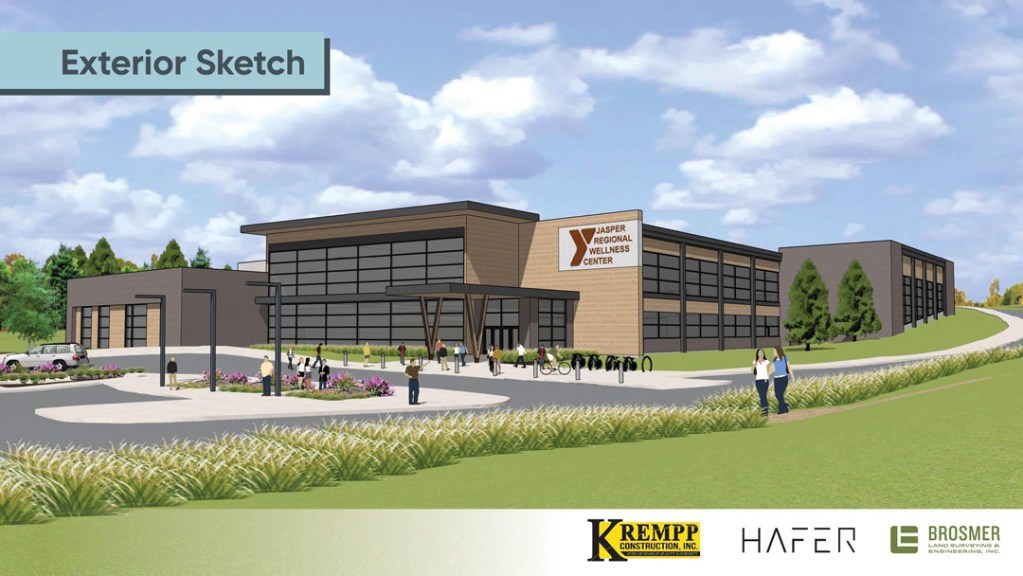
If everything goes according to plan, construction on the Regional Wellness Center could begin as early as September.
At Wednesday’s meeting, the Jasper Common Council received an extensive overview of the project, including the funding sources and construction timeline.
Mayor Dean Vonderheide was joined by Tri-County YMCA Executive Director Mike Steffe, City Attorney Renee Kabrick, Hafer Associates President Jeff Justice, and Clerk-Treasurer Keirsten Knies in the 45-minute presentation. The slides for the presentation are at the end of the story.
The Regional Wellness Center is a sub-$45 million project combining recreational facilities, community spaces, and health programming into a 90,000 square foot building through a partnership with the Tri-County YMCA.
The facility, to be constructed on a 10-acre site adjacent to Jasper High School and The Parklands, will feature four gymnasiums, an aquatics center, wellness areas, and community spaces designed to serve residents from toddlers to seniors.
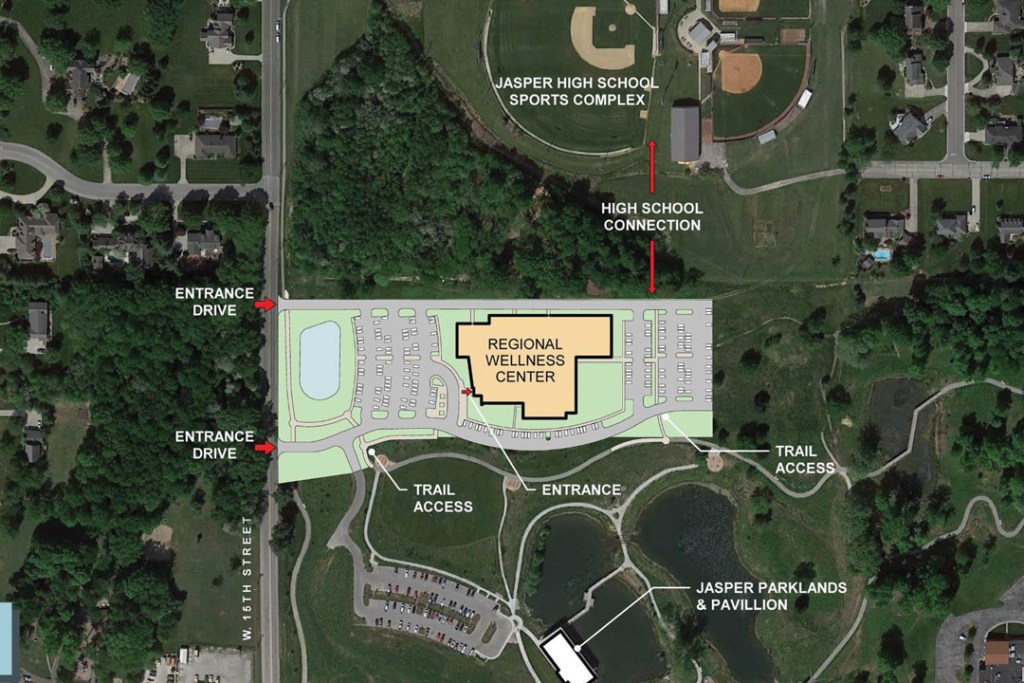
Project funding combines multiple sources, including $13.1 million in private donations already secured through YMCA fundraising efforts, with a goal of reaching $15 million. Additional funding includes a $5 million Ready 2.0 grant, the Jasper food and beverage tax revenues, and planned bond issuance of about $18 million.


The two-story facility will include a 7,000-square-foot wellness area, a teaching kitchen, and an indoor walking track over the four gymnasiums. The aquatics center features multiple spaces for different activities, from zero-depth entry areas for seniors and toddlers to a 25-meter four-lane swimming area.
Project architect Jeff Justice of Hafer describes the building’s design as complementing the existing Parklands Pavilion, with the facility serving as an anchor for the western side of the park.
Financial planning includes using $5.8 million in initial cash contributions from various sources, including: $2.58 million in EDIT funds; $500,000 contribution from the county; current Food and beverage tax revenues; and Central TIF funds
Construction will proceed under a design-build approach, with preliminary cost estimates falling within the project’s not-to-exceed amount of $45 million. The project team emphasized this figure includes contingencies and soft costs.
The YMCA will manage facility programming and operations under a management agreement, while the city will maintain ownership of the building and grounds. Describing the essence of the agreement between the two entities, Mayor Vonderheide said, “hypothetically, if you took the building, turned it upside down, and shook it, everything that would fall out, the YMCA would take care of. Everything that is secured as part of the infrastructure the building is sitting on, the city would own.”
Steffe explained the Tri-County YMCA’s important role in the region and how the Regional Wellness Center is an extension of its mission to promote mental and physical wellness by providing access to physical activities, programming and classes while promoting community.
Illustrating the Tri-County YMCA’s diverse roles, Steffe told how he was at the Ferdinand facility on Wednesday and several boys were playing basketball. He noticed a Chromebook open on the gymnasium floor and asked them what was going on. It was a snow day for students in the county, and one of the boys told him they were completing their e-learning. “I have to have it in by 3 o’clock,” one of them told Steffe.
Steffe noted that with many people now working from home, the YMCA and a facility like the Regional Wellness Center will help attract families to the region.
City officials expressed cautious optimism about the project’s timeline while acknowledging potential challenges from changing state regulations affecting tax revenues. Including the changing formula for how cities determine the maximum amount they can increase levies annually.
The current budget bill (SB 1) being considered by the state legislation includes reducing that levy increase to zero in 2026 and one and two percent over in 2027 and 2028.
Councilman Chad Lueken pointed out that the project’s financial model was based on the 4 percent levy increase rate. He asked if that would impede the city’s ability to pay off current projects and take on future projects.
City Attorney Renee Kabrick told him that whenever the city bonds are issued, they have to take into account those kinds of unforeseen circumstances. Those contingencies are included in the funding model.
She added that in the financial planning for the Regional Wellness Center, they ensured they did not use the sum total of all of those funds being tapped to pay for it.
“We are using EDIT funds, but we are not using, and we’re not close to using, all of the EDIT fund that are available on any given year,” Kabrick said, as an example.
Clerk-Treasurer Knies explained that payments will be structured to maintain funding for other city priorities, including public safety, road construction, and infrastructure. She specifically said the mayor has a five-year plan for using the EDIT funds to address those needs.
Additionally, the Food and Beverage tax has already exceeded the estimated revenue it was expected to produce. Implemented in 2024, it generated $577,000 in its first year, exceeding projections of $495,000 annually. Kabrick told the council that this excess could be used to support a fund for operations and future facility maintenance or to pay off the principal on the bond.
The formal approval process for bonds and bond anticipation notes is scheduled to begin in March 2025. The process will include public hearings in April and final approval by the council in the coming months.
Noting the city’s uncertainty about the state budget proposal’s impact on taxes, Councilman John Schroeder said, “We can only build what we can afford.”
The project represents years of planning, with initial discussions dating back to 2018. As identified through public input sessions, the indoor facility was also included in the city’s comprehensive plan. You can read the Impact Jasper plan at this link.
“I hope you feel as excited about it as we do when we meet with potential donors to the program,” Mayor Vonderheide told the council, adding those meetings have been extremely optimistic about the impact the Regional Wellness Center will have on the community.
