
Q&A on the Wagon Works development in Huntingburg

The Huntingburg Common Council approved the two requirements for the Wagon Works development by Paragus Development to move forward in applying for the tax credits through the state.
During Tuesday’s meeting, the council approved rezoning of the former site of the Huntingburg Wagon Works from heavy industrial to light commercial to allow for the multi-family development. The board of zoning appeals had recommended the action Monday evening and both groups passed the request unanimously.
The council also unanimously approved the tax abatement request from Paragus to abate the property taxes on the property for 100 percent for 10 years. When Huntingburg issued a request for proposals for workforce housing as part of the Stellar Community process, Paragus responded and was chosen as the developer to create the apartments. Paragus has maintained the abatement is a necessary component of any housing project it was involved with in Huntingburg.
What’s the plan?
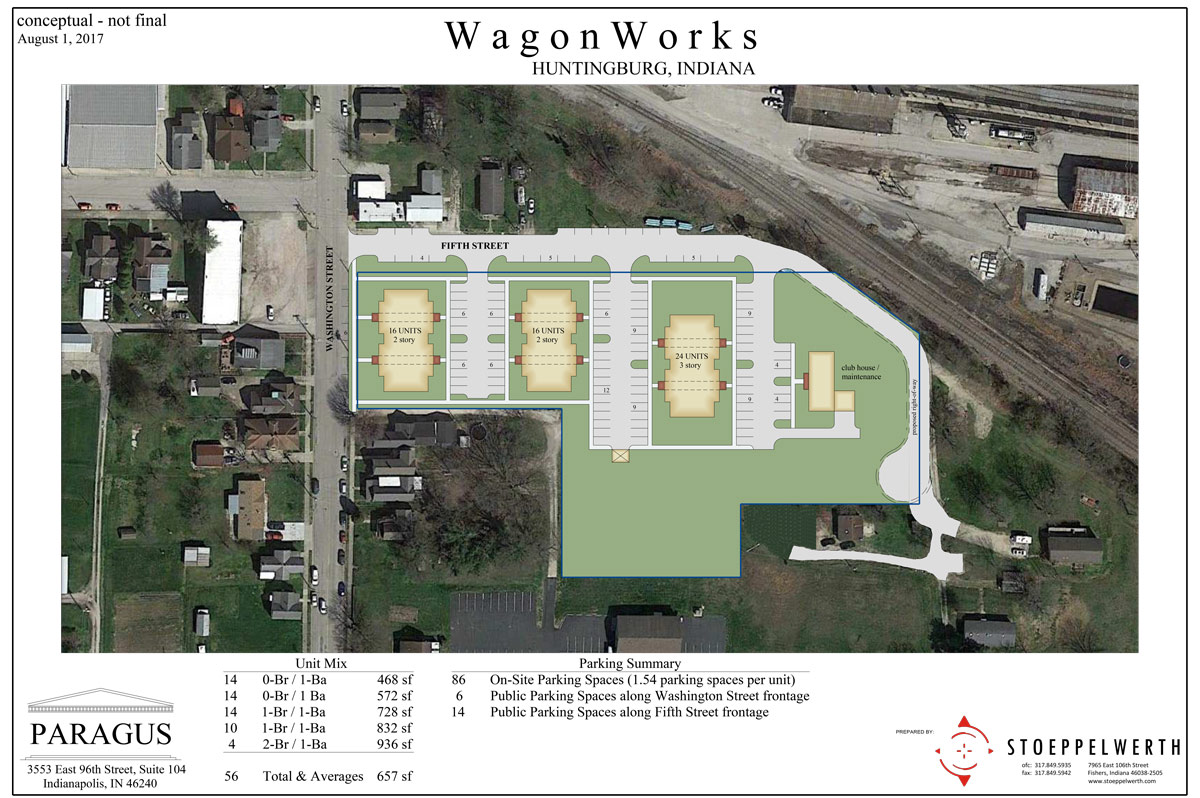
Paragus plans on building a $5.8 million dollar 56-apartment complex on the 3.5-acre property at 419 N. Washington Street currently owned by OFS Brands Holdings. The 56 apartments will be housed in three buildings — two 2-story buildings and one 3-story building. The 56 apartments will consist of 28 studio apartments, 24 single-bedroom apartments and four 2-bedroom apartments. Rent will range from $230 for the smallest studio apartment to $600 for the 2-bedroom apartments.
The development will also include amenities such as a fenced-in dog-walking area, a picnic area and a parking space for each apartment. Apartments will have a porch, patio or balcony; a garbage disposal; dishwasher; and hookups for cable and for a washer and dryer.
There will be two, part-time property managers.
These types of apartments were determined to be necessary for the labor force to grow in Dubois County and Paragus has reviewed those needs to determine the type of housing it will offer in the development.
Click to expand the layout image below to see the apartment sizes.
Who can live there?
Each apartment is regulated to having two occupants per bedroom. A studio apartment automatically qualifies for a single occupant, single-bedroom is two occupants and two-bedrooms is four occupants. The agreement also allows for an infant up to 12 months old in addition to the regular occupancy. Paragus is responsible for ensuring these standards are maintained and they will be subject to state audits.
The apartment community is designed for individuals entering the workforce for the first time and is, therefore, income restricted, meaning there is a maximum income a person or family can have to qualify to live there. Those income amounts are adjusted annually. These are the maximum amounts a person or family can make as of May 1, 2017: $28,440 for a single person; $35,520 for a two-person family; $36,600 for a three-person family;$40,620 for a four-person family.
Once a household is qualified, the household will continue to qualify even if their income increases. However, if their household size increases, they will have to be requalified to live in the apartments. If a two-person household qualifies with a single wage earner but after moving in, the other person gets a job and increases the family’s income, they will still qualify to live in the apartment.
If the household consistency changes and someone else moves in, they tenants must requalify.
What about utilities?
The apartments will be all electric and the tenant will be responsible for the electric bill for their apartment. Water, trash and sanitary sewer will be paid for by Paragus.
What about that tax abatement?
The 100 percent abatement for ten years is allowed by the State of Indiana and Paragus Developments was up front with the city about the need of the abatement when it answered the city’s original request for proposal. According to the developers, the tax abatement is a necessary component for the development to even by considered economically feasible.
The current property tax liability on the unimproved property is about $2,600 annually. When Paragus finishes the apartments, the property tax liability on the site will increase to about $28,000 annually at current rates. According to Bingham Greenebaum Doll attorney Dave McGimpsey, although the city is abating about $329,980 in property taxes over 10 years, in year 11, the property taxes paid to the City of Huntingburg would exceed the amount the city would have received on the unimproved property during that same time.
What about those tax credits?
Gary Ritz, senior developer with Paragus, said the development will take advantage of the Rental Housing Tax Program designed to provide low-cost housing for employed individuals. Rather than subsidies being given to the potential tenant or the developer, the developer receives tax credits administered by the Indiana Housing and Community Authority.
With the low cost of the apartments, the tax credits are needed to recoup the cost of the construction estimated to be nearly $6 million.
Paragus will apply in November for the tax credits and know if their application is approved by February of 2018. Fortunately for Paragus, Huntingburg’s Stellar designation gives them a pass from having to apply with all the other projects the state must consider for the tax credits. Huntingburg’s Stellar designation allows for one project to go forward and only be considered with other Stellar communities vying for the tax credits and there is no other Stellar designated community in the running for the credits this cycle.
If they are awarded, Paragus will receive what amounts to $4.8 million in tax credits over the course of ten years. Those credits will be sold to a partnering business needing to dump some of its tax liability. The income from that sale will be used to fund the construction. Partner businesses usually consist of ones located in the county the project is occurring in or a financial institute.
By participating in the tax credit program, Paragus has strict liabilities in regards to the tenants living in the apartments, the condition of the apartments and the continued maintenance of the apartments. If they are found to be in non-compliance of occupancy restrictions or other issues with the buildings, they could have to repay the tax credits. This liability continues for five years after the tax credits are awarded.
As Paragus has been involved in 25 of these types of developments in the past, if they had compliance issues, they would not be eligible to apply for the tax credits for the Huntingburg project.
Who is Paragus Development?
Founded in 1988, Paragus is an Indianapolis-based developer, contractor and property manager with several projects across the state. The company currently has 25 projects similar to the Huntingburg proposal that have been approved and constructed. They also have created business buildings, single-family homes and are property managers.
What’s next?
Paragus Developments will apply for the tax credits through the state and if awarded, begin construction next year.
An interesting nugget of knowledge.
When this area of Huntingburg was originally platted in 1878, it was subdivided as residential lots. In 1906, it became industrial.

http://www.in.gov/myihcda/rhtc.htm
Rental Housing Tax Credits (RHTC) / Tax Credit Assistance Program (TCAP) website. There is a FAQ sheet right on this page that goes through everything about the program.
First question on the FAQ… Section 8 vouchers.
It`s a shame that Huntingburg wants to destroy it`s historic past. Maybe the city should reconsider it`s decision. Hopefully someone on the city council will join me in my efforts and contact the Indiana Historical Society before going forward with this project.
How far out from downtown, etc, do you believe the city should go to not “destroy its historic past”? The city listened and backed up and out from a recent proposal for housing in the old city hall on 4th St – and I agreed with that one. But this is on the other side of Washington up against a drainage channel and the RR, and is also buffered by church property. People of various needs and backgrounds need places to live – they can’t nor shouldn’t be excluded from everywhere and while this isn’t the perfect place for such a development it’s far better than others, all things considered.