
Megan Durlauf: She’s okay being ‘Hug-a-Thug’
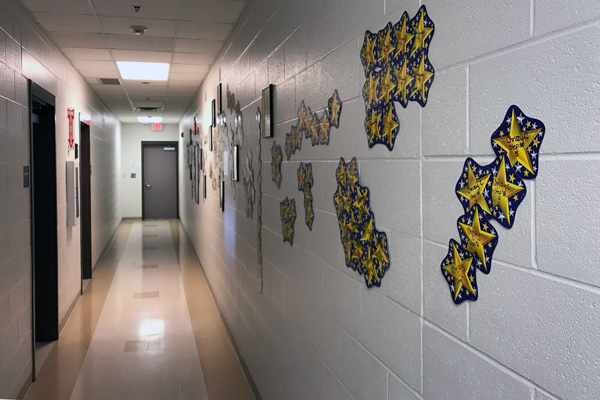
Each star stuck on the wall leading back to the dormitory areas and training rooms at the Dubois County Community Corrections Center proclaims a small victory for one of the participants.
They frame a poster outlining a list of achievement tiers designed to lead participants to understand and care about morality. The program is called Moral Reconation Therapy, and it outlines 13 tiers of moral development in a person.
The first tier begins with developing honesty and trust. The 13th tier — probably a tier that many people in society outside the criminal justice system have yet to achieve — is developing grace and empathy for others. Participants must reach the 12th tier to complete the program in community corrections.
As participants achieve levels in the therapy, they get to put stars up on the wall recognizing that achievement: a physical reminder, or trophy, for the accomplishment.
Those accomplishments are small victories for the case managers as well. Each is a step further down the road to helping a person live a mentally and emotionally healthy life avoiding decisions to break the law through substance abuse or other illegal activities.
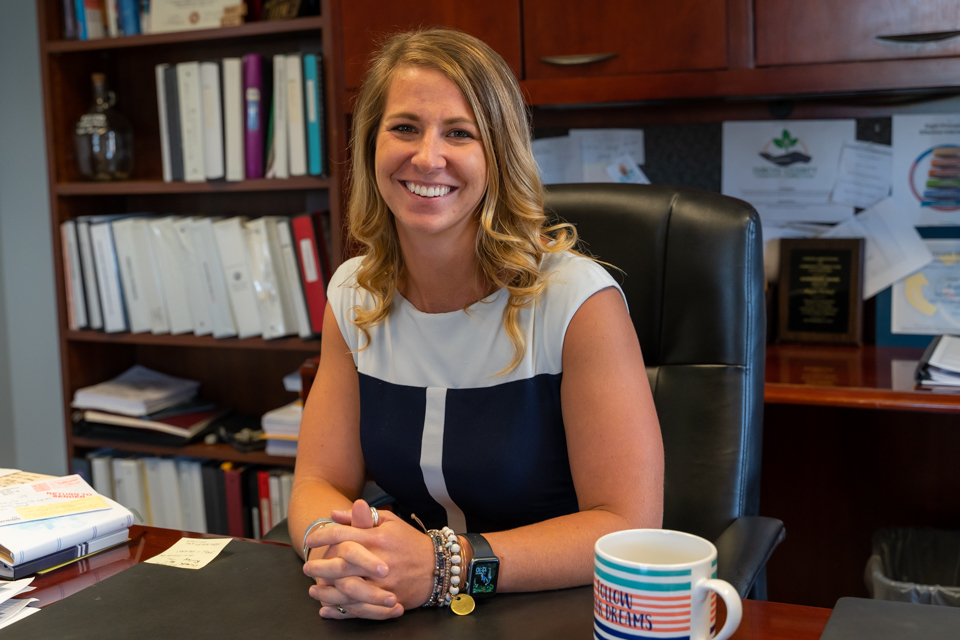
For Megan Durlauf, director of Dubois County Community Corrections, walking down the hall leading back to the training rooms and seeing the stars can be bittersweet.
At first, she’s struck by how a year ago, there were no stars on this wall.
“So I see progress, and in this job, you don’t get that,” Durlauf says. “I can see at the end of the day we did something.”
But then she’s reminded of how slow that progress can be or how sometimes it just stops.
“I see people who are on there, and I think about how they’ve been released, and I’ve heard they’re not doing so hot right now,'” she said. “Sometimes, I wish we could have had people for a bit longer.”
The average stay for a participant in community corrections is about 60 days. Durlauf pointed out that the short-term participants drive that average down, but it’s still a short time for an impact.
With studies showing that it takes 250 or more hours to make a significant reduction in recidivism for moderate to high-risk repeat offenders, it can be hard to achieve the necessary changes in someone’s life the first time they end up in community corrections.
Those hours can take the form of structured skill-building classes and one-on-one counseling, but in scheduling around a participant’s employment and court-ordered programs, that’s a difficult number to obtain.
“Where we see the most lasting change is in those people who are here for a year or more,” Durlauf said, adding that, minimally, nine months is enough time for them to make an impact.
It’s not to say that in those short stays, participants didn’t achieve anything if they only received 30 hours of programming. But, when a moderate or high-risk offender returns to the public with only 30 hours, the likelihood of them recommitting a crime is higher. The only positive is that when they return to the justice system, maybe they will be a little further along in their development. They may have more of a foundation for facilitators to work with to move them up the ladder so they make better life decisions when they leave community corrections.

Durlauf holds on to those moments of success that do occur.
“I’ll never forget the day I was in the lobby, and a guy had just passed his twelfth step,” she explained.
Animated, Durlauf recreates what she heard. “He goes, ‘Danielle, baby, I did it! I passed MRT, and oh, I feel so good. I didn’t pass high school, and I couldn’t get my GED, but I did it!'”
Moments like that are what keep Durlauf working in community corrections.

Durlauf ended up in community corrections despite having a different career planned when she left Forest Park in 2007. She headed to IU and completed a degree in psychology while minoring in criminal justice and social work with plans to work with children. A stint interning at a daycare quickly changed her mind.
Coming to the end of her college time, she was still searching for a career when she was introduced to community corrections. It was an easy introduction with her maiden name being Lampert, a name that resonates throughout the criminal justice system in the county.
“I grew up around it,” Durlauf explained. “My aunt, Tammy Lampert, worked here (community corrections), and she gave me an opportunity to complete an internship.”
Durlauf came in and started filing paperwork. Then the director at the time, J.P. Weisheit, asked if she wanted to work part-time. So, in 2010, she began supervising juvenile road crews. “More kids,” she laughed.
But she used her youth as a way to reach the juveniles. She worked with them when they were doing things like picking up trash rather than just telling them what to do.
“I wanted them to see that it’s not me versus them; it’s us,” she said. “We are a team, and I want to see them get better.”
She fell in love with the work through these interactions. She worked her way up to cover shifts as a corrections officer in the control room, where she completed nightly counts of participants, patted them down, and completed other necessary tasks maintaining order in the facility.
After working part-time for about seven months, she applied for a treatment program facilitator position that had opened when additional funding became available. In 2012, she was hired for the job and took on the challenge of bringing new resources into community corrections to facilitate classes.
“At the time, we had anger management, a bible study, and AA, and that was about it,” she said.
She brought in parenting classes with help from the Purdue Extension. She also became certified in a couple of different classes and began facilitating them herself.
Teaching these classes is something Durlauf loves. “That’s my jam,” she said. “I still facilitate a class a week because I love it so much.”
These classes are where she feels the change occurs in participants’ lives.
“That’s where the magic happens,” Durlauf said. “It doesn’t happen because they are separated from society, and they are being punished. Like that is going to change them. The magic happens when they’re in a group or one-on-one with a case manager or a facilitator learning skills about how to make better choices.”

Better decision-making skills will keep them from doing the same things that brought them into contact with the criminal justice system in the first place.
“It is about needs,” Durlauf said. “They came in here with needs, and we use the risk assessment to determine what those needs are.”
If those needs aren’t addressed, people will continue to make decisions based on them, bringing them back into contact with the criminal justice system.
“It absolutely blows my mind to think that there are people in this world who believe we can lock somebody up, not treat the things that brought them into contact with the criminal justice system, and throw them back out into the world,” Durlauf said. “Then (they) get pissed off whenever someone reoffends.”
Durlauf wishes more people viewed these problems in light of the underlying reasons they occur. Everyone has a story, a past, or a reason that has brought them to what could be considered the lowest point in their lives.
While she loved being a facilitator, when William Wells was hired as director at the facility, he advocated for an assistant director. She applied and was hired for the position and held it for about four months before he resigned.
The corrections board had her take over as interim director in February of 2017. She decided to apply for the directorship and was subsequently hired by the board in March.

It was a new role requiring her to add to her skillsets.
“I knew a ton about evidence-based practices. I knew a ton about client interaction. I knew a ton about how to get people to the point where they’re ready to change and how to implement effective interventions,” she said. “I didn’t know crap about budgets. I just knew if you spend less than you bring in your golden.”
She feels that the Community Corrections Advisory Board hired her because they could see her passion and her dedication to seeing community corrections succeed.
“I started in this line of work out of curiosity,” Durlauf said. “I think that in order to stay in this line of work, it has to become a calling.”
Recently, community corrections lost a large grant that had been used to sustain some employees and programs with the facility. She’s working to find other grants to make up for that loss, but she’s dedicated to maintaining as many services as she can to help better people’s lives as well as the community.
Her dedication to those ideals of changing people for the better has earned her the nickname “Hug-a-Thug” in some circles. Durlauf is dedicated to evidence-based practices — practices that have proven to be effective. Hug-a-thug works when applied scientifically.
“Basically, if our team members at community corrections are not building rapport with the clients, we do more harm than good when it comes to measuring the long-term success of our clients,” she explained. “If being ‘hug-a-thug’ means we are reducing the likelihood that someone is going to go back out into my (and our) community and commit future crime, I’m cool with that. I’m in the business of rehabilitation and increasing public safety. Research has shown those objectives do not conflict; it’s science.”
Meanwhile, she’s watching more stars appear on that wall as more and more participants complete the programs and begin to live as part of the community rather than the unwanted outliers.
Megan and her husband, Jeff, live in Ferdinand with their two children.

This girl exudes passion in everything she does! She’s creating a mind shift for our community! Way to go Meg!
Meghan is the shit!
Meghan has always been there for the inmates and such a nice person with attitude and on the eyes.
Megan, Great story and I know you earned what you have going on!!