
Mail Call: A Vietnam vet’s story

Bob “Doc” Fowler’s situation only became more confusing when his captain told him a helicopter was coming to pick him up.
“We were on a search operation,” Bob explained. “It was later in the afternoon and things had kinda wound down when I got the call to come see the captain.”
Bob’s captain told him a Huey helicopter was coming to pick him up to fly him back to Phu Bai. In 1968 Vietnam, it was unusual for a helicopter to be sent out to pick up a lone Hospital Corpsman 2nd Class. “They didn’t bring anything out and didn’t pick anything else up,” he explained. “I thought someone back home had died.”
At Phu Bai, Bob made his way to the colonel’s office and when he arrived, was told to sit down.
“Have you been writing your mom that you haven’t been getting your mail,” the colonel asked.
The question was so far from all the scenarios Bob had been contemplating that he was at a loss for words.
The colonel then laid it out for him. Somehow, Bob’s mom, Ravalee, had learned her son had not been receiving his care packages. So, she called her distant cousin, Vance Hartke, who happened to be a United States Senator. He called the Pentagon, who called the Commandant of the Marine Corps. The Commandant then contacted the general of the western Pacific theater who got the colonel on the line.
Bob could only apologize to the colonel.
“I tell you what Doc [all hospital corpsmen are known as docs by their Marines], I am going to have an orderly bring all your mail in,” the colonel seethed. “Then you are going to write a letter to your mom telling her you got your mail.”
After that, Bob was a little more cautious about what he wrote to his mom while he was serving in Vietnam.
This is just one of the more humorous stories Bob plans on sharing in a book he is working on. It’s based on Bob’s attempts at explaining Vietnam while placating his mom’s concerns about his diet and hygiene — in one letter, he included a personal drawing of a ramshackle shower the company had access to so he could prove he was showering — through the letters he wrote to her.
Now 67, the Huntingburg resident and insurance broker with a proclivity for sharing puns on Facebook is taking the time to revisit his past through the letters he sent to his mother during his stint in the U.S. Navy from 1966-1970.
The letters Ravalee had sent her son are all long gone; Bob had to destroy them while in Vietnam. Then, after mom passed away in 1989 and his dad, Robert, passed away a bit over a year later, Bob’s sister found the hundred or so letters Bob had written his mom in a box in their home.
They give a clear line of events for him to follow in the absurdity, and horror, he found himself in at times. They shake free some memories he wants to share.
He wasn’t on track to head to Vietnam. In 1966, the 18-year-old was attending Evansville College on a deferment from the draft. “I was majoring in girls and Sigma Phi Epsilon,” he writes in the notes of his book. “I had a solid D grade point average and I lost my deferment.”
To stay in college at the time, you needed a C average.
“I got my 1-A draft notice from Uncle Sam,” Bob said.
Bob’s dad, an Army veteran who served in the 101st Airborne in World War II, advised young Bob to avoid getting drafted into the Army. “He said they would send me straight to Vietnam,” Bob explained.
Bob knocked on the Air Force recruiter’s door, but unfortunately, they weren’t accepting any new recruits. “I went to the Navy, and they were filled up also,” he said. “But they had a 120-day deferment that would allow me to join.”
“It was really spiffy and had all these great pictures of where the Navy goes,”
To take part in the deferment, Bob had to pick two jobs, or rates, before enlisting. The recruiter handed him a big glossy book. “It was really spiffy and had all these great pictures of where the Navy goes,” he laughed. “There was Hawaii and Rota, Spain, and all those places.”
Bob chose radar technician first. “And then I came to the page that had hospital corpsman on it,” Bob explained his trap. “It had a corpsman in his whites standing between two good looking Navy nurses. I decided I would sign up for that.”
The job looked safe to Bob, but he recounts that the description under the picture did say Navy Corpsmen were sometimes assigned to Fleet Marine service. Those words didn’t ring any warning bells for the accidental sailor though. “I thought well, fleet and marine, I’ll go out on a ship,” Bob said. “I had no idea I was a deer in the headlights waiting for the truck to hit me.”
At the end of boot camp, Bob was waiting in line as the chief handed out orders to the new sailors. One after another, each man heard they would be reporting to hospital corpsman school. Bob feared the slots would fill up before they got to him. Those fears were assuaged when the chief handed him orders to the coveted school as well.
“I felt lucky,” Bob explained. “But, these other guys were upset, they didn’t want to go to hospital corpsman school.”
He asked them why. “Because we’re gonna get our asses shot off,” they said after explaining that corpsmen get assigned to the Marines.
“Then the light went on,” Bob added. “Until then, I had thought I would be working in a hospital or something.”
Bob did get to work in a hospital for a short time when he was sent to St Albans Naval Hospital at Long Island for his first duty station. About six months in though, he was sent to Camp Lejeune to learn how to be a Marine.
There he learned how to recognize booby traps, conduct patrols, fire different weapons and respond to ambushes.
Some of the training bucked what Bob felt was common sense.
“We had a Marine sergeant in charge of us,” Bob said. “I remember he said, ‘alright docs, today we’re gonna learn about ambushes.'”
He then sent them on a patrol. “They started shooting blanks at us and your first inclination is to, of course, get down,” Bob said. “So that is what we all did. We got down and returned fire.”
“No, no,” the Marine Sgt. bellowed at the sailors, “that’s not what you do.”
Bob shook his head as he explained the sergeant’s instructions. “He told us that when we ran into an ambush, say from our left flank, we were to turn and charge the ambush,” he said incredulously.
“It didn’t compute,” Bob laughed, “but he assured us that was what we had to do.”
A few months later, Bob was headed over to Vietnam aboard a commercial airplane. “The stewardesses were smiling and telling us to have a nice day as we departed,” he said. “I was thinking, ‘have a nice day, do you see where we are going?'”
The heavy, humid heat hit him in the face as he exited the plane to find his assignment in Lima Company with the 3rd Battalion, 5th Marine Regiment, 1st Marine Division. The surreality of the moment continued when he found his assigned division in a giant Quonset hut. “They said, ‘welcome aboard Doc,'” Bob remembered, “and told me I would have to hitch a ride to my company about 20 miles away in the Hai Van Pass.”
The commercial flight with the pleasant stewardesses, the controlled chaos of finding his battalion, hitching a ride to his company, and then moving into his new living quarters, a cave dug into the side of a hill. “It was all so bizarre,” the Bosse High School grad said. “Like a movie.”
Bob had continued his correspondence with his mom that he had started in boot camp. “I knew she would worry,” he explained.
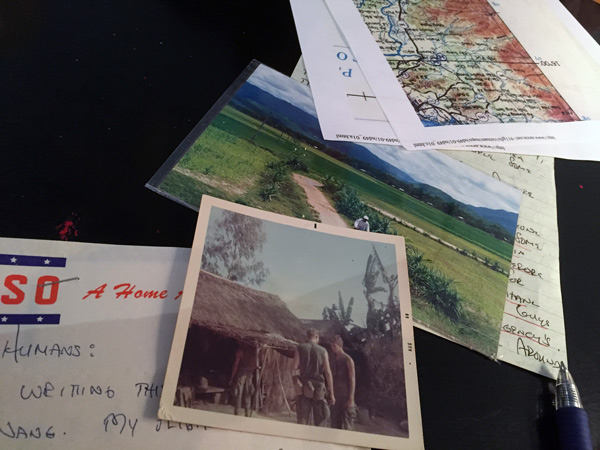
He had even sent her postcards from his layovers as he came across the Pacific to Vietnam. The cards and letters up to then had started with a familiar salutation, “Mom, Dad, Dick [his brother], Sis, and Pokey [the family dog].” Soon after arriving in Vietnam though, the salutation on Bob’s letters changed to a simple “Humans.”
“I didn’t feel human anymore,” Bob explained.
Between the time in the field, the lack of necessities, the fighting, the injuries, the deaths and all the other dismantling aspects of the war, he felt his humanity was stripped away.
The letters and care packages from his family were an important connection with the humanity that was back home. It was important for all the men. So important that if one of the guys wasn’t receiving any mail, other guys in the company would have someone they knew begin to write him.
Bob’s mother’s continued litany of letters kept him in touch with humanity and forced him to respond. Although at times the responses probably didn’t do his mother’s heart any good.
He arrived in Vietnam in March of 1968. He wrote this in June.
“Those prayers you said everyone was saying for me are doing some good. Our plt. [sic] was caught in another ambush the night before last (they had us surrounded) for awhile. No one was killed, thank God. However, about 10 or 11 guys were wounded, 4 were emergencies, grenades were landing all around me. When the reinforcements came, we all got in the Amtrack [sic]. They shot that with a rocket. I was inside, my ears still ring. It looked like the 4th of July when it hit. I came out without a scratch though. God was with us that night.”
This was early on in Bob’s tour and rather mild in terms of some of the other things he wrote.
“When I read some of these letters, some of the stuff I put in there, I think, crap, I probably scared the crap out of her. Not thinking you know,” Bob said. “I think I wrote in one that there was 60 casualties. It is hard telling what she thought.”
Bob is dealing with some health issues that puts him on a dialysis machine about 12 hours a week. He has been spending that time organizing his notes and writing stories to go along with the letters. His penchant for humor bleeds over into a different perspective of the devastating war. But despite his ability to laugh at some of those uniquely military moments, it doesn’t stop him from choking up a bit when he remembers that time.
“It’s not a bang-bang shoot ’em up kinda story,” Bob said. “But, it is filtered through Vietnam.”
He spent 12 months in Vietnam before returning to the United States to finish his final year in the Navy. He considered staying in but his experience and designation with the Marine Corps would likely have found him sent back to Vietnam.
“I already made it through once,” he trails off.
He plans on titling his book “Mail Call,” a reminder of that important moment when the men serving in Vietnam could be reminded of home. A moment in which they could feel human again.

I want an autographed copy. If you need someone who was there to proofread it, I would be happy to do so.