
Lisa’s Room: A safe place for child abuse victims to tell their story

Lisa’s Room is a simple room.
It’s bare of any furniture except for two chairs facing each other in a corner. A simple paper easel is attached to the wall between them. Some markers are in a box beside one chair that sits with its back against the wall.
A small camera lens attached to the wall focuses on one of the chairs.
Two windows relieve the claustrophobia a bit. Through them, the light illuminates the muted colors of the carpet, walls and chairs; nothing garish or fun, just gray and muted green offset by some white trim.
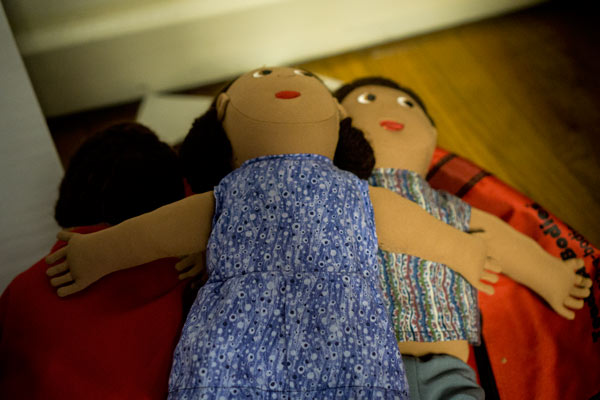
No toys are visible in the room but obediently waiting behind the closed double-doors of the closet are a boy and girl rag doll. There is no tea-party planned for the anatomically-correct pair.
Above the closet, a black-domed eye watches and records everything in the room. It and its counterpart by the chair send everything back to the screens in another special room.
The monitors in this room have several feeds joining those from Lisa’s Room. These come from the waiting room where toys, coloring books and a special table with colored chalk provide distractions for waiting children and their caregivers.

Outside, the nondescript ranch house sits on a regular street of similar houses in the middle of Jasper.
It appears normal and boring. It’s by design.
And Lisa doesn’t live here.
The house belongs to the Southwest Indiana Child Advocacy Center Coalition (SWICACC). A long name for an organization whose mission is to provide a safe place for a child to tell their story of abuse, sexual or otherwise.
This home is one of five the organization operates in Region 17. A region that includes Crawford, Daviess, Dubois, Martin, Orange, Perry and Spencer counties.
With over 280 forensic investigations into cases of child abuse in 2015 alone, 47 of which were in Dubois County, the need for the homes and the special skills of forensic interviewer and SWICACC executive director Tammy Lampert is apparent. Driven by volunteers, Lampert is the organization’s sole employee.
According to Lampert, the majority of those investigations are for allegations of sexual abuse with physical abuse a close second.
“These homes provide a comfortable environment for me to interview the victim while a team can overview the process from the separate room,” Lampert explained.
Compared to the clanging of the six-inch thick steel door, the cold brick walls and concrete floors of the sheriff’s department, the home provides a less intimidating environment for the victim to be interviewed.

As these investigations and incidents go, a child is subject to lasting damage that needs to be remediated through a team of professionals. This multi-discipline team is comprised of the prosecuting attorney’s office, investigators, child services, victim advocates as well as the mental and medical health providers.
Each time a child recounts their story about the abuse they suffered or the crime they witnessed, they relive the event, causing further damage. By bringing everyone together in a single room with a single recorded interview, the impact of reliving those horrible events over and over for each interview are lessened considerably.
“It can be intimidating to see officers and investigators enter, so the team is already in the observation room when the child comes to the house,” Lampert said.
They are out of site, and as the child becomes acclimated to the home setting and Lampert or one of the other forensic interviewers, they are told about the friends who will be watching the process.
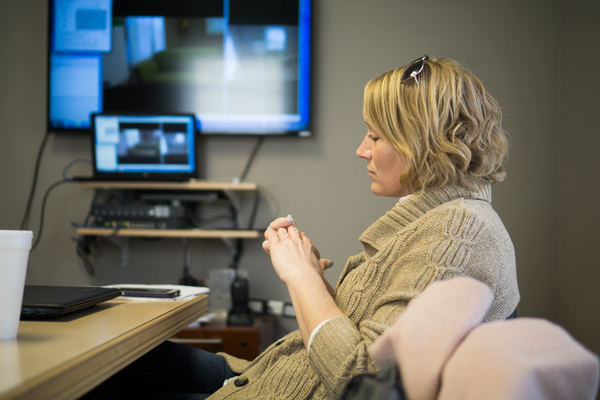
Demonstating the interview process she uses, Lampert curls up in the chair against the wall in the bedroom. Her posture gives her a less intimidating stance. She appears relaxed and informal which calms the child, and she can gain some trust with them to attempt to ascertain what happened.
“I am already building a relationship with them as soon as they are in the waiting room,” Lampert explains. “Then, when we get back here, I’ll say something like, ‘you like to ride your bike, tell me all about riding your bike.'”
This establishes a pattern with the child for being thorough when the time comes for them to explain what they experienced or witnessed regarding the criminal incident. “I want them to be able to use their words to be able to account for everything,” she explained. “As a forensic interviewer, I have to conduct a neutral, fact-finding interview. So I don’t suggest anything or introduce anything, I follow the lead of the child.”
While she opens up a conversation with the child, the multi-discipline team listens and watches. When Lampert moves into allowing the child to tell their story, the team can speak to her through an earpiece she wears.
“Usually, all I know is the name of the child,” Lampert admits. “Because I don’t want to be influenced by the case.”
As the interview continues, investigators may ask her to clarify details with the victim. “As an interviewer, I don’t know everything they need,” she said. “So, they are able to ask direct some of my questions.”
She has worked with children as young as two-years-old and with adults that are developmentally delayed. “If we have an adult that functions at a 13-year-old level, we are going to talk to them here because this is where they are most comfortable,” Lampert said.
The recorded interviews are used by the prosecuting attorney’s office in the court process against the perpetrators of these crimes. According to Lampert, many times the videos will illicit plea bargains from those who are charged.
SWICACC also saves the taxpayers money in the investigation and prosecution of these cases. “On average, we save about $1,000 per case we are involved in,” she said. “Because the teams are all here, they don’t have to conduct a separate interview or track each other down.”
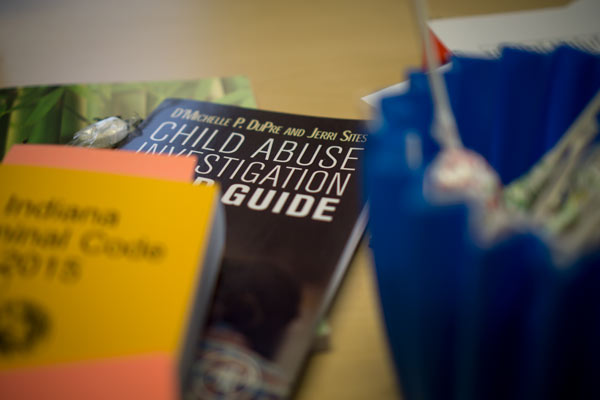
Lampert can’t say she isn’t impacted by the stories she hears from the victims. Sometimes she starts to tear up but composure is important during the process so as to keep the interview moving along. “Once I felt that I was gonna lose it, so I told the child that I need to step out to see if my friends had any questions,” Lampert said. “But that didn’t help, because when I got into the observation room, everyone (the multi-discipline team) there was crying.”
It’s a heartbreaking but a necessary organization.
SWICACC is funded through a grant provided through the Victims of Crime Act, a grant from the Department of Child Services and fundraisers.
All five homes SWICACC operates from have been donated. In Jasper, the home was decorated through the generosity of local furniture companies as well as individuals raising money for the organization. “For example, we had a bride donate all the money she received during a dollar-dance at her wedding reception,” Lampert said.
Lampert started with the organization three years ago.
“When I first started, I was like this is how we should have been operating for the past 50 years,” Lampert said. “If we don’t exist, the alternative is for them to be interviewed at the police station, at DCS, or in the home where the abuse likely occurred.”
“What we do is really good,” Lampert said. “I want people to know that if something has happened, tell somebody. There are people who care and a team that wants to help.”
