
Jasper Mayoral Election: Forum reveals differences

The candidates for mayor of Jasper wore different lapel pins.
The incumbent’s pin bore the city’s new logo although with an antiqued finish. A modern reflection of his own course for the city and his pride in his imprint on its future with a slight nod to the past.
The seasoned challenger wore a pin from the city’s past featuring its crest. A call back to the city’s rich German history and tradition of community pride as well as his own civic service.
The millennial wore a silver cross bearing the imprint of the U.S. flag. For local politics, a confusing symbol in its grandiose conveyance of two concepts that are becoming more and more disconnected nationally.
Adornments hold meaning and in an evening of tame banter and vision-casting hosted at the Vincennes University Center for Technology, Innovation and Manufacturing, those pins may have been the only shots fired between the three.
The two with history, incumbent Mayor Terry Seitz and Democratic challenger Wayne Schuetter, did have to hold their own with a few questions about city issues and decisions. The relatively unknown independent challenger Joshua Budd played things off the cuff with little chance for any hard questions.
The topics that continue to be discussed in this election include tax increment finance (specifically the large district created by the city this year), consultant contracts, the Jasper Library/Hoosier Desk collaboration and the biomass issue.
Consultants
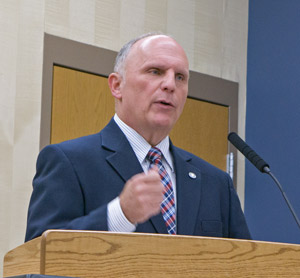
Seitz faced the question about his administration’s apparent reliance on consultants first. “You know, I look at those plans and the things we have done as very low hanging fruit,” he responded about the consultants. “I learned from the Clerk-Treasurer’s Office in about 2012 that we had invested 1.5 million dollars into the riverfront before I had ever come into office. You all seemed to like that so let’s claim that.”
According to Seitz, the planning has created $50 million in investment into Jasper. “I think they have served us extraordinarily well and given us a very good return.”
Budd commented that he thought the consultants were important in the process but that the city had done a bad job of explaining the process to the citizens.
Schuetter, who didn’t have a chance to answer questions about consultants at the forum, has stated that he would like to rely on local talent in terms of vision-casting. As part of the utility service board, he has approved using consultants and engineering firms for utility projects and studies but he feels that the community has dedicated, creative talent that could have been used to complete the Downtown Master Plan for a much lesser cost.
Tax Increment Finance (TIF)
When questioned about the large tax increment (TIF) district encompassing about a third of the city, Seitz fell back on the city’s comprehensive plan to explore utilizing TIF and abatement as a means to invigorate industrial growth.
“Specifically in our comprehensive plan adopted before I took office, it says do these things. Not just once, several times,” he said. “Ultimately, the State of Indiana gives us two tools as a city or a local government, county too, to use; tax abatement and tax increment financing. They are strictly controlled and again, in state code.”
He pointed out that abatement and TIF only impact new investments. “We can stay as we are, or we can have new investments,” he said. “Frankly, in my opinion, we are 25 years overdue in these things. Other cities have been utilizing them in a magnificent way, and we are very much behind.”
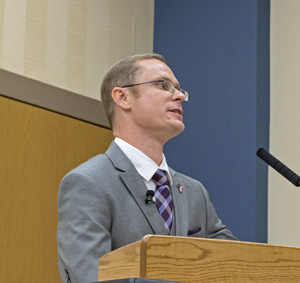
Budd took a different approach. “Do we need more business,” he asked rhetorically. “I mean, we are thirsty for people. We have 500 to a 1,000 jobs that need to be filled and we want to add more businesses that are going to create more jobs that won’t be filled because we need more people.”
He explained that he felt by attracting more people to the area, new business would grow organically.
Schuetter, who didn’t have a chance to answer this question either, has explained that the tax increment fund district is too large. And although he understands the effectiveness of abatements, he would like to refine it to make businesses more responsible for meeting the requirements of the terms of the abatement. “We have had businesses that received abatement that have not met their goals in regards to job creation and they only lose a few points from their score,” he said.
Schuetter said he would also like to expand tax abatements to small businesses due to the large role they play in the economic and civic welfare of the city. He would like to see abatements that help small businesses get through their first tumultuous years.
Biomass Conversion
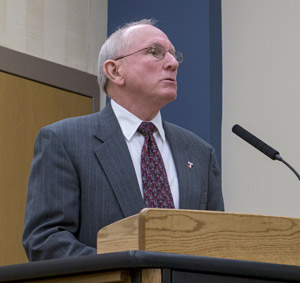
When asked, Seitz explained that he was impacted by the decision solely due to his taking office after the decision was finalized. “As a mayor, I was obligated to honor the lease,” he said.
In regards to the lawsuit, Seitz added that he was specifically advised by the attorneys in the lawsuit that it did not involve him as it had occurred before he took office.
Budd admitted he didn’t want to speculate on what he would have done in regards to the biomass conversion. “Those hypothetical questions can be somewhat loaded because real life is vexing itself. So, stepping back five years ago and deciding what I would do is a hard position to put anyone in,” he said. “I think I would make a decision that was fiscally responsible for our community and healthy for our community. I think the health is much more important than the finances.”
Schuetter, who was chairman of the Jasper Utility Service Board during the biomass conversion exploration and decision, said that in reviewing the decision-making process, he wouldn’t have changed much about it.
He explained that the details of the lease would have set Jasper up for a great future and the safety considerations had been well addressed.
“The developer was willing to invest in Jasper over a 100 million dollars, and this was before tax abatement was passed,” he said. “There were things [in the lease] that would have made Jasper so advanced in different ways.”
Schuetter pointed out that the developer had agreed to constant monitoring of the emissions of the plant and the emissions standards he agreed to were stronger than those mandated and enforced by the Indiana Department of Environmental Management.
“The things we had in that lease should have been used when we talk about tax abatements,” he added. “He [the developer] didn’t make promises, he agreed to concrete things.”
He explained that the utility service board sat and listened to people and answered their questions and concerns. “This could have changed the face of Jasper and we could have changed the face of energy in this state,” he said. “We were going to be paid $425,000 a year for a lease; not a purchase. A lease.”
He added that the council and utility service board had discussed taking about half of those lease payments and creating a program for low income citizens to improve the energy efficiency of their homes.
Hoosier Desk/Arts and Library Collaboration
Seitz explained that the city brought the library building committee to the Hoosier Desk site while they were meeting in 2014 to decide on a course of action. “I am an advocate of repurposing that site,” he said. “I think it is a great opportunity. I thoroughly appreciate the library board’s very difficult decision and I hope we can play this out.”
Schuetter said he was concerned about taking four and a half acres of private land off the tax rolls. He explained that he was in favor of a collaboration of some sort, but he felt that depending on the decision next year during the referendum, he would support developing a cultural district rather than a center. “And if you have a cultural district you can help small businesses come in there. You can have a variety of restaurants and a variety of shops. You can have other entities like studio space,” he said. “You can have other things that are connected to the arts.”
He added that he didn’t want to be trapped in a mindset that this was the only way to accomplish a collaboration.
Budd stated that the current library was like a big foot in a small shoe, but he added that he didn’t know if he could take sides in the decision. “I hear it from both sides to be honest with you,” he said. “I think that the cultural center idea and the perspective of it is very appetizing.”
He added that he didn’t think it mattered where it was at.[hr]
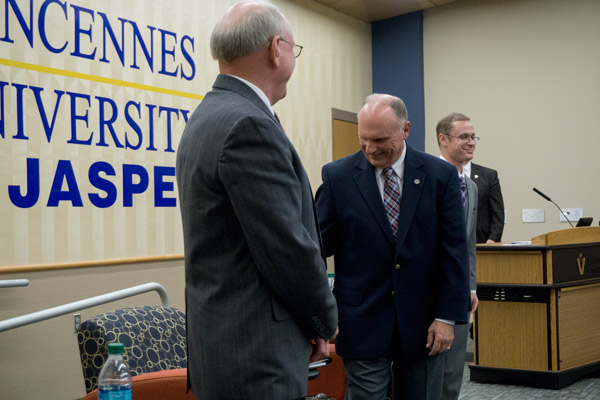
These are the city’s three choices for mayor. The election is November 3.

Mr. Budd made an incredibly good point when discussing the TIF districts. It is wonderful that we have all of this development coming into our town. However, with an unemployment rate of 3%, where are we going to find the workers from not just within Jasper, but within our own county?
Perhaps best is to focus on the community and creating affordable housing in the county. I am surprised by the homes that we see being built and how grandiose they are. The average home price in Jasper in 2013 was just under $128,000. Not out of the price range for the median family, but could be for someone coming into the community new. For the properties listed currently, just a little over half fall into the $128,000 range and below.
Creating a town with an inviting nature is difficult. Changing the culture is even harder. Jasper has an unfortunate reputation of having snobby and fake people. Just read the recent article from The Herald about Jasper and Vincennes. They will be nice to you at church, but talk behind your back at work. I hear countless stories from people who have moved into the city or married into the city of them being treated as second class citizens. Changing this would be incredibly beneficial, but it brings to mind a saying a friend of mine has about Jasper. (for the record, we both are from Jasper), “Change is bad, and different is wrong.” I feel like that is incredibly accurate. I seem to remember Mayor Seitz asking to send a few people to a workshop for something. The council did not want to because it was not something done in the past. We get stuck in our ways in Jasper and we do not want to change them.
The two candidates who really separated themselves I think from this forum were Mayor Seitz and Mr. Budd. On a personal note, I want to thank both Mayor Seitz and Mr. Budd for stopping by my neighborhood and visiting our house. Mr. Budd on two separate occasions. But Mr. Schuetter kept the “change is bad” saying true. Taking four acres or so off the tax rolls would be bad for the bottom line. But the community impact of what could be created in that space should outweigh any tax purposes.