
Jasper Council: River Centre revealed; TIF approved
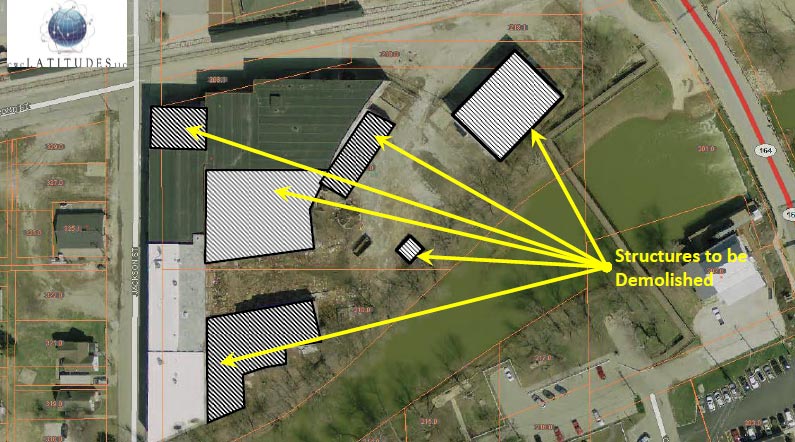
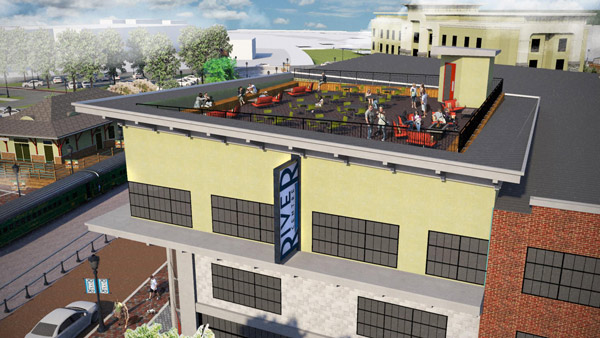
If a redeveloper’s plans come to fruition, the Jasper Cabinet property will become the site of a hotel, office and retail space and apartments within the next three years.
Jane Hendrickson, owner of Boxer Girl LLC, announced the $26 million project to turn the building into a mixed-use development known as the River Centre at the Jasper Common Council meeting Wednesday.
The council was considering a resolution to create a tax increment finance district encompassing the property and some city property adjacent to it.
The project will be planned and designed in 2015 and 2016 with plans to begin work in 2017 with it completed by 2018. A separate hotel created through a partnership with General Hotels Corporation will feature 80 to 100 rooms. The first floor of the Jasper Cabinet building will host 36,000 square feet of commercial and office space. The top two levels of the building will be used to create 75 one- and two-bedroom apartments.
“I believe River Centre will become an economic catalyst for downtown and the Riverfront and I believe River Centre will become an important destination for Jasper, Dubois County and the region,” Hendrickson told the council.

Ed Curtin with CWC Latitudes LLC presented a fly-through of the proposed project. When the video completed Councilman Dave Prechtel said the development was impressive.
Councilman Randy Buchta asked Councilman Tom Schmidt if he liked the development. Schmidt has been very vocal about the lack of progress with the Jasper Cabinet building and property for several years. He has voiced that the building should be demolished several times.
“I’ll be the first guy to make the motion that we approve this TIF,” he said to laughter from the rest of the council.

James E. Dora, Jr., President and CEO of General Hotels Corporation, also spoke to the council. “I really get the flavor of downtown and see the opportunity of development of the riverside area,” he said. “There is just a great potential; a great vision for the downtown area. I hope I have the opportunity to be a part of it. I think it will be a very exciting project.”
Dora did not have which brand the hotel would carry.
Councilman Earl Schmitt asked about how the development would combat flooding issues. Ed Curtin explained that the first floor of the hotel would be two feet above the 100-year flood plain. Additionally, Curtin said the floor of the Jasper Cabinet building could be raised if it was not already higher than the flood plain.
“We are pretty close to being okay from a 100-year standpoint,” he said. “We feel pretty good about it but have some more investigation to do.”
[adrotate group=”16″]
The council heard about the tax increment finance district before the presentation.
Jasper Redevelopment Commission president John Bell explained that the tax impact study had indicated the development would create about $345,630 in captured increment if the assessed value of the property was about $15 million.
He explained that if the project were not in a TIF district, the impact on the four taxing entities — Greater Jasper School Corporation, City of Jasper, Dubois County and Huntingburg Airport — would only amount to an additional $56,400 annually. The $56,400 was arrived at by Umbaugh and Associates, who prepared the impact study, by adding the difference in the tax rates that would occur if the project was included in the assessed value of the city.
During the discussion on TIF, Councilman Kevin Manley stated he had an issue with the larger tax increment finance district that went into effect in March. “I do believe that we need to address the third of the city that’s in the TIF district sometime in the near future,” he said. “I voted for it but I just think it’s too big.”
“We are making decisions about what is best for the community and if we come back and think we need to revise that, I am open to that discussion,” Bell said.
Councilman Tom Schmidt agreed with Manley. “I think the best way for the TIF to work is what we are doing here with the cabinet company and taking each project on its own rather than having such a big district,” he said.
But according to Bell, creating the large TIF district is what brought the Jasper Cabinet development to the table. “There was good in doing that,” he said and added that they also didn’t want to miss any opportunities of increasing the city’s income by a business not being located in a TIF area.
Manley asked Clerk-Treasurer Juanita Boehm how the TIF would impact the property tax caps for the four taxing entities that are funded through the area.
“That assessed value doesn’t go into figuring the tax rate and then that tax rate can get a little higher and that also impact these other entities,” Clerk-Treasurer Juanita Boehm said.
In regards to the impact of TIF on the assessed value of the city and the carry-over to property taxes, an improved property in a TIF does not increase the assessed value of the city.
For example, if the net assessed value of the city is $100 and the city’s operating budget requires them to create a tax rate of .01 cent per $1 of assessed value to meet their budget, as the assessed value of a city increases, then the impact on the taxpayers decreases. So in this example, if the city’s assessed value increases to $101 then the tax rate would go down if the city’s budget didn’t increase.
When a development occurs in a TIF or a business receives an abatment, the increase in assessed value of the property is not included in the assessed value of the city. So, as indicated by Umbaugh’s report for the River Centre project, if the new development is assessed at $15 million, that assessed value is not added to the assessed value of the city. It stays in the district and does not relieve the tax burden on the taxpayers of the city.
Bell pointed out that without the TIF, the River Centre would have never been brought to the table and the property would not have been improved.
The council agreed this was an appropriate use for the tax increment finance and approved creating the separate TIF around the property.
The council also took the following actions.
-The council approved $350,000 in incentives — what those incentives will consist of has not been determined — and $50,000 in off-site infrastructure improvements for the Jasper Lofts II, a workforce housing development in the former Jofco building at 402 E. 13th Street. Jasper Lofts II is an estimated $8 million development that will add 44 one- two- and three-bedroom workforce apartments to Phase I in the same building. Phase I of the Jasper Lofts already received $450,000 in incentives from the city in the form of tax abatement as well as another $50,000 in off-site infrastructure improvements. Phase I received $1,199,705 in Rental Housing Tax Credits from the Indiana Housing and Community Development Authority. The incentives approved on Phase II will assist Miller-Valentine Group, the developer, in receiving tax credits for Phase II.
-The council also approved $400,000 in incentives and $50,000 in infrastructure improvements to the Vine Street Lofts, a $12 million project that will create 62 apartments for seniors age 55 and older. Similar to the previous developments, the letter of intent from the city, as well as the one recently approved by the county council, will impact the points Miller-Valentine receives on their application of the competitive tax credits.
-Approved the sale of two small portions of land the city owns at Truman Road and St. Charles Street. One tract .168 acres in size is being offered for $2,948. The other, .083 acres in size, is being offered for $1,457.

Love the Dora family and the project in which they have been involved. I think they would do a great job with this Rieverfront property.