
INDOT: Be prepared, solar eclipse could create traffic problems
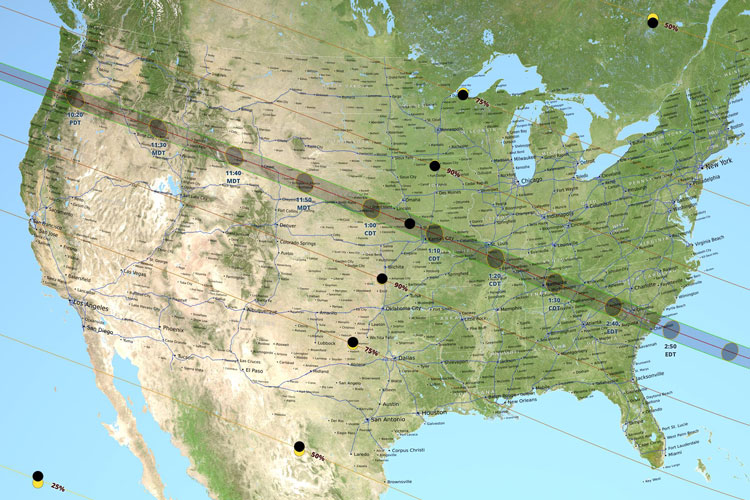 On Monday, August 21, 2017, all of North America will be treated to an eclipse of the sun.
Anyone within the path of totality can see one of nature’s most awe inspiring sights – a total solar eclipse. This path, where the moon will completely cover the sun and the sun’s tenuous atmosphere – the corona – can be seen, will stretch from Salem, Oregon to Charleston, South Carolina.
Observers outside this path will still see a partial solar eclipse where the moon covers part of the sun’s disk. In Dubois County, the moon is expected to cover about 98 percent of the sun. Evansville is situated to experience a partial eclipse of 99 percent and Jeffersonville will see 96 percent.
This mid-day event waxes and wanes over a period of several hours. It will begin at about 12:56 p.m. in the Dubois County area.
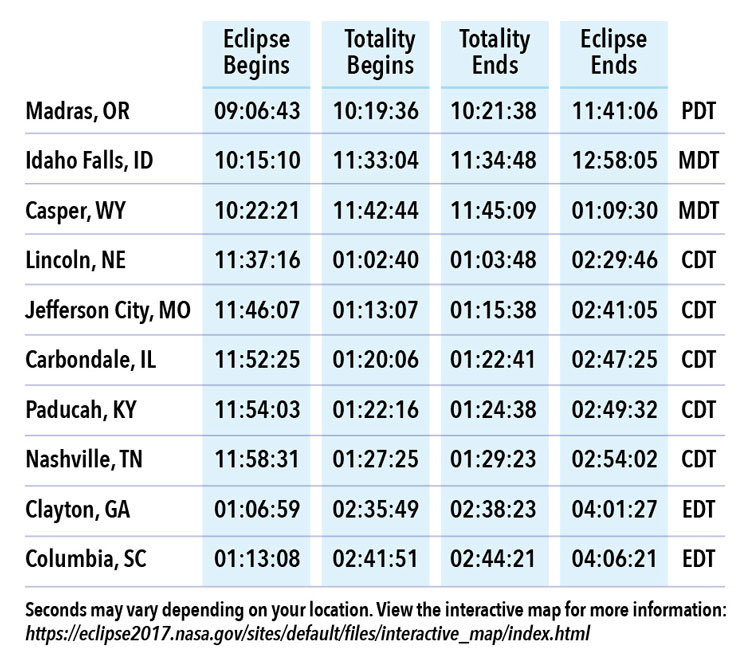 The last time most Americans experienced a total solar eclipse was 1991. In 2017, an estimated 500 million people will be able to observe the August 21, 2017 total solar eclipse, in partial or total form: 391 million in the U.S., 35 million in Canada, and 119 million in Mexico (plus Central America and parts of South America and northwestern Europe).
In Indiana, the Department of Transportation is urging motorists to plan for traffic congestion expected to occur in southern Indiana before and after the total solar eclipse on August 21. Approximately 200 million people live within a day’s drive of the total eclipse path. Many will be on the road to get a closer view.
Interstate 69, U.S. 41, and U.S. 231 are expected to experience increased traffic in southbound lanes before the event as caravans of motorists head for Western Kentucky where the moon’s full eclipse of the sun can be viewed within a 70-mile-wide swath encompassing Hopkinsville, Paducah, and Madison, Ky. After the event, transportation planners anticipate a “mass exodus” from total eclipse regions. Expect heavier than normal northbound traffic on these routes.
Interstate 65 will also see increased traffic going to—and returning from—total eclipse vantage points that begin at Bowling Green, KY and extend beyond Nashville, TN. Again, southbound traffic is expected to rise before the solar eclipse. Northbound lanes will experience congestion after the eclipse.
If skies are clear, the solar eclipse promises to be an unforgettable celestial phenomenon, the first that has been visible to all 48 contiguous states in a hundred years. Beyond the total eclipse’s 70-mile-wide path, a partial eclipse will provide a sky show that becomes more and more pronounced the closer spectators get to the sun’s full black-out. Make plans now for overnight accommodations—overnight camping is prohibited at rest areas.
If planning to view the eclipse, wear safety glasses. They are available on-line or from many popular retailers costing from $2 to $70; some are being given away by organizations. DO NOT look at the partial eclipse without proper filtration.
[quote]DO NOT look at the partial eclipse without proper filtration.[/quote]
Visit the NASA website at http://eclipse2017.nasa.gov.

Again, while not to miss this one, there will be another on April 8, 2024 – less then seven years hence – and no one in this area will have to go anywhere, as we’ll be smack dab in the path of totality. The world will be coming here and elsewhere along the totality path from Texas to Maine. Rare as it is for just one of these across the U.S., it will be a long, LONG time as measured in multiples of future generations – likely centuries – before our survivors ever see two here like these in just seven years.