
Huge plans for future of Rosenvolk
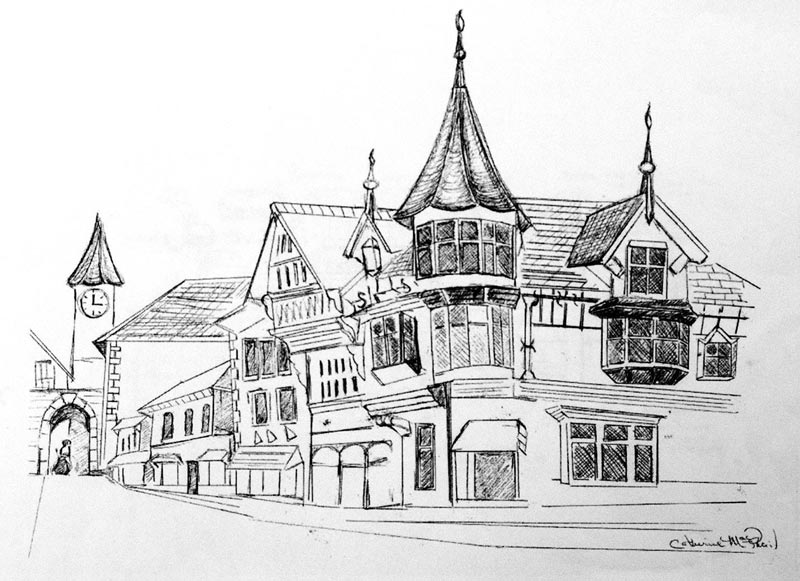
“First, I want everyone to know we tried really hard to keep it in Ferdinand. We looked everywhere for the right place, but most people did not want to sell or the price was simply more than we could go,” said Catherine Le Blanc, who, with husband Dan, founded the Rosenvolk German Medieval Festival.
“We will, however,” she continued, “be staying in Dubois County. We have found the perfect piece of property near the community of Dubois that is not as expensive and, after hearing our presentation the owners are more than willing to work with our organization while we seek funding for its purchase.”
Lots of plans are already in place for the Rosenvolk Education Initiative non-profit, whose organizers are seeking to grow and expand. Catherine highlighted many of those and also provided drawings of what the grounds might look like sometime in the future.
The dream includes a sustainable farm complete with several operating businesses, and school and summer camps within the complex’s three-tiered foundation. A 50-room medieval castle as the centerpiece will provide hotel accommodations for visiting guests, with a non-denominational period church nearby. The surrounding curtain wall encompassing the castle will connect towers and other fortifications. There will also be space for approximately 200 two-story small shops with small living quarters on the second story where shopkeepers can reside during the season.
Good use will be made of the three-tiered land by creating an outer tier for the parking lot and two inner tiers of shops encircling the village inside the wall.
Outside the curtain walls, the Black Dragon Meadery will be open year-round, near the entrance to the shops, and always accessible to the public. Paul Peterson, a/k/a Pete Wylde the Master Meadmaker, will craft his many fine meads.
Catherine came across 100-year-old German stained glass from Munich — the stained glass capital of the world at that time — that will adorn the castle and church. Approximately seven theaters will be used for special events such as masquerade balls, a mud hall for thespian comedic performances “in the mud”, acrobats, fire-breathers, stilt walkers, period music performances, madrigals and all sorts of entertainment.
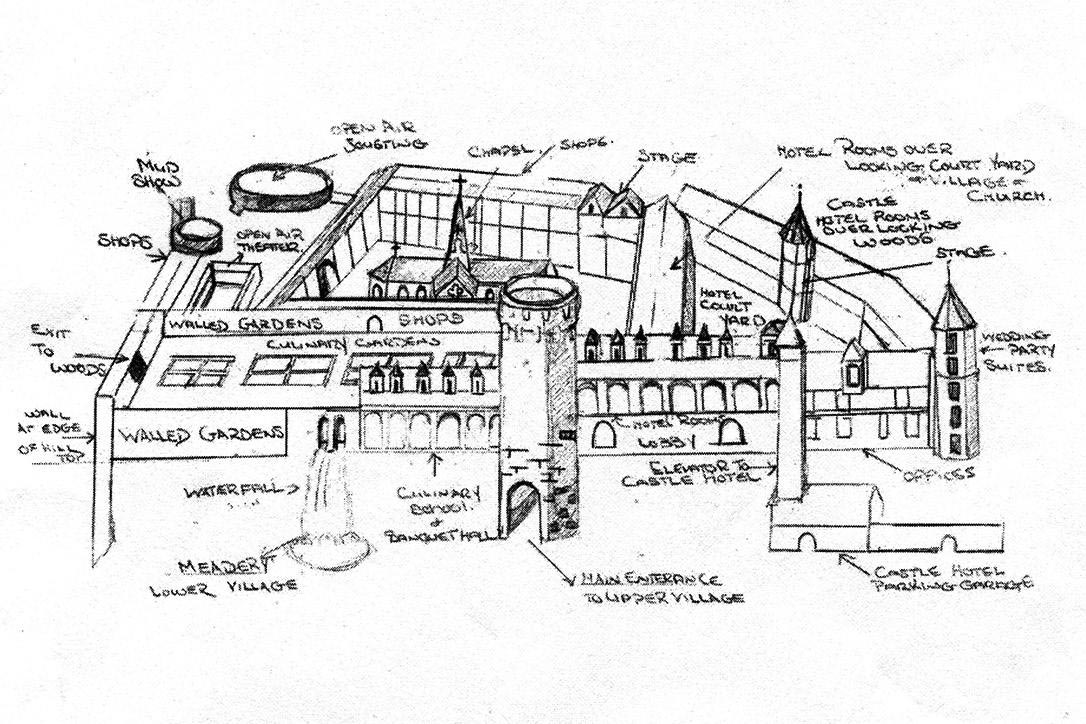
The curtain walls will look as realistic as any medieval fortress, which usually included Arrow Loops (vertical slits allowing the castle defenders to shoot arrows); crenellations, which are the sawtooth pattern and the whole top part of the castle wall including the wall walk, crenels and merlons (think “battle stations”); and of course, the machicolations, or openings between the parapet corbels pointing down from the top of the wall, allowing defenders to drop things upon their attackers — like boiling oil and large stones! There is little this castle won’t have, except maybe boiling oil, falling stones and bloodthirsty warriors. But of course, there will always be plenty of chivalrous knights.
Catherine pointed out that Rosenvolk will not be leaving Ferdinand for a couple of years yet, and while plans take shape the Rosenvolk German Medieval Festival will continue to be produced in Ferdinand during the transition.
“And even though we may have moved from here by 2019, everyone in Dubois County will benefit from this move. Medieval fairs across the world bring in between 100,000 and 600,000 people per event. They have very huge followings.”
Catherine added, “Rosenvolk was offered land to produce the festival at a place known to many as Castle Knoll in Orange County. However, the committee refused the offer because we wanted to stay loyal to Dubois County. It’s our home now and we love it here. We would have stayed in Ferdinand if we could have found enough land — and we hunted vigilantly for three years.”
The Rosenvolk campus will also contain a 1,000 seat banquet hall, where medieval banquets may be featured (think weddings, royal balls, corporate events, etc.), as well as a culinary school operated in conjunction with the sustainable farm. The Rosenvolk Committee has added Josh Emmons to its ranks. Emmons is a culinary artist who attended three culinary schools, studying the science, biology and chemistry of the cooking process. Emmons specializes in how these processes not only affect the food, but in turn, how it all affects the human body. He and his students will eventually grow some of the food on-site for the culinary school, with a focus on what food is — from farm to fork.
Building upon relationships formed between farmers and gardeners he plans to source, his school will go beyond the farm-to-table norm, and build a “start to finish” process.
Once the school is established, he hopes to include a culinary television show focused on recipes, best and worst practices in the kitchen, equipment and add gardens and greenhouses to his itinerary to focus on local producers which will service the school.
Josh also hopes to source local meats, and plans to have a small operating dairy and an aviary on-site for educational purposes.
Hodson Mills, a sponsor of the Rosenvolk Festival, knows people have a real interest in gluten-free products. Hodson’s has been sending Emmons samples of their various ingredients to test and work with, to develop gluten free flours. Josh considers himself something of a culinary archaeologist.
Catherine has been studying the dining concept of “Removes,” learning how they work and why. She explained, each course is simply a little bit of food served, then removed and replaced with a little bit of something for the next course that aids in the digestion of food. There are 8-12 courses served. She hopes to offer “Removes” at medieval weddings or even corporate banquets scheduled in the future Rosenvolk Banquet Hall.
As for the not-for-profit Rosenvolk Education Initiative, a big part of its goal overall is to fund education days. Those education days will be in the form of Camp Rosenvolk — a huge part of the Le Blancs’ mission from the very beginning of the faire — to teach youngsters about the medieval way of life in a fun interactive process, by promoting the food, crafts and environmental aspect of living medieval.
Children attending the camp will see and learn about a real working forge, with blacksmithing expert Butch Sparks, chief-smith. Learning workshops at the camp will offer participants the chance to make their own bow and arrows.
Jousting school will teach the proper use of a sword and jousting etiquette. There will be a full-sized jousting arena complete with Chariot Archery and Gypsy Horse Acrobats. A 1,000 seat, indoor jousting stadium arena will offer a medieval times dinner show year around.
Through Emmons and his students, children will learn about cooking, gardening, candle-making, sewing and theatre arts — all part of Camp Rosenvolk.
The Rosenvolk committee envisions numerous fantasy weekend based on different popular themes, including television shows, various films and video games. Imagine a Harry Potter Weekend, The Outlander, Game of Thrones, Faerie Worlds, Steampunk and general cosplay weekends where visitors can come, dress up as characters for the weekend and reenact scenes.
As to a winter event, Catherine explained, “I have been opening negotiations to incentivize the German vendors to bring extra merchandise and people to man the booths to the village of Rosenvolk. Approximately 60% of their vendors fly in from Germany for that period of time. It would allow these German vendors more exposure and chances to capitalize on their time in the US. We’ll also want to rename our event ‘Christmas Medieval Market’ so as not to detract from the wonderful annual Christkindlmarkt that takes place in Ferdinand.”
The Rosenvolk Castle and company will host many other events throughout the year, making good use of the future facilities, and keeping tourists enticed to come to Dubois County in all seasons of the year — come to Dubois for a visit and stay awhile!
Previously published in Ferdinand News.

Wow – that’s some BIG dreams and BIG plans. It will have to be done for more than seasonal use – this is a BIG-TIME, FULL-TIME proposal and investment. I’m all for that, but if I lived by choice in a rural area and small community like Dubois and others, would I want such a development? I’m really not sure. It may happen anyway someday in one form or another, progress being what it is. Still, even just the construction of it – all the supporting infrastructure to serve a small city, really – and if it’s the success of dreams (a la, “if you build it they will come”) it will mean additional development, residential expansion, traffic and roads into surrounding areas. Nothing wrong with dreams and plans, but as it goes, “be careful what you ask for – you just might get it.”
I disagree Ruth, ask around people want some growth done right. If we want our children to stay and live here then we need to promote growth. I agree it must be done right as to not create an infrastructure mess. Yes if you build it they will come. If done right they will come back, spend money and that helps maintain local businesses and maybe just maybe our youth will want to stay.
But that’s my point: Is this kind of “growth” for this area, right? And as I said, I’m really not sure. Personally, I’m neither for it not against it – I don’t live in the more directly impacted areas – but if I had chosen to live there for my farming and/or the tranquil, rural environment, I would be. Yes, I could move, but I would fight (it) to remain, first. For now, just posing important questions to give careful thought and consideration to, plus the other location comments have merit. One not mentioned is garnering enough investors willing to risk millions to build it so out-of-the-way and off the beaten path.
It would seem to me that it will be an uphill battle to success at the chosen location.
Quite possibly too out-of-the-way for tourists passing through the county to somewhere else.
And unless the hotel is built first, which could be under utilized for quite a while, it will be a remotely located niche attraction with no place for tourists to stay should they have weekend guests.
Hopefully, it works out for Dubois and helps them preserve the school, etc, in the future. I would totally go to it and likely take part in any craft shows they have especially if they have good food.
You’re right about being too far out of the way for tourists. Being closer to I-69 and Holiday World help attract visitors and keep the hotel occupied.
This location has French Lick’s tourism in mind. Quite a good strategy actually…