
Fire conquered by coordinated efforts of city and Ackerman Oil
Update- comments from Jasper Mayor Terry Seitz:
Mayor Seitz applauded the response and performance of the Fire and Police Departments to the fire at Ackerman Oil yesterday, but also recognized the efforts of the city’s Wastewater Department and Storm Water Coordinator Chad Mundy in containing the dirty water.
“I understand that wastewater employees shut the pump down after an alarm notified them of a problem with the lift station,” Seitz stated, “Ackerman Oil was also in a unique position to pump the trapped contaminant from the drain and store it for future disposal.
Mundy and Wastewater employees worked into the evening to insure the contaminated water was contained and removed.
Seitz also reported that there was no contamination to the city’s water supply or wastewater treatment facility and the lift station is back in operation as of this morning.[hr]
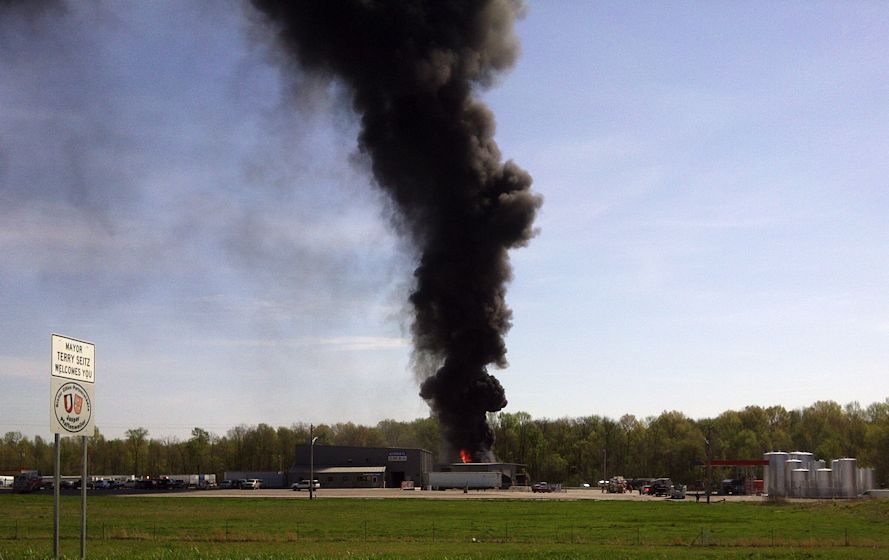
An employee at Ackerman Oil was testing the flammability of an older batch of product on the back loading dock of the business today at approximately 11:30 a.m. According to Ackerman Oil CEO Mike Ackerman, the employee wasn’t prepared for a fire. The batch flashed and a fire spread quickly to nearby pallets loaded with various diesel, oil, and fuel mixtures. A fork truck in the way of the blaze became engulfed as the fire grew out of control. Sprinklers flooded the area but were unable to contain the chemical fueled fire and flames waved 30 to 40 feet into the air. A pillar of black smoke grew and could be seen for miles.
By this time the fire department and first responders were on their way to the scene. Rubberneckers began to slow along U.S. 231 as they approached the intersection. Photos flooded the internet and Facebook.
The fire department responded with seven trucks and two dozen volunteer fire fighters. Jasper police, the Dubois County Sheriff’s Department, and the Indiana State Police responded also and began to set up a perimeter as the fire department positioned a tower truck on the north and a ladder truck on the south side of the Ackerman building. The newly commissioned Engine Seven also made it’s inaugural run. Later Chief Hochgesang would reminisce about wondering when the new engine would finally be used.
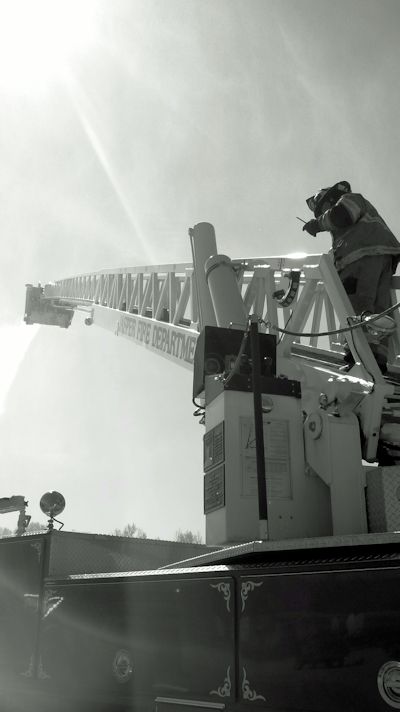
The teams extended the ladder and tower and began to spray thousands of gallons of water onto the fire. As the copious amounts of water mixed with the burning chemicals it sloshed down the drains and flames began to lick up up through grates within the garage and building.
The fire department continued to pour water onto the blaze and the black smoke began to turn white as the flames were beat back and the burning chemicals cooled. The fire department continued to flood the area with water cooling a nearby train tanker filled with heavy oil. The outer layer of the tanker’s double wall was crinkled in the intense heat that had billowed from the loading dock not 20 feet away only minutes before. The next tank in the line had lost paint on the side nearest the fire as well.
Wastewater Superintendent Ed Hollinden had ordered the nearby lift station shut off to keep the polluted water out of the city’s wastewater treatment plant. With nowhere to go the 64,000 gallons of water used to put out the fire and cool the area now began to pour from two manhole covers in the line.

As a train engine began to pull the string of tanks away from the fire, the attention of the firefighters, city employees, and Ackerman Oil employees turned to the dirty water mixture of soot, oil, and chemicals that now streamed from two manhole covers behind Rural King.
Mike Ackerman, in full command, ordered his own pumper trucks to the manhole cover on the north east corner of his property where city wastewater workers had gained access. The trucks backed up and men began dropping four inch lines into the black effluent coursing through the inundated wastewaster lines in the area. The lift station was also unable to keep up with the amount of water draining from the recent battleground and gray water flowed from the manhole lid into a nearby stream.
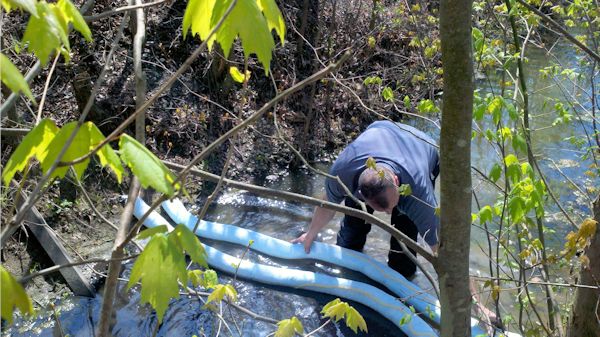
The battle turned from stopping the fire to containing the environmental impact. The creek ran south towards the Patoka River and Ackerman was the first to splash into the stream with a retaining boom. He placed it across the narrow stream to stop the oil and chemicals floating on top of the water from continuing down stream to the river. Oily slicks already coated the edge of the small creek in small amounts and dirty water was still flowing from the lift’s manhole.
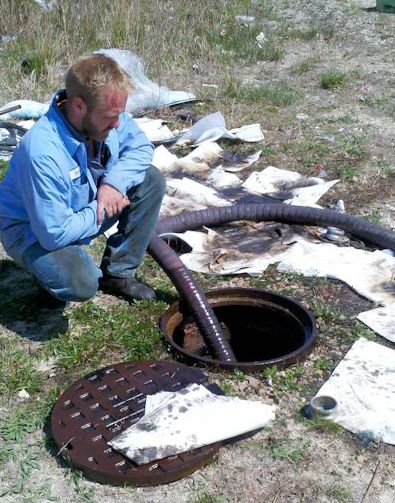 A tractor with a pump attached arrived at the manhole upstream of the lift station and began to fill a large semi-tanker that an Ackerman employee had recently pulled up. It seemed the flood may have been abated but another truck was brought down to the lift station to begin pumping from that manhole to add to the relief.
Storm Water Coordinator Chad Mundy joined Mike Ackerman further upstream placing booms and adding towels to the surface of the water to absorb the floating mixture. The crews continued to clean the dirty water up and pump from the wastewater drain . The crews worked into the evening pumping the dirty water from the drain to keep it from ever entering the wastewater treatment plant.
Ackerman and Chief Hochgesang both extolled the response of the fire and police departments and that not single life had been lost; the impact had been held to the small creek and Ackerman’s loading dock. Ackerman’s trucks continued to pump the water from the wastewater pipes into the afternoon and it is now contained in several tanks on the property.

[fbshare type=”button”] [twitter style=”horizontal” source=”dcfreep” float=”left”]

Are they sure that no oil or chemicals made it to the lift station? Is there any chance of city water being contaminated?
We will follow up with the wastewater superintendent today to find out the extent of damages, if there are any. We will also attempt to find out if any dirty water made it into the river. The lift station pumps the wastewater to the wastewater treatment plant. The wastewater and drinking water are two separate facilities. The wastewater plant treats the sewage and wastewater, whereas the city drinking water comes from the city water treatment plant that draws from the Patoka River off of Second Avenue opposite of the Riverwalk.
Could Rubberneckers have been replaced with concerned citizens? There are many words in the dictionary you could have used to express the good people of this county. This comment along with See..click..fix (a way to nit pick your neighbors) have gave me great insight to the character but not definitive character of DCFreep website.
The employees of the D.C. Freep are natural "rubberneckers" (my neck hurts as I write this), sorry if you were offended.
According to Merriam-Webster,
rubbernecker (n) from the intransitive verb rubberneck
1
: to look about or stare with exaggerated curiosity
2
: to go on a tour : sightsee
Merriam-Webster's Example:
I think Mr. Crane used the word rather accurately. Nothing pejorative about the truth. –JZ
Not sure the example came through…"drivers passing the accident slowed down to rubberneck"
"Mike Ackerman, in full command, ordered his own pumper trucks to the manhole cover on the north east corner of his property where city wastewater workers had gained access."
Too bad Ackerman was not in "full command" before the fire started. Any word on how much Ackerman Oil will be fined for this careless act?
Brett in regards to statement " gained access ". You said I heard, SCADA showed full capacity on lift station on south side and was shut down. Crew then dispatched to scene with a manhole wrench to verify. Along with ordnance of where water can and can't flow comes a responsibility by the city to handle flow from a kick ass fire department. Man in full command showed by action a shortcoming of lack of equipment or use of when responding to emergencies. Waited till now to give you enough rope. Hope you're next meeting goes well. Talk about a wake-up call, could have been in center of town's gravity system.