
County Council reluctant to jump into Jasper Courthouse Square project
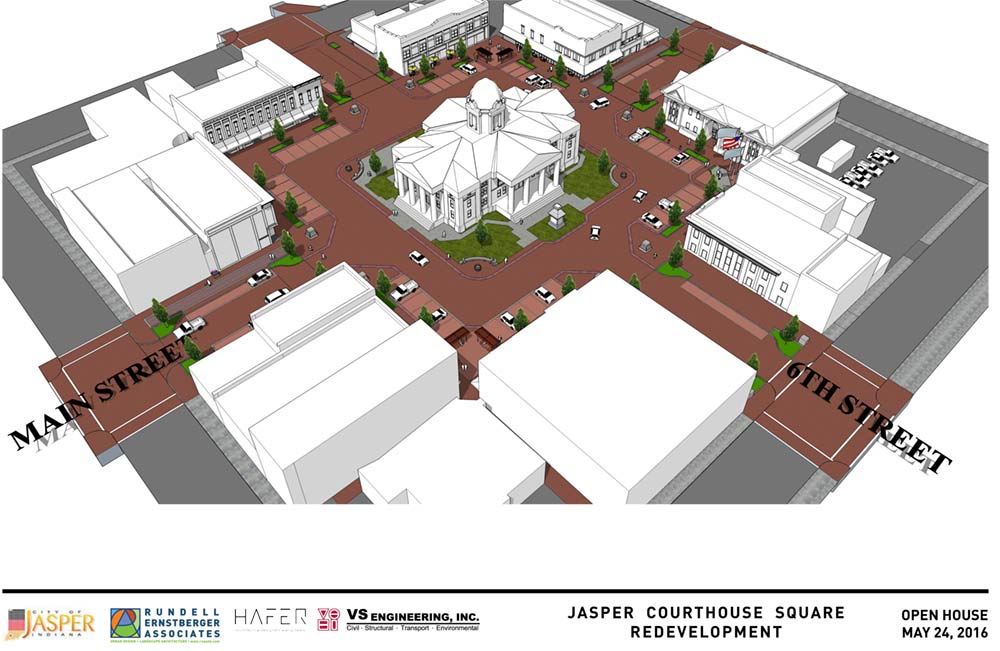 The County Council seemed reluctant to join the City of Jasper in the Courthouse Square renovation project.
Jasper Councilman John Bell, who is also president of the Jasper Redevelopment Commission, and Andy Seger, who serves on the redevelopment commission and is president of the Jasper Economic Development Commission, both addressed the Dubois County Council seeking support for the project they feel is good for the county as well as the city.
Whereas the city sees the recent release of millions of dollars of local option income taxes (LOIT) as a windfall that can be leveraged for a special grant to kickstart the downtown project, the county views the money as a temporary remedy to its own continued budget issues.
For background, through Senate Bill 67, the State released LOIT funds that had been kept in reserve in response to the economic downturn. With continuing economic recovery, the state released those funds to the counties and municipalities from which they were originally withheld. The funds came with a stipulation that 75 percent had to be used for roads, streets, sidewalks and related infrastructure. The remaining 25 percent would go into rainy day funds.
The City of Jasper received $1,666,554, of which about $1.2 million was set into a special fund for road and street projects. The county received about $2.1 million.
Along with the returned LOIT funds, the state created a matching grant program with House Bill 1001 that allows counties and municipalities to double those funds. Each entity can apply for a matching grant of up to a million dollars this year. There is $184 million up for grabs this year and applications are due by 5 p.m. July 15.
Last week, the Jasper Common Council gave approval to proceed with a plan to match a million dollars of the LOIT funds for a grant to support the downtown project. The project includes many improvements to the streets sidewalks around the courthouse and a block in each direction from the square.
Additionally, with the surface improvements, the city plans on updating utilities like water, sanitary sewer and storm sewers; all items covered by the matching grants, according to Jasper City Attorney Renee Kabrick.
The city is asking the county to partner with them on the project by providing $500,000 of the LOIT funds for a $500,000 grant. They also requested the county provide $500,000 directly to the project from those funds.
“Is this about revitalization? Is this about roads and infrastructure? Is this about beautification? Is this about economic development?” Seger said during the presentation to the council. “I think the answer is, yes, yes, yes and yes. As we see it, they all go hand in hand.”
But, Dubois County Council president Greg Kendall said he had a hard time giving the city a million dollars while telling county employees he was freezing their wages or making budget cuts. “It [the request] couldn’t have come at a worse time for us,” Kendall said while complimenting the plans for the square. “Property taxes have been depleted through state cuts and we have 300 employees that I question whether they will be too happy about us asking them to make cuts and then we are going to give away a million dollars.”
In fact, later in the meeting the county council unanimously decided to freeze wages and the hiring of any new non-essential employees for 2017. They also indicated they would hold the department heads accountable for any budget cuts or cost-saving practices that were discussed at a special meeting in March.
Bell pointed out that there will be a lot of competition for the grants, and the funds were set up to impact roads, sidewalks and infrastructure, not wages or operational expenses.
“It is going to be advantageous if we set ourselves apart,” he said. “Everybody has road projects locally. If we can combine efforts by the city and the county and have a regional project; that sets us apart. Early talks with INDOT (Indiana Department of Transportation) indicated they agreed with that.”
However, the county has had to dip into its economic development income tax funds the past four years to offset the budget deficit. For 2016, the county used $1.6 million to offset those losses.
It also uses EDIT funds to pay for the road paving, maintenance and repairs.
Between covering those operational deficits and the county road work, the county’s EDIT fund is being tapped for more money than is coming in. What has been a savings account for the county to pull from in times of need is being depleted. Due to this, the county is viewing the SB 67 and HB 1001 money as a way to relieve pressure on the EDIT fund.
Commissioner Elmer Brames, who was in attendance at Wednesday’s meeting, told the council that after attending a special INDOT meeting held in Vincennes Wednesday morning and afternoon, he was under the impression the state was willing to support any viable road project with those grant dollars. “The indication I got at the meeting this morning was that most legitimate projects are going to be supported,” he said. “I feel good that we can leverage the Senate Bill 67 money as well.”
Dubois County Highway Superintendent Steve Berg told the council that he felt the Courthouse Square project could benefit from federal funding as a revitalization project whereas the SB 67 and HB 1001 money could go directly to roads.
Jasper City Attorney Renee Kabrick espoused upon the potential economic impact of the downtown renovations being proposed. She told the council it would help to attract talent.
“We understand completely that between the city and the county there are enough road projects that we could spend that much and more every year for a long time and never get them finished,” she said. “We feel this is a way to maximize the economic punch that we would get from those dollars to benefit the entire county.”
Commissioner Larry Vollmer said he had a hard time supporting the downtown project when he had county residents “eating dust on rock roads.” He also pointed out that a large portion of this money would go into replacing utility infrastructure under the streets around the Courthouse Square. “I have a problem with the county replacing city water lines,” he said.
Bell responded by saying the county money won’t necessarily go to the infrastructure. “We have compassion for those who have roads that need repaired,” he said. “But this is a blip in time that can have an economic impact on all of us. We will all have a benefit from this.”
“I agree with what you said about the beauty of the plan Greg,” Councilman Jerry Hunefeld told Kendall. “It may be a Cadillac. I can see a lot of work was done on it and it could change the complexion downtown.”
Bell agreed. “It really could set us apart,” he responded.
The council will make a decision on supporting the project at the June meeting to be held on Monday, June 27 at 4:30 p.m. in the council chambers at the County Annex.
More details about the project can be found here.
Also at the meeting:
-Approved the advertising $44,000 for the purchase of new controllers for the heating, ventilation and air conditioning system at the Dubois County Community Corrections. According to the maintenance manager Jerry Gramelspacher, the controllers no longer work, and he is making manual adjustments to manage the environment of the center.
-Approved advertising $45,000 to pay for a new circuit board for the air handler at the Dubois County Jail. The circuit board can’t be repaired, and the air handler has to be manually operated, according to Sheriff Donny Lampert.
-Decided to remove 10 automated CPR devices from a recently approved expenditure. Last month, the council approved $161,000 out of the cumulative capital fund for various medical equipment for Dubois County Ambulance Services Director Suzan Henke. Henke had planned on using most of the money to equip the county’s seven ambulances with automated CPR devices but some money was set to equip the 12 fire departments with rescue pump systems for CPR. Under review, the council and Henke agreed they will only purchase two of the devices to pilot them with the fire departments. The move reduced the cost of the approved purchases by about $12,940.
-Approved hiring three new employees at Community Corrections with funding recently received through a grant. Community Corrections Director William Wells said the positions will only be filled as long as they are receiving funding through the grant. Once the money is gone, the positions will be terminated. The grant will be used to pay for a Drug Court Case Manager, Intake Case Manager and a Field Corrections Officer.
-Approved the compliance certificates for two tax abatements for Temple-Inland and Superior Insulation. Temple-Inland was awarded a five-year tax abatement for $846,000 in equipment purchases for its St. Anthony location. Superior Insulation received an eight-year tax abatement on $350,000 in improvements it made to a building originally owned by Mulzer Stone. The council approved the compliance statements in a six to one vote with Councilwoman Charmian Klem voting nay. Klem stated she had not viewed the compliance documents and without that review was unable to vote in support of the compliance for the tax abatement. “We got an email that stated the companies submitted their tax abatements in a timely manner and the review found them to be in compliance. I never saw any of the paperwork nor was it made clear that it was a compliance review. I voted nay because I felt uncomfortable supporting something I had so little information about,” she explained by email Thursday morning.
-Heard from Councilman Craig Greulich that he was unsatisfied with the council’s budgetary review process and the actions taken to abate the continued budget deficit. During the discussion, Councilwoman Martha Wehr pointed out that the county is not currently in the red and has nearly $8 million in EDIT funds to help cover operational costs. They acknowledged the loss of property tax income that has caused them to have to dip into those funds each year for the past four years. In preparation for the upcoming budget process, the council approved freezing employee wages as well as any new hires of non-essential personnel. They also discussed hold department heads accountable for any cuts they mentioned during a special meeting in March. Greulich and the rest of the council agreed that although freezing the budget for about four years could allow the income to catch up to the expenditures, they did not want to do that to the county employees and didn’t feel it was a feasible long term fix. Wehr pointed out that the growth factor, estimated to be about $200,000 for 2017, would allow the county to increase its levy, and they would need to do so or risk losing that amount in 2018.
