
Adding dye to ice, fun but take precautions to protect and preserve
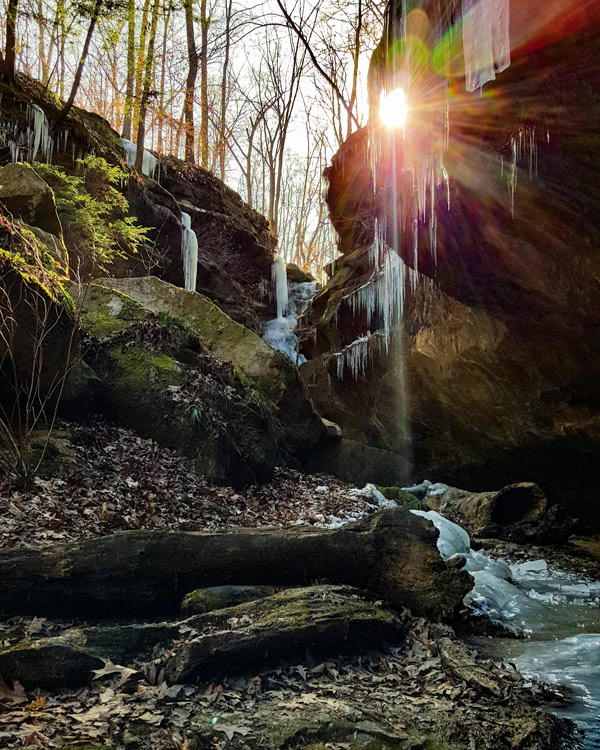
With the recent cold snap, several readers have sent us images of the frozen waterfalls of Hemlock Cliffs to share with our followers.
The well-documented beauty of this unique Indiana box canyon located in Crawford County in the Hoosier National Forest is worth a visit. Be warned though, the short hike is considered a bit rugged as the trail follows rock steps along one side of the canyon wall to drop down into the canyon basin. Depending on what direction you take on the trail loop, it could be treacherous with the ice and snow of recent weeks.
It’s not a large canyon, and the trail meanders for about a mile and half loop with a sidetrack to a half-moon-shaped cavern under one of the waterfalls.
The National Forest Service has designated the site a Special Place, and it has some added protections due to that designation and their efforts to maintain its beauty for the future generations.
When the water freezes, the already beautiful area is crowned with the spectacular views of natural ice sculptures.
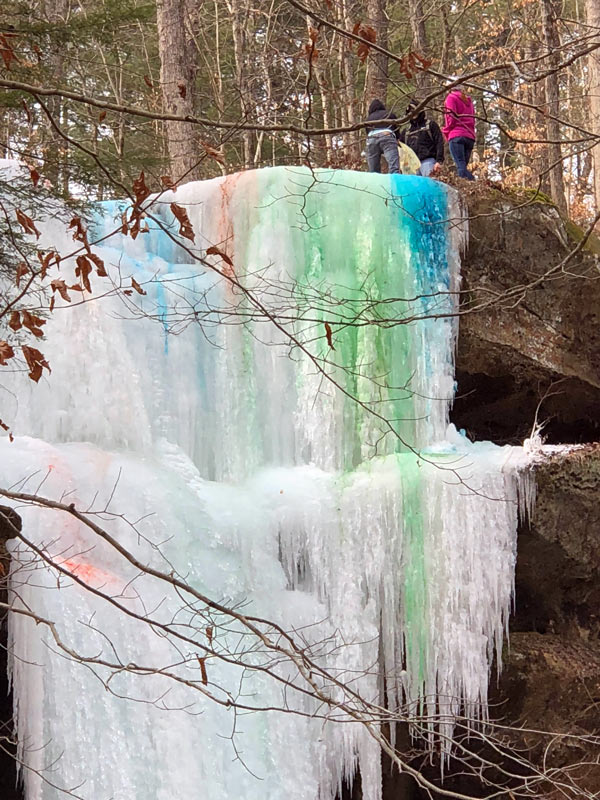
As this happens anywhere in Southern Indiana in the winter, a common thing to do for fun photos is to add dyes to the ice to create rainbow-colored ice formations.
After the photos of the formations at Hemlock Cliffs were shared, another reader shared a photo of some folks allegedly adding dye to the ice there. We haven’t confirmed whether this occurred at the national forest area, but we did reach out to the forest service to determine whether it was okay to do this activity there.
Andrea Crain, public affairs officer for Hoosier National Forest, explained that there is no law against adding food-grade water-soluble dyes to the ice formations in the national forest.
She did, however, offer up some downsides to doing so as well as explain some rules that have changed at Hemlock Cliffs recently.
“We don’t actually have any rules against adding water-soluble food-grade dyes, but please, don’t take that as us encouraging people to do that,” Crain said. “You are, however, impacting other people’s experiences.”
She added that if someone sees another person doing this and decides to do it themselves and they don’t use food-grade water-soluble dyes, there could be consequences for that person.
“If someone did use toxic, harmful chemicals, we would be able to ticket them and there would be legal ramifications there,” Crain said.
She added that if someone did use these chemicals, the impact could extend to the plants and animals as well as get into the area’s water supply. “If you put anything toxic on the ground, it can get into the water supply,” she said while adding that some dyes are sweet tasting and could be attractive to animals to ingest and be sickened.
“Also, you may think this looks really cool, but this is a really special place to people. Hemlock Cliffs is designated as a special place,” Crain said. “People go there to get away from town, to get away from other people sometimes. When you see that glaring reminder that these other user groups are around you, it really takes away from that natural experience.”
Hemlock Cliffs is a designated special place by the Forest Service due to its natural attributes as well as its historic significance.
“It has archeological indications of some of the earliest Native American occupation dating back as far as 10,000 years ago,” Crain explained.
This might come as a surprise to some, but to protect the unique plant species in Hemlock Cliffs, the forest service has now banned camping and campfires in the popular area. This change was made last year.
“We really want people to stay on the trails out there,” Crain added. “Tramping off the trail can have a bigger impact than that water-soluble dye. Your footprints can have a bigger impact. Those activities are available in other areas of the forest, just not at Hemlock.”
Crain pointed out that if the photos we received were taken at Hemlock Cliffs, those individuals were off the trail and could be ticketed.
Here’s another cool photo from Scott VanPelt for you to enjoy.


Just please leave it alone! Why does someone have to ruin something so naturally beautiful?
Agree. Last photo (by Van Pelt) is best. Actually surprised it’s allowed at all in a National Forest. Yes, the culprits could be cited – but by then it’s too late.
Agree!leave alone,if you want to see it with all those colors take picture of its natural beauty and get a box of crayons and go crazy!
Signs also posted that say please take out whatever you bring into the forrest. I know tgey mean trash etc but I personally think it’s mych more beautiful the way Mother Nature made it originally!