
Windows on her world
“It was right over there, Ruth,” a beefy man says, pointing to the emptiness where the North Tower once stood. “Remember? When we came to New York that time? We ate at Windows on the World.” “I remember,” his wife says and pauses, squinting into the sky. “Up there at the top. The view was amazing.”
–Pete Hamill (Smithsonian Magazine)
September 10, 2001.
I imagine it this way. My high-school classmate Stacey Peak is at a birthday party at Windows on the World—table 77—in honor of the mother of a close friend and coworker, Marisa Di Nardo. There’s wine, food, dancing—as recalled by Harley Di Nardo in his sister’s obituary. In a 2017 Wall Street Journal article, Harley noted that his older sister purchased two $200 bottles of wine. Never mind that it’s Monday. There is money. There is youth. Just another night in insomniac city.
“If you live in New York and you have money, it’s a lot of fun,” said veteran film producer Holly Becker, who already lived in New York a few years before Stacey moved there. Both were good friends when they were younger, both graduates of Tell City High School, in Tell City, Ind. The Class of ’83. Go Marksmen.
While Googling images of the World Trade Center (WTC), I find an old advertisement, circa mid-1970s, with the Twin Towers, the tallest buildings in town—and, briefly, in the world. “The closest some of us will ever get to heaven,” the ad proclaims. To read those words now, to contextual them with the 2001 mass attacks, jolts the mind, steals the breath.
Seven days before Marisa’s and Harley’s mother’s birthday, Stacey turned another year. Thirty-six! Eighteen years earlier, as a senior, she was actually in Manhattan, performing in the Gimbels Thanksgiving Day Parade, twirling, hoisting and waving a flag for 2.5 miles, a fiery-red-headed vision of precision and perpetual motion, keeping step with the Marching Marksmen. There were few things in Tell City more exciting than knowing your town was being represented on the streets of New York City by a high-school band which had consistently made the state finals. Firetrucks were reserved for their return from Indianapolis as part of a makeshift, late-night parade when they arrived home with trophies, a pillar of small-town community pride.
I imagine her, on Sept. 10, 2001, in her almost heaven, attired in fashionable fineries, looking through the floor-to-ceiling windowpanes, first greeted by her own reflection, perhaps, a red-haired angel looking in, a meet-cute moment with a celestial doppelganger, and then, feet planted on the 107th floor, she looks down at the Con Ed powered star galaxy that is New York—“a city lit by fireflies,” a city-struck Bono will sing three years later.
“She told me it had always been her dream to live in New York City, and I said, ‘Well, if it’s always been your dream and you have an opportunity, it seems like you got to give it a try,’ ” Holly recalled via phone from her home in LA. “So, she did.”
I imagine Stacey at Windows on that Monday night and wonder if the epic view from her vantage point is lost on her by then? For two years, she has worked in an office two floors below as a powerbroker for Cantor Fitzgerald. She has dined and partied in Windows countless times, with coworkers, customers, and family and friends who visit from the Midwest. When you become a part of the whole that is the magic of Manhattan, when you are a proven player in the world’s most globalized city, where millions live and billions are made, does this sweeping view remain fresh or does it eventually elicit a been-there-done-that brashness? Does the diamond that you desire, the blinding light that you immerse yourself in, eventually shed its shine?
“One time she said to me that ‘for such a big city and so many people, you can get lonely,’ ” said Stacey’s older sister, Toni, via phone from Tell City. “You live by yourself. You work all the time.”
While Stacey didn’t seem lonely to Holly, she did acknowledge that what one says to family could differ from what’s said to colleagues.
Yes, Stacey achieved status in a rarefied place, but Holly conceded that “it wasn’t like everything about her life was perfect. No one has a perfect life. She wasn’t madly in love with anybody, but she had dates. She certainly got a lot of attention from men in the world where she was. She was attractive and she stood out, and I’m sure that was part of her success. When you talk to your family, you know, you do tend to share the hard times because you can’t share them with your friends. You have to put on a great face for your friends.”
Two years earlier, Stacey had left BTU Brokers, a natural gas and electricity brokerage company in Houston to enter the Cantor Fitzgerald stratosphere. That a Southern Indiana river-town girl had proven herself in a career dominated by men tells you a lot about her mental and professional drive. The following passage from 102 Minutes: The Unforgettable Story of the Fight to Survive Inside The Twin Towers, by Jim Dwyer and Kevin Flynn, provided perspective on the prestige of Stacey’s employer: “Few companies in the Trade Center had more people, with more money at stake, than Cantor Fitzgerald, a trading company famed for its aggressiveness.”
Stacey was a power player in that powerful world, an aggressor who likely lived by the axiom of the harder you rise, the farther the fall.
“She had what they call ‘a book,’ a book of business,” said Gail Gibbs, who was treasurer and a director of BTU, via phone from Houston. “She and Marisa were very big producers.”
A book of business is a record of clients and managed assets, which provides a valuable advantage to firms.
“There weren’t too many women in this that were successful. But those two were very successful. They were smart. They were good with people. They worked hard. They were young and liked to party,” said Gail. “Part of that business was to party.”
Gail’s husband, Randy, was president of BTU. The successful company had provided employees, like Stacey and Marisa, an opportunity to springboard to larger firms like Cantor Fitzgerald. Stacey landed her job with BTU based on her track record at APB Electricity, an Over-the-Counter electricity broker located in Louisville, also on the Ohio River shoreline, about an hour from Tell City.
“What comes to my mind (when thinking of Stacey) is effervescent echo,” said Gail. “People were attracted to her because she had a big personality.”
Randy concurred: “She had a great sense of humor. People were attracted to her, and she used her femininity in a male-dominated environment to be very successful at what she did. People wanted to do business with her. Her customers were very loyal to her because they saw how fiery and committed to them that she was.”
The Houston couple was more than just an employer to Stacey. They provided her a home away from home and a sense of stability. They vacationed together. Visited the Gibbs’ summer home. Stacey’s mother, Bobbie Peak, actually referenced the couple on a website that Stacey’s employer, Cantor Fitzgerald, set up to commemorate 9-11 victims employed with them: I will always be so very grateful to Randy and Gail . . . They took her under their wings and treated her as one of their family. She thought of them as being very special friends.
I imagine Stacey staring down at Manhattan, and other boroughs beyond, seeing those bridges, buildings, streets, avenues, headlights, the dazzle of light reflecting from the Hudson and the East Rivers. Aircraft landing lights search through the sky, from safe altitudes, like candles navigating a dim tunnel, the never-ending interconnectivity of small towns and cities, countries and continents. Maybe the storm brewing that evening, the novelty of erratic nature, reawakens her wonderment (that is, if the scene from her perch has indeed lost its pop), causes her to flash the same smile I last saw at graduation 18 years before—the smiles of all of us never stretched as wide as then—as she considers the journey that got her here at the cusp of midlife, the choices made at various crossroads since 1983 leading her to this presentness that represents her own window on the world. She’s a quarter-mile high, ear level with the thunder, her smile like lightning carving the nocturnal sky.
She is in the North Tower. The North Star of global commerce. She is a dweller of the Manhattan skyline. A budding neophyte at the nexus of capitalism. Blooming. She is power. She is energy. She is female. She is drawn to this enviable perch, 107 stories up, in a building that not so much scrapes the sky as defies it, feeling at home in, and a part of, one of the dynamic duo of towers, a bastion of an economic empire. Imagining her there is as mind-boggling to me as seeing Philippe Petite part an August sky via his famed aerial act in 1974, the pinnacle of humankind highwire artistry. She is a small-town girl finding her place, her own space, seeking a personal balance in the big time while performing her own financial high-wire act daily in the thinner air.
I also can’t help but imagine her obliviousness that night to the ill wills and ill winds—the jet-fueled malevolence to come—headed her way in the form of deeply disturbed perpetrators who are drawn to the WTC for the same reason she was drawn there, the power her tower symbolizes. The difference being Stacey is there to experience that power, to fuel that power via her chosen career, to achieve a fulfilled life, while the others, the wickedness coming her way, aim to pancake and pulverize this symbolic center of global trade, to fracture the famous skyline and all it represents.
“After dinner, we went to the Greatest Bar on Earth for a couple of drinks before heading down to the lobby and waiting for our cars,” Harley Di Nardo emailed me. “That was the last time I saw them.”
***
September 11, 2001
Stacey, Marisa and Harley parted ways at 1:30 a.m.
Four hours and 15 minutes later, in Maine, Mohamed Atta and Abdul Aziz al-Omari boarded a commuter flight to Boston.
I imagine Stacey warmly asleep, perhaps sharing a bed with her pets, a dog (JonJon) and a cat (Weber).
Atta and al-Omari boarded American Airlines Flight 11, which departed at 7:59, bound for LA. Three other terrorists passed through Logan security and boarded the same flight.
I imagine Stacey waking, tired (maybe), a bit hungover (maybe)—or maybe not (she belonged to the city, and by then, the city belonged to her). She catches the subway and returns to the North Tower; calm, clear blue skies erase last night’s darkness, an Etch A Sketch shaken. She ascends via an elevator to her office two floors beneath the party six hours earlier. A new day. Customers to call, money to make. Stacey Peak, at the peak of the world, her powers, once again. Dressed to kill.
102 Minutes notes how “Cantor occupied 4 floors near the top of the building – 101, 103, 104, and 105 – and they were far busier than most at this hour. Some 659 people were already at work.”
Fifteen minutes after takeoff, the terrorists overpowered Flight 11. Atta took a pilot’s seat. The turning point when an aircraft became a missile had happened.
According to The 9/11 Commission Report, a flight attendant on the hijacked jet reported via phone, “Something is wrong. We are in a rapid descent. We are all over the place . . . We are flying low. We were flying very very low. We are flying way too low . . . my God, we are way too low.”
The call abruptly ended just before the jet hit the North Tower at a tilt, as if the terrorist at the controls wanted to clip as many floors as possible, a knife twist into humanity’s heart.
According to The 9/11 Commission Report, “Evidence suggests that all three of the building’s stairwells became impassable from the 92nd floor up. Hundreds of civilians were killed instantly by the impact. Hundreds more remained alive but trapped.”
“I thought, oh my God,” recalled Gail. “I thought that Marisa and Stacey were probably a little hungover, and I thought, hopefully, they didn’t make it to work on time. It would not be unusual for them to stroll in a little late (at BTU). But our business was a little different from Cantor. Cantor was run more with an iron fist. Randy was live-and-let-live; make your numbers, do what you do. As events were unfolding, I called her, and my recollection is that my call went to voicemail. I left a stupid message like, ‘Stacey, do you see what’s happening?’ And, of course, she was living it. I was stunned. It was my hope that those girls were going to work late.”
Just before Flight 11 hit, the Gibbs were on an open-mic call with Marisa and others. The mic picked up all sounds in the room, not just voices. The meeting had been noisy. People yelled, which is not unusual when powerbrokers share a direct line with customers, shouting about natural gas and weather derivatives—it’s all part of making deals, the unraveling of the daily mystery as to how much money each would take home by nightfall. A high-finance business barometer in action, a perpetual see-saw battle of ups and downs, cheers and jeers. After the plane struck just a few floors below, Gail heard the ensuing panic captured on the call, as if her phone had been redialed to an area code of inhumanity. The last voice she heard from the squawk box was Marisa’s. Gail spoke very little about what she heard. “And that was the end,” she said. I didn’t pry. That part of the story wasn’t mine to tell.
According to The 9 / 11 Commission Report, “A jet fuel fireball erupted upon impact and shot down at least one bank of elevators. The fireball exploded onto numerous lower floors . . . The burning jet fuel immediately created thick, black smoke that enveloped the upper floors and roof of the North Tower . . . The only hope for those on the upper floors of the North Tower would have been a swift and extensive air rescue. Several factors made this impossible. Doors leading to the roof were kept locked for security reasons, and damage to software in the security command station prevented a lock release order from taking effect. Even if the doors had not been locked, structural and radiation hazards made the rooftops unsuitable staging areas for a large number of civilians; and even if conditions permitted general helicopter evacuations—which was not the case—only several people could be lifted at a time.”
Reflected Randy Gibbs, “Every year I am saddened and reminded of the personal loss I and thousands of others experienced that day, and in the aftermath. I personally lost dozens of former employees, colleagues and competitors. My emotions ran then and continue today . . . a mix of grief, anger and helplessness.”
***
Stacy didn’t perish upon Flight 11’s initial impact.
We know this because from Cantor Fitzgerald, she immediately called her mother, Bobbie, in Tell City, a map speck along the Ohio river near mid-point of the boot-shaped state’s tattered toe and worn-down heel.
Bobbie, who died at 89 in 2014, shared details about the call on the Cantor Fitzgerald memorial page: My phone rang about 5 minutes before 9AM. I thought it might be Stacey calling because she called early from work sometimes if things weren’t too busy. When I answered it was Stacey and she said in a very concerned voice, “Mom, our building is on fire and we may be trapped in here! I just wanted to tell you how much I love you.” Then we were cut off before I could say anything. I will never ever forget her call. Her words are replayed in my mind every day and it haunts me.
The dial tone in Bobbie’s ear was as foreboding as the sound of an ECG machine flatlining.
And that was that.
Toni Peak, Stacey’s sister, was working at an aluminum plant across the river in Kentucky when word spread from customers and coworkers about a plane crash somewhere in New York. Then, more specifically: Manhattan. Then: the WTC. Finally: the North Tower. A plane had sliced through the mighty structure between the 93rd and 99th floors. Toni sped to Bobbie’s house, where other family members gathered.
According to The 9/11 Commission Report, “Within ten minutes of impact, smoke was beginning to rise to the upper floors in debilitating volumes and isolated fires were reported, although there were some pockets of refuge. Faced with insufferable heat, smoke and fire, and with no prospect of relief, some jumped or fell from the building.”
“We were just glued in front of the TV watching the whole nightmare unfold,” Toni recalled. “I was in shock, and I think I kept thinking, hoping and praying she would get out. I mean, we were just devastated, worrying about what she’s going through and how could she get out.”
Family members had visited Stacey in New York several times. They had firsthand experience with the dizzying views below Windows. They understood the precariousness of the situation.
“We knew they were hurting,” said Toni.
That Stacey had called following impact harbored hope, though.
On TV: the plane’s impact replayed over and over like something monumental captured during a televised sporting event; billows of smoke, jet-fuel black; a sky partially afire; an anomaly of gray, black and orange—the calling card of an unholy menace—framed by a still perfect baby blue summer sky; the devil’s delight was on full display just two hours past dawn. Hell’s brewing, Bruce Springsteen sang one year later.
Seventeen minutes later, another jet, Flight 175, sliced through the South Tower, piercing through glass and steel with the ease of a knife cutting butter. Surely, this wasn’t the actual news they were watching. Surely, it was a movie trailer for some upcoming disaster flick, Airport meets The Towering Inferno, an Irwin Allen wet dream.
“It takes a long time to get from one flight of steps to another,” said Toni. “We kept holding out, hoping and hoping and hoping . . . ”

It is here that I stop imagining Stacey there, and instead imagine her when I once knew her. In high school, we made each other laugh if our paths crossed at outdoor “keggers,” or we honked when dragging Main Street and our used cars passed by (it was the summer of Joan Jett and John Cougar), or she flashed me a wink and a smile between classes (quite a thrill for a scrawny boy who knew she was way out of his league; she liked his cousin anyway; they all liked his cousin). She called me by my common nickname, Saalmy—though she made the two syllables sound like a term of endearment. Seriously, I can hear her saying my name as I write this on Sept. 11, 2025. Saalmy.
102 Minutes described the Cantor Fitzgerald scene this way: “Smoke infiltrates the floor. Eventually, fire blocks the stairwells. Employees seek refuge in these offices, including about 50 in a conference room . . . In Cantor Fitzgerald’s northwest conference room on the 104th floor, Andrew Rosenblum and fifty other people temporarily managed to ward off the smoke and heat by plugging vents with jackets. ‘We smashed the computers into the windows to get some air,’ Rosenbaum reported by cell phone.”
Stacey’s family continued holding out hope. But then an even more harrowing scene unfolded. Just before 10 a.m., the South Tower crumbled, like a sandcastle stomped by an invisible giant. An end-of-the-world rumble sounded, like an earthquake. A monstrous, malignant cloud devoured the streets, a detritus of inhumanity encroaching the intersections and avenues with the belligerence of tsunami waters. Mass panic set in throughout the duration of the eerie, volcanic-like violence. As the rumble faded, sirens filled the city, sounding as ominous as a devil’s symphony. What once was there was no longer there. The North Tower stood alone. Where once had been two was now one. A separation of twins. The surviving tower had an air of loneliness to it. It smoldered, flamed, but remained defiant and dignified despite its nakedness. Beside it, an emptiness, where a hole in the world had formed, those who had been inside vaporized into millions and billions and trillions of memories. Even the lucky living, those just outside, whose heels death had nipped, looked like ghosts, some still holding ashy briefcases. Visions of Vesuvius. The terrorists had targeted the towers, and, in so doing, they had assailed our towns, cities, countries, continents.
Still, there was hope in Bobbie’s silent living room on 2 Orchard Hills Drive.
Then, to no one’s surprise really, the lone structure fell, as if due to a weighty grief, a surreal instant replay of 29 minutes before.
Wrote the New York Times’ James Barron: “In New York, people watched in disbelief as first one tower and then the other appeared to explode, floor by floor. Then a debris-laden avalanche began falling, blocking out the brilliance of the late-summer sun and covering the streets of lower Manhattan in a ghostly gray layer.”
“Stacey had a fear of fires,” recalled Toni.
***
The days are laden with images. There was a car outside my apartment block that got a few parking tickets
in the days after 9/11. Eventually it started to get flowers. Enough said.
—Colum McCann, Novelist, New Yorker interview
During a eulogy at Stacey’s funeral service in Tell City, Holly Becker, who encouraged Stacey to follow her dream, provided mourners a glimpse into Stacey’s life in New York City. She also shared pre-9/11 photos of the WTC to demonstrate the true scale of the Twin Towers, as well as the scale of her old, dear friend’s life.
“Stacey worked at the very top of those tall buildings, so she was on top of a very big world and that’s exactly where she wanted to be,” read Holly.
To say Tell City has a skyline is an overstatement. A water tower atop a high hill. A few impressive grain bins. Its “high rise,” gloomily called Twilight Towers, stands six stories tall, provides the best view in town, and shares a street with a cemetery, a view to die for.
Tell City had a population of 7,700 in 2001 (it’s not much different now), compared to NYC’s 8 million). To put it into greater perspective, on any given day, the number of people working at the WTC could be Tell City’s population seven times over.
Growing up in Tell City, there were a couple of women’s dress shops and a one-screen movie house called The Swiss Theatre. Two of Stacey’s big interests had been fashion and theatre. This too made NYC a natural move.
“She really did have an amazing sense of style and she knew how to take advantage of the Fashion Capital of the World. I remember her telling me recently how she was in a store with Julia Roberts and she started showing her around and what to buy,” read Holly. “We used to go to shows there a lot . . . I helped her find an acting class, and I really think that she spent some of the happiest times that she ever had in that class. She called me one night after she had performed some scene and she said, ‘God, Holly, I just lost every sense of myself in that time and I felt like I was in a different world. The teacher said I should pursue acting.’ She was just so happy.”
One of the last times sister Toni saw Stacey was when she spotted her in a Saturday Night Live audience. “She called me and said, ‘I’m going to be there. Make sure you stay up and watch it.’ There was Stacy looking around at the camera. I couldn’t believe I saw her.”
That she was able to score such a hot ticket was a testament to the connections Stacey had developed in the city.
On the Cantor Fitzgerald memorial page, Toni wrote, “She was tender-hearted and thoughtful, open and honest, sincere and warm and loving. She was complex, analytical, dramatic, serious, deep, sometimes moody and dark. Yet she was so easy and comfortable to be around. She had such a passion and an eagerness to live life to the fullest, to learn, to change—to experience all she could.”
Stacey had started to journal about her life in the city, but most pages had remained blank when Toni recovered her personal belongings. The few words captured in that journal centered on her acting class. Said Toni, “She must have had to get up and do something because she wrote, ‘Gosh it was scary. Several told me how good I did and what a natural I was.’ ” Then Stacey added, ‘If only I could see that in myself.’ ”
Holly sensed nothing but confidence in her friend.
“New York City is the biggest trading market in the world. You’ve got to have a lot of moxie to do that. She somehow wound up in that world and rose really fast. She had to go to New York. That takes a lot of guts,” said Holly. “Evidently, she was really good at her job. She was making huge money. It was amazing what she accomplished. She was confident, enjoyed her life and was comfortable doing stuff in the city on her own. She was enjoying her life. She had a really nice apartment. She loved to shop. She went to nice restaurants. She had a really privileged life that not many people get.”
***
Stacey was one of 657 Cantor Fitzgerald employees killed that day. The company’s loss represented 23% of the WTC’s death toll. No other company experienced such devastation to its workforce. Overall, according to the Center for Disease Control and Prevention, women made up 23% of the Ground Zero casualties.
Before our scheduled interview, Toni texted a flurry of messages about Stacey, even though I had yet to ask a question. She was nervous about getting the words right. She discovered how revisiting memories of her baby sister and writing them down proved therapeutic—the 24th anniversary of 9/11 just days away. Still, there was a reluctance to talk too much about 9/11, not because it was painful but because she respected others who have their own troubles to worry over and work out.
“It was such a horrific day that we can never forget what happened. I can’t even look at the TV. It makes me sick to look,” Toni said. “I can’t even believe it happened yet I do worry that you have to be careful because there’s so much pain and suffering every day all around us. Some we know of and some we can’t even imagine happening in the world. Just in our little town, it’s a tough life for too many. I’m just careful about bringing up 9/11.”
That our world has gone amok makes it even more important to keep 9/11 in our minds and the memories of Stacy and all victims alive, including the second responders, the majority being undocumented workers, who cleaned up Ground Zero.
Wrote Karla Cornejo Villavicencio in her amazing book, The Undocumented Americans, “Rescue workers called the sixteen acres of debris on Ground Zero ‘The Pile.’ The powdered debris in The Pile contained more than 150 compounds and elements including plaster, talk, synthetic foam, glass, paint chips, charred wood, slag wool, two hundred thousand pounds of lead from fifty thousand computers, gold and mercury from five hundred thousand fluorescent lights, two thousand tons of asbestos, and ninety-one thousand liters of jet fuel. The nearly three thousand human beings who died made up such a minuscule part of that that the odds of finding identifiable remains were less than one in a quadrillion. It was a site of desolation set on fire.”
According to The Mesothelioma Center at Asbestos.com, “First responders, survivors and residents exposed to the dust are developing health effects such as respiratory diseases and cancer,” adding that “the attacks exposed an estimated 410,000 to 525,000 people to toxic dust. This number includes more than 90,000 workers involved in the rescue, recovery and cleanup efforts.”
It is the attack that keeps attacking.
For Randy Gibbs, the memory of all those he knew who died at Ground Zero hasn’t waned.
“I see their faces and recall my last interactions with each of them on that day and remember to never forget. In this news cycle world it’s easy to move to the next event of the day but this is a day I come back to and never forget. I remember where I was and what I was doing on that morning 24 years ago today, just like the days JFK, MLK and John Lennon (great influencers of their time) were shot,” he emailed me.
***
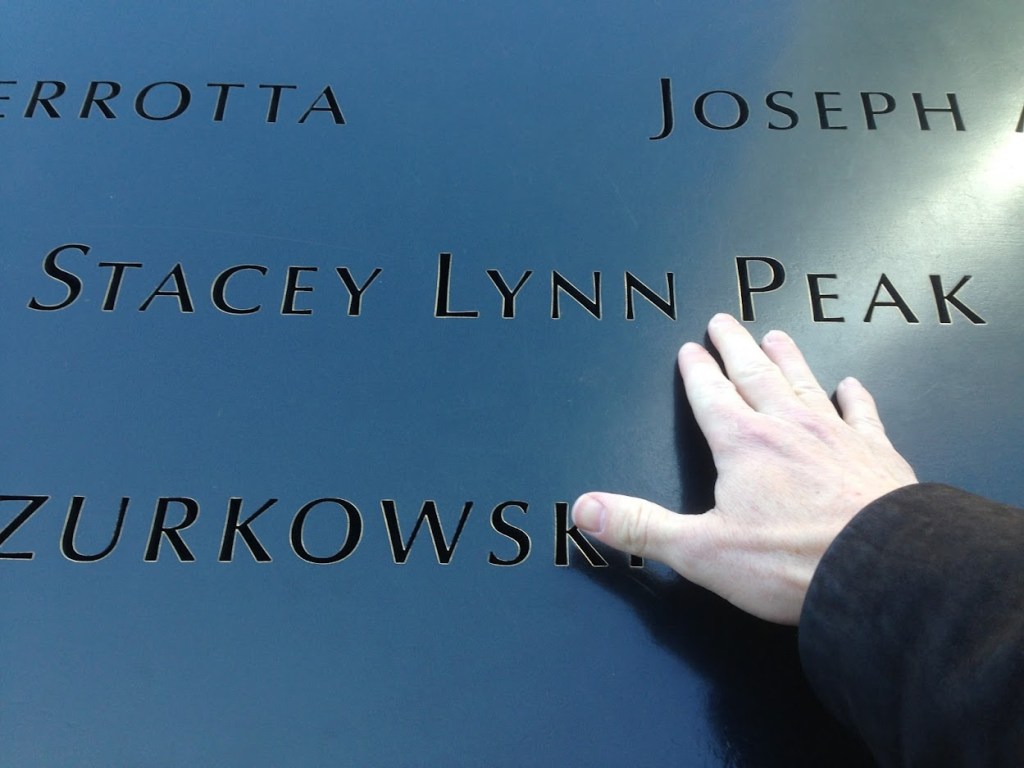
This is not the first story I’ve written about Stacey. Several years ago, I referenced her while recalling a visit to the 9/11 Memorial (and New York) for the first time. With the story, I included a photo of Stacey’s name inscribed on a bronze panel there (Panel N-50). Now and then, people who read that story will text me their own photo of Stacey’s name. It’s the most rewarding thing about writing that story. It tells me I succeeded, albeit in a very small way, in keeping her alive.
During a second trip there, my wife and I took a guided tour inside the 9/11 Museum. Much like inside the United States Holocaust Museum in DC, there’s a profound heaviness to the place, a sense that you are walking on sacred ground. Inside the In Memoriam section, there is a floor-to-ceiling exhibition of portraits of the nearly 3,000 who died that day. I paused to collect my breath upon first seeing Stacey’s face hanging up there among the dead. Her smile. One artifact on display pulled from The Pile is Marisa Di Nordo’s purse, a bit charred but mostly intact. Inside it was the Windows on the World receipt ($729, including a $60 tip for the waiter and another $60 for the captain) from her mother’s birthday party that Stacey attended.
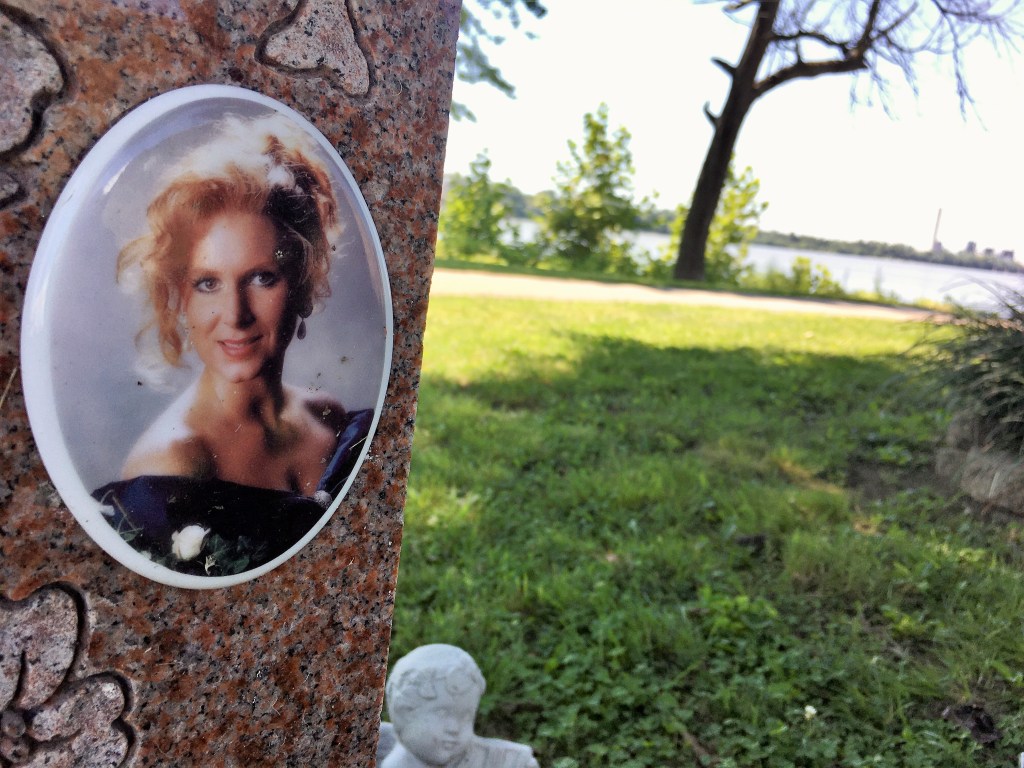
There are personalized memorials in other cities and towns to recognize their own natives and residents who perished on 9/11. In Tell City, one was erected at a tiny park behind a floodwall adjacent to the Ohio River. It includes a bird bath, a bench, and Stacey’s portrait.
“We always clean that up real nice a few days before,” Toni texted. “My family members all take a little bundle of flowers or something to put on the bench or on the ground in memory of Stacey and all the lives lost on 9/11 and after. Tell City has been very good and caring about remembering Stacey and all the 9/11 victims. Stacey’s friends or neighbors might pick up a single flower and stop by to remember what had happened. Everyone is so kind.”
At our 20th high school reunion at the Moose Lodge, a memorial table was set up for classmates taken too soon, including Stacey. I immediately left—it was too much to take in, the towers, my tears, the senseless slaughter of my classmate. I never attended another reunion.
I used to think 9/11 was not my story to tell. I was not there. I was not related to anyone who was there. I had not even been to New York before it happened.
In my first story about Stacey, I recounted being at the 9/11 Memorial and overhearing a 20-something woman telling three children, “…one theory is terrorists aboard planes…”
One. Theory.
One theory is terrorists . . .
Her comment made me realize that 9/11 is my story to tell. It’s everyone’s story to tell.
As a Pew Research Center Report points out, “Yet an ever-growing number of Americans have no personal memory of that day, either because they were too young or not yet born.”
Besides keeping the memories alive of those we lost that day, we also have to revisit what happened to keep the truth alive in an era of conspiracy.
The act of terrorism was not theoretical. The terrorists were terrorists.
“The lesson of 9 /11 for civilians and first responders can be stated simply: in the new age of terror, they—we—are the primary targets. The losses Americans suffered that day demonstrated both the gravity of the terrorist threat and the commensurate need to prepare ourselves to meet it,” stated The 9 /11 Commission Report.
Tragedy often begets regret. I regret having lost touch with Stacey. Holly regrets the lack of photos of them together. Toni regrets not keeping more of Stacey’s personal effects.
Gail Gibbs recalled a phone call she received from Bobbie Peak when Stacey was considering jumping geography to Cantor Fitzgerald.
“Her mother and her sister didn’t want her to move to New York,” Gail said.
The family fretted over what would happen to Stacey, alone, in the largest city in the U.S. They pled with Gail to convince Stacey to stay in Houston.
“Stay here,” Gail told Stacey, respecting her family’s wishes.
According to Gail, Stacey shrugged it off—New York didn’t scare her—and commented, “I’ve got a better chance of getting killed by a terrorist (than dying in New York).”
end
Scott can be reached at scottsaalman@gmail.com.
