
VUJ shows off new collaborative robotics lab
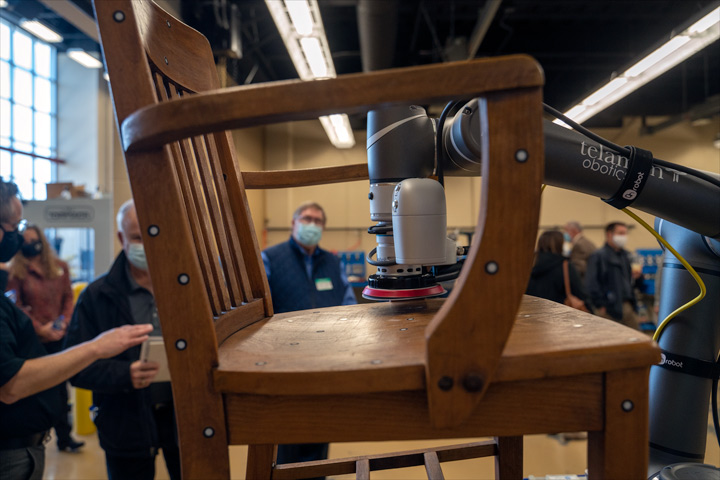
Local business leaders, industry representatives, and educators got a tour of the new specialized equipment students and potential employees are training with at VUJ’s Cobot Lab.
Through a grant from the Lilly Foundation and a partnership with Mt. Carmel-based Telamon, 11 robotic arms designed to collaborate (cobot) with humans were installed in October. The easily programmable cobots can be programmed with the push of a button to perform repetitive tasks while their human counterparts complete more intricate maneuvers.
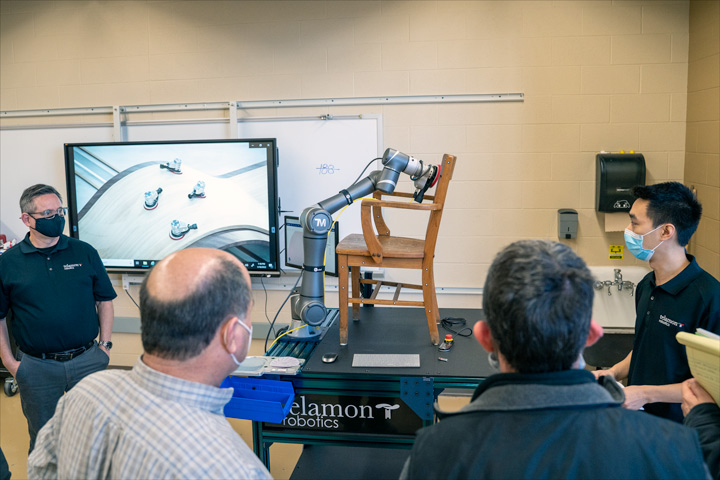
According to VUJ Dean Christian Blome, the new lab is an excellent addition to supporting the university’s goal of being a valuable member of workforce development and training in the region. He pointed out the local campus’s work over the past three years to facilitate collaboration between local industry and schools.
“This is doubling down on that mission and the vision we have for this campus to not only serve our students but to serve our local economy,” Blome said about the lab.
With the workforce development challenges this area is facing, the lab provides training that will support the technological adaptations occurring at local manufacturing facilities as they strive to maintain competitiveness in the global marketplace.
“This is one way to help make that great workforce even more productive and more capable,” said VU President Dr. Chuck Johnson.
He explained that the lab is a great example of how the university is partnering with industry to introduce new technology to students and employers. Employers can then begin to consider how to deploy the technology in their manufacturing processes.
The new collaborative robotics lab in the CTIM is part of an $8 million “Developing a Workforce Ecosystem for Industry 4.0 in Indiana” grant funded by a Lilly Endowment Inc. initiative.
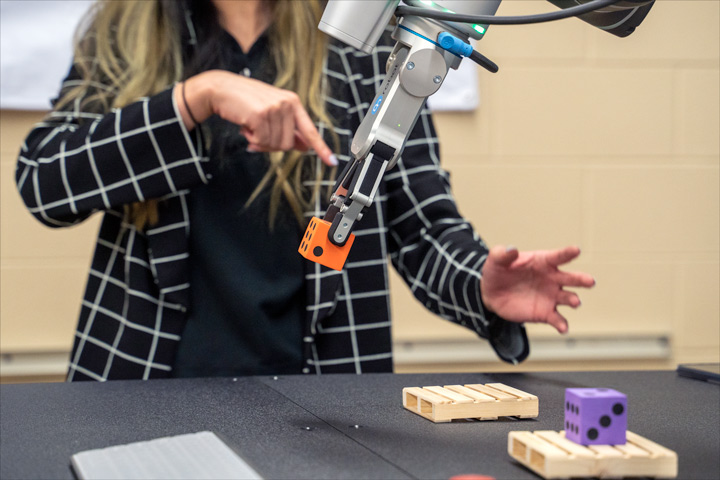
In application, the cobots appear simple to program and operate. Through the connection of a variety of manipulative tools to the end of a multi-jointed arm, an operator can program the cobot by manually running through the motion and actions with the arm and actuated tool. Once fine-tuned in the program — a program similar to those used in programming courses adopted in elementary school and with STEM toys, the arm will perform the repetitive action like stacking and moving objects as it was ‘taught’.
With the assistance of 3D scanning and cameras, the arm can perform more intricate tasks like sanding a chair or searching for a specific part and handing it to a human operator. The applications of having a third arm and hand seem endless in regards to repetitive processes.

According to the VUJ Center for Technology, Industry and Manufacturing director Jacob Berg, there are about 40 students currently enrolled in two courses based around the new lab and they plan on growing those numbers as the partnerships with the local school corporations through the Patoka Valley Cooperative continue to blossom.
“The students love it, they love robotics in general,” Berg said. “But probably more importantly, given the state of our economy and employment, Vincennes University is really at the forefront of that evolution in robotics and automation.”
According to Johnson, bringing the lab to Dubois County was an easy decision based on the tremendous amount of manufacturing in the area and the university’s supporting role.
“Our goal is to be a contributor; to be a problem solver. One of the things we want our employer partners and our K-12 partners in the community to know is we’re here to support you. We’re here to help everyone achieve their goals,” he said. “We want this community to continue thriving long into the future.”
