
Unbelievably beautiful quilts to be auctioned for Ferdinand’s 175th
 Ferdinand area quilters have always been known for their impeccable stitching, unique designs and creative spirit.
Don’t believe it?
Well check out the four special Ferdinand Terquasquicentennial quilts to be raffled during the town’s premiere celebration June 18-21. The quilts will be on display during Ferdinand Day at the Dubois County Museum this Sunday, February 22, from noon to 4 p.m. Joyce Beck and her committee will be selling raffle tickets for $1 apiece or $5 for six chances, which isn’t a lot of money considering the countless hours — and stitches — that went into each of these art gallery-worthy creations.
Quilter extraordinaire Becky Fuller is responsible for all facets of the Ferdinand, Indiana – established 1840 quilt. In fact, she spent around 2.5 hours per night over four months in the execution of her design.
To see it is to marvel at her ingenuity. She describes all the facets included in the quilt in her words, this way.
The View from the Top of the Hill:
The south entrance into Ferdinand provides a beautiful view of the town ahead with St. Ferdinand Church (founded 1848) and Monastery Immaculate Conception (founded 1867) being the most prominent buildings.
 Rev. Joseph Kundek, a missionary from Croatia, along with the generous donations from Ferdinand I, Emperor of Austria, hung a sign on a tree with the name “Ferdinand” and advertised in Ohio and Pennsylvania newspapers encouraging German Catholics to move to his new town in Southern Indiana. Many packed all of their belongings and moved, coming from Troy on the Ohio River, finding only the aforesaid sign and little else. The hardiest stayed and prospered.
 They were a talented and industrious group — farmers, blacksmiths, inventors, masons and brewers encountering many hardships, most real but some possibly imagined and told as tall tales (as told around many a pot-bellied stove on bad weather days). The tall tales (also known as bull—-) were even popular in the local newspaper (remember “B. Spreader”?) and are still told to this day around several Ferdinand shops and cafés.
 Some of the more well-known settlers were Florenz Kitten, Sr. and Frank Heidet, Sr. (known as the Frenchman). Florenz settled in Ferdinand around 1850 at age 10 and later obtained several patents for his inventions, one of which was the Kitten Steam Engine. He established the Kitten Machine Shop and began building engines of which about 20 still exist. In its heyday, the foundry was Ferdinand’s largest industry.
Frank Heidet Sr. began a blacksmithing and wagon-building business. The business still exists with its original name (Frank Heidet and Son) and is still family owned although the “village smithy” has become the “friendly hardware man”.
Many Ferdinand people were able to keep their heads above water during hard times, especially during the “Great Depression” of the 1930s. The Civilian Conservation Corps (CCC) was established and created the Ferdinand State Forest. Several farmers survived (like it or not) on a “cash crop” of moonshine, especially during the Prohibition period. Some local merchants became “wholesalers” by taking batches for payment of bills (and maybe reselling them). Al Capone was known to have come from Chicago to Ferdinand for his purchases.
The “ghost” of the Ferdy Flyer, pulled by Engine No. 3 is still seen and felt by some even though the tracks are now gone. The 50-ton locomotive built in 1913 pulled a coach manufactured in 1880 and was the shortest independently-owned railroad in the nation in its 85 years of operation. The Ferdy traveled daily to Huntingburg only and back again but carried a wide array of merchandise – from high school students to locally made furniture to communion wine.
The Wollenmann House built in 1903 and owned by Dr. Alois Wollenmann has been remodeled and until recently had been kept in the Wollenmann family. The Swiss chalet-like characteristics of the house (Dr. Wollenmann was Swiss) reflected the area’s dominant ethnic heritage, and the same characteristics were used to some extent in the building of many local homesteads.
Three other quilts will be raffled along with Becky’s gorgeous masterpiece, all beautifully crafted.
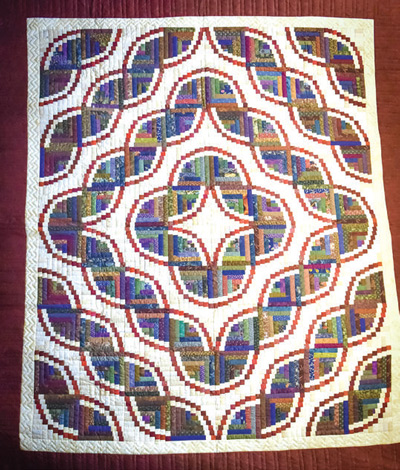
The Snake River Log Cabin Quilt was designed by Judy Martin. The log cabin was a favorite in the mid-19th century. This log cabin quilt was inspired by the Drunkard’s Path quilt. Its curved illusion is accomplished simply with the use of squares and rectangles. Its scalloped log border echoes the curves of the quilt, fashioned in shades of brown, rust and beige. Mary Alice Zink pieced the quilt, which was quilted by the St. Ferdinand Quilt of the Month ladies.
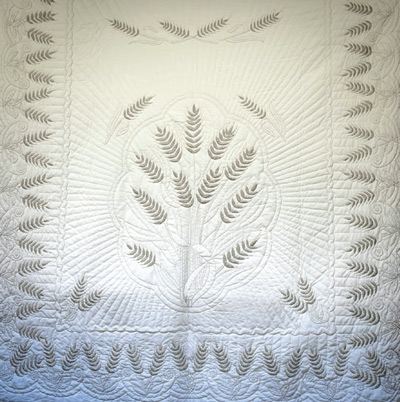
The Abundant Wheat Quilt was designed by Ruth Raber from Montgomery. It features a large bundle of wheat in the center with a wheat pattern in the border. Mary Englert stitched the outstanding embroidery, featuring both the satin stitch and backstitch. The taupe floss replicates wheat atop the ivory fabric. Ruth Schwinghammer quilted this beautiful quilt.
Joyce Beck, who spearheads the quilt raffle, is known far and wide for her lovely quilts. She created this Labyrinth Quilt by combining squares, rectangles and half-square triangles for a real show stopper!
Any of these quilts would be a welcome addition to any home. Be sure to see them up close and in person this Sunday, February 22, during Ferdinand Day at the Museum where raffle tickets will be available for purchase.
