
Twenty-seven shades of gray
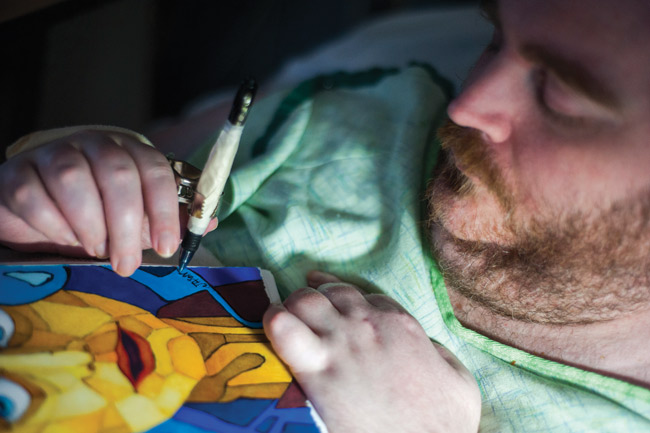
Jason Stockburger’s latest work is an abstract portrait. The woman’s face is multifaceted, her blue hair flowing. Her eyes are also a piercing, arresting blue and seem to follow the viewer.
He studies the piece carefully, then selects another blue prismacolor marker, adding subtle shading and depth to the woman’s blue tresses.
Finally satisfied with the piece, he settles back.
“I like how a lot of them have turned out,” Stockburger muses. “I’d like to find a market for them.”
This is a turnaround. Although his artwork won virtually every contest in which it was entered all through high school, Stockburger, now 38, balked at the idea of becoming a professional artist.
“I enjoyed art. I didn’t want to have to worry about making a living with it.”
After high school, Stockburger served in the U.S. Navy, then worked in factories and at convenience stores. “I bounced around, trying to find my niche,” he shrugs. “I was never really happy with one thing. But it’s not too late. Maybe I should have tried harder to make art a career.”
In late September, 2007, Jason Stockburger’s life was radically changed.
“It was a car accident,” he states flatly. “I fell asleep and my truck went off the road… flipped a few times.”
The next morning, Ted Weidenbenner, husband of Stockburger’s godmother, Judy, was on his way to their lake in Pike County to do some fishing. And, for the first and only time, he decided to take the back roads.
He spotted Stockburger’s truck in a ditch off the side of the road. Unable to move, Jason had lain inside throughout the night.
Jason’s mother, Debie Stockburger, believes Ted finding Jason’s truck was divine intervention — the first of many.
“I broke my C5 and C6 vertebrae,” Jason explains. “They said if I’d broken one more up, I’d have no movement at all. So, in that sense, I am lucky.”
Although he has some movement in his arms, Stockburger is classified as a quadriplegic. He has no feeling or movement in his fingers.
Fortunately, his high school art teacher, Tom Schum, taught his students to use their arms when drawing — not just their fingers.
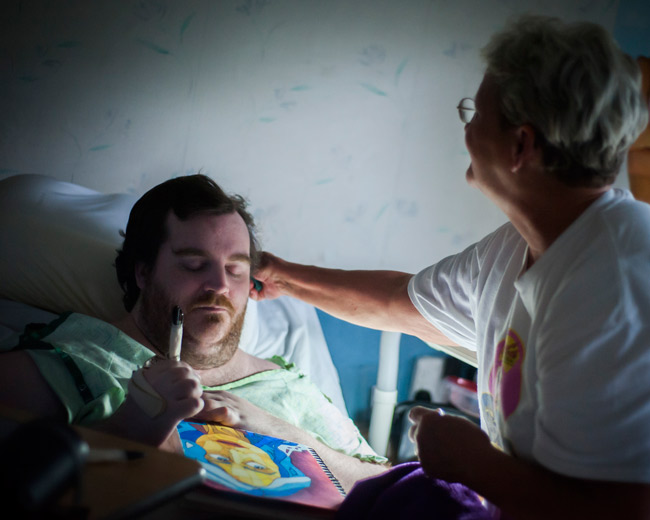
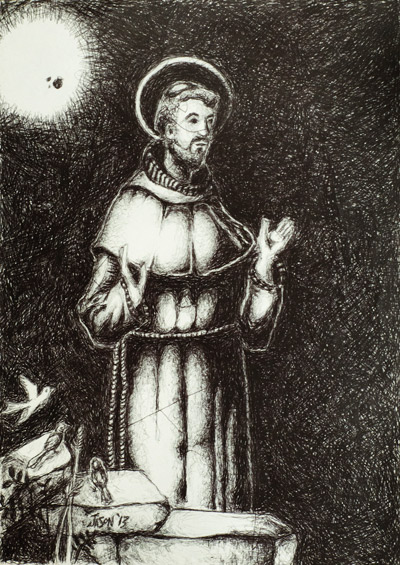
As part of occupational therapy, Stockburger was given a device that slid onto his hand. A clamp held a ball-point pen. After weeks and months of surgeries and recovery periods, Stockburger began drawing.
The drawings were good. But they lacked color. Debie suggested prismacolor markers, but the device would not accommodate their shape.
Jason’s father, David, made a trip to the hardware store. A modified device, using a battery clip, worked perfectly. Debie purchased a set of 156 professional prismacolor markers, with both brush and fine tips.
And 27 shades of gray.
It was about that time that Jason’s computer broke down. He had been watching movies, documentaries and playing internet games to pass the endless days.
Debie presented him with the prismacolors and a sheaf of drawing paper.
Then she dragged her feet when it came to getting his computer repaired.
“She said I couldn’t have my computer back until I spent some time with art,” Jason grins wryly.
It was quite an incentive.
When Jason works, he must have someone change the markers. His mother is usually on hand to offer help, but staff at The Timbers, where Jason currently resides, are happy to oblige, if needed.
“It’s a miracle,” Debie murmurs. “He lost nothing of his brain and God left him just enough movement to continue his art.”
“I used to have a lot more control. I’m critical that way… This used to be a lot easier,” Jason grimaces. “The biggest thing is not being able to use my fingers. I can’t even grasp something to pull myself around.”
Debie contacted Jason’s former art teacher, Tom Schum (hers as well), and he came for a visit. He returned with another retired art teacher, Fred Roberts.
Fred Roberts, it seems, had not been doing much artistically lately. Jason’s endeavors, against the odds, inspired him to go back to his easel.
“If I can inspire someone to try harder it… makes me feel better about myself,” Jason muses. “The ones who inspire me are the artists who use their mouth, or their feet. They have a lot more to overcome than I do.”
[quote]I was always good at art,” he concludes. “I don’t know if I was always an artist.”[/quote]
Schum and Roberts contacted friends — art studio owners — who have agreed to show Jason’s work.
They want at least ten pieces.
“It will probably take a few months,” Jason says. “I want to work on some bigger pieces, but I haven’t been that daring yet.
“But I’m getting there.”
Last Friday, June 21, Jason sat in a wheelchair for the first time in years. In time, he hopes to be able to use an easel and, perhaps, paint again.
“Getting into the wheelchair, maybe I’m one step closer.”
Jason is hoping some modifications will allow him to expand his choice of media.
But, art supplies can be expensive under the best circumstances. The American Legion is planning a fundraiser for Jason in the near future to help their fellow veteran.
“For the most part, I’ve accepted my situation,” Jason says. “I’m still trying to make the most of what I have.
“I can’t see anybody saying my work is rubbish, after seeing the state I’m in. Oh, they might think it, but they wouldn’t say it. Wouldn’t bother me if they did. I’ve never been too concerned with other people’s opinions. Everybody’s entitled to theirs.
“But, by the time I have something [a piece of artwork] I consider finished, it’s rewarding. It’s rewarding either way.
“I was always good at art,” he concludes. “I don’t know if I was always an artist.”

