
Timbers of Jasper hosts Gov. Braun ceremonial signing of Medicaid reform bill

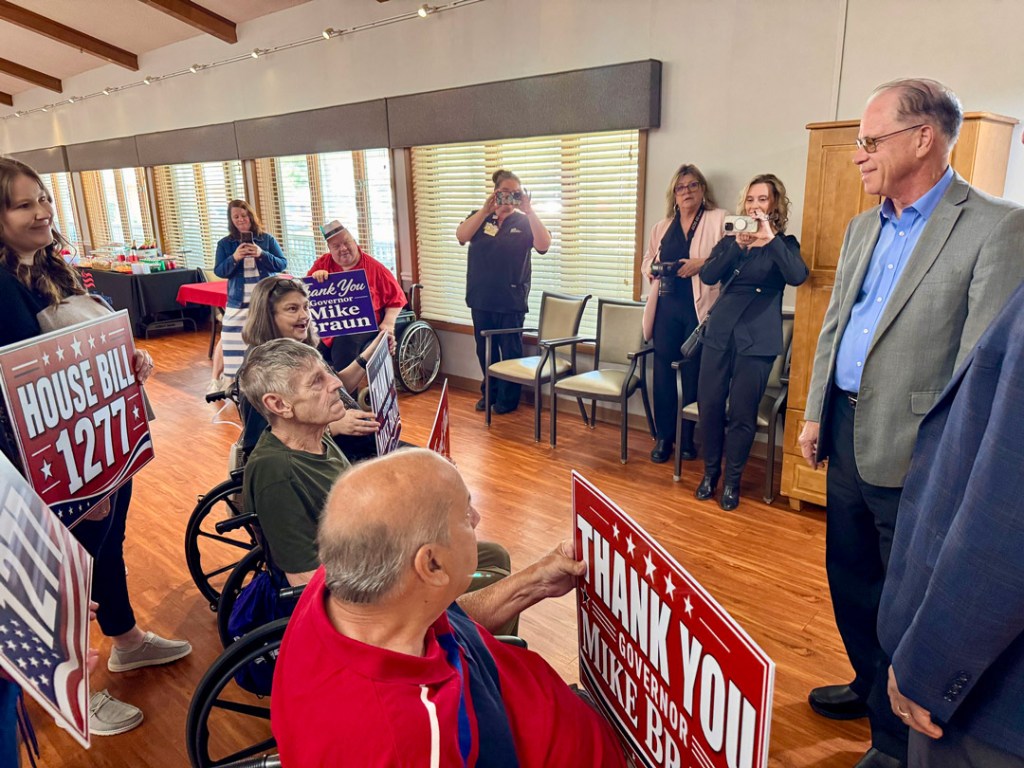
Gov. Michael Braun ceremonially signed House Enrolled Act 1277 at American Senior Communities’ Timbers of Jasper long-term care community on Friday.
“Hoosiers deserve a long-term care system that is compassionate, sustainable, and focused on the needs of seniors,” Gov. Braun said in a released statement. “This law helps ensure Medicaid resources are used responsibly while supporting continued access to care for elderly Hoosiers.”
The bill reforms the PathWays for Aging Medicaid program for elderly and vulnerable Hoosiers in need of skilled nursing, assisted living or other home and community-based services.
“When it comes to a bill, when you get it through the process, many things can derail it,” Gov. Braun said. “And when the industry that the bill is about likes it, that’s not always the case, and when you can say it’s going to improve quality and do it at a better value, those are three things that don’t necessarily happen on a bill. In this case, we got it.”
State Rep. Brad Barrett (R-Richmond), HEA 1277’s bill author, joined the governor as well as long-term care staff and residents directly impacted by the ongoing issues in the PathWays for Aging program.
“Great thanks to the governor,” Barrett said. “Without his willingness to advocate for this and to let us work with his agency on making adjustments to the rollout that happened just a few short years ago, we wouldn’t be here.”
The PathWays for Aging managed Medicaid program launched on July 1, 2024, allowing Humana, Elevance Health and UnitedHealthcare to oversee Medicaid coverage for approximately 117,000 Hoosiers. The program has been plagued with issues since day one.
Soon after its launch, Humana and Elevance were placed on corrective action plans with the state due to a multitude of billing, claims processing and contract violations. Last year alone, all three insurance companies owed more than $100 million in late and inappropriately denied Medicaid payments to just providers of skilled nursing care.
By July 1, 2025, one year into the insurance companies overseeing PathWays for Aging, the program was more than $300 million over budget. A recent report from international accounting firm Clifton Larson Allen (CLA) further evaluated public data from FSSA on the PathWays program and projections issued under the previous fee for service program for this population. CLA found that of the $300 million overage in program expenses from the managed care entities, Indiana was paying $91 million per year more for individuals in nursing homes than it would have had the state maintained its control under a fee-for-service structure.
Due to the insurers’ administrative and financial failures in overseeing the PathWays for Aging program, the new law attempts to address these shortcomings by moving long-stay nursing home residents out of the PathWays for Aging program and into a fee-for-service model not run by the insurers, effective July 1, 2027. Nursing home residents who are 59 years old and younger today are currently under a fee-for-service program, so with this statutory change, long-stay residents would also be under fee-for-service. Similar to what the Clifton Larson Allen report identified for Indiana, New York instituted a similar transition for its long-stay nursing home population and saved $246 million per year as a result.
The new law also implements an individual cost limit for Medicaid beneficiaries on the PathWays waiver. The PathWays Medicaid waiver allows individuals who qualify for nursing home-level care and are 60 years old or older to be served in their home or community. As FSSA has publicly shared, thousands of individuals cost the Medicaid program $150,000-$200,000 or more per year in care, while nursing home care is nearly half that and assisted living care is a fifth of that cost.
The new cap on costs is expected to result in tens of millions of dollars in annual savings for the Medicaid program, allowing FSSA to reinvest those savings to expand access for the nearly 12,000 individuals currently on the PathWays waitlist.
FSSA is also required to file a waiver application with the Centers for Medicare and Medicaid Services by September 1 to establish a standalone waiver for assisted living services. Illinois, Ohio, and other states have similar assisted living Medicaid waivers, which have served as important Medicaid cost savings programs given the clear affordability and high quality of assisted living services.
In sum, this new law, coupled with current efforts by FSSA to address waste, fraud, and abuse, which recently discovered $200 million in improper payments made to attendant care providers, is critical to making the PathWays for Aging program sustainable, ensuring elderly and vulnerable Hoosiers have access to needed long-term care services.
According to Paul Peaper, president of the Indiana Health Care Association/Indiana Center for Assisted Living, the waitlist was in response to exploding Medicaid costs, and assisted living is being unfairly targeted. He said a separate waiver creates a clear path to the most affordable HCBS service that generates the clearest savings to the state, and allows the state to specifically assess the population using those services and the resulting cost savings realized versus lumping assisted living in with more than a dozen other HCBS, as is currently the case for PathWays and the corresponding waitlist.
“Indiana’s long-term care providers and their residents appreciate Governor Braun, Representative Barrett and Representative Goss-Reaves for their leadership on this critical matter,” Peaper said. “We had a lot of fun welcoming them to the Timbers of Jasper for a ceremonial bill signing and introducing them to Hoosiers who will directly benefit from this new law. But the momentum doesn’t stop here. Even as we celebrate, we know there is more work to be done to continue fixing the problematic PathWays program.”
