
The Parklands plans revealed; features additional 25 acres of land

Turning the former Jasper Country Club into a destination park is expected to cost up to $4 million but that includes the acquisition of an additional 25 acres that will expand the park to over 75 acres.
On top of revealing the features of the new park, Dubois County Community Foundation Executive Director Brad Ward announced through grants, state funding and local charitable donations, the city will add 25 acres to the park from the Eversmann Family Trust (5 acres) and the Gramelspacher-Nordhoff Family Trust (20 acres).
Additionally, a preliminary cost of $5,630,700 to construct the features and purchase the land would be reduced to the $3.4 to $4 million being forwarded to the council for approval.
Ward announced the cost reduction came through several factors. The matching grant from the Bicentennial Nature Trust and a reduction in the cost of the new property had saved $401,850. As part of over a million dollars in charitable giving, the Seger family had provided $118,000 for the acquisition of the 25 acres and $100,000 to create an endowment to support the maintenance of the land. Also, a $35,000 grant from the Indiana Heritage Trust and $20,000 from the Dubois County Community Foundation would bring the cost down to $4,955,000.
[adrotate group=”4″]
Then, the Seger family dedicated an additional $781,150 to be used to develop the park. Ward also announced they were seeking about $400,000 in additional grant opportunities and $400,000 in donations from local sources. The last $400,000 also included naming rights for certain features of the park.
Without the additional grants and donors, the cost of the project to the city would be around $4 million rather than an estimated $3,373,850. However, Mayor Terry Seitz expounded on the potential domino effect of local donors after hearing how the Seger family had been so generous.
Roger Seger stated he and his siblings had decided the large investment in the park was a proper legacy to honor their parents, Jerry and Lila Seger. “We felt this would be a neat project to remember our parents by,” he said.
Seger complimented all the families that had provided donations in the form of a reduced cost on the additional property, the work the city had competed and the sacrifices the neighboring residents to the park had made to create the park as well as the work completed by the community foundation.
He explained that the investment was important for his family. “We think turning a 40 acre park into a 75 acre park is a worthwhile project for us,” he said. “The idea of a destination park in the middle of the city was unforeseen when we started. Now, it is pretty cool for the city to talk about a destination park in the near future.”
The design
Representatives from Hafer Associates and Rundell Ernstberger Associates presented their proposal to turn the meadowlands, trees and ponds into a nature-based destination park designed to be enjoyed by anyone of any age. The firms were represented by Pete Andriot, principal of Rundell Ernstberger, and Jeffrey Justice, President of Hafer Associates.
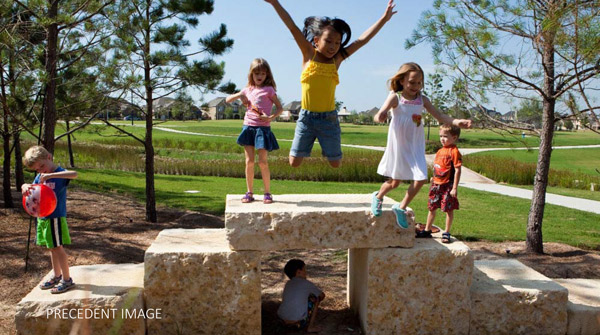
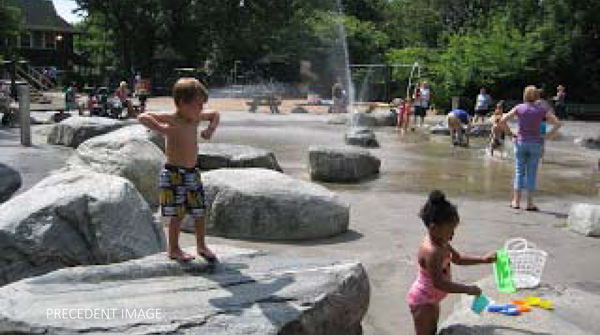
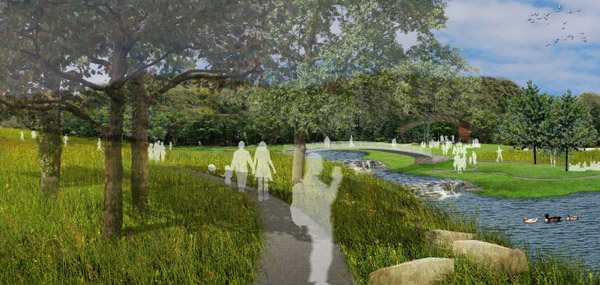
As the presentation shows, the design features a natural theme for many of its features. Shelter houses, bridges and rest areas will feature wood beams and very little glass or metal. The play equipment resembles stacks of boulders and timber pieces placed in a jungle gym array that entice children to figure out their own way to play rather than being directed by teetertotters and swings.
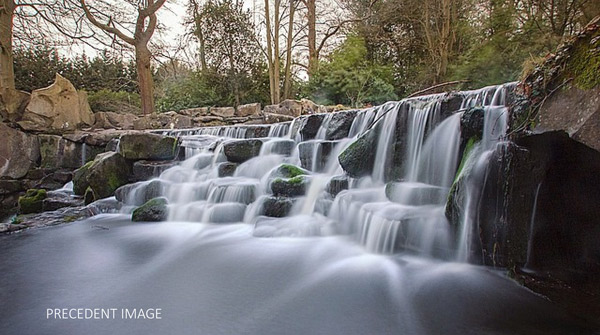
Additional features in the preliminary plan include the creation of two cascades on opposing ends of a central lake. In the design, the southern cascade falls about five feet and the northern cascade falls about 20 feet and will have a bridge spanning over it. The two opposing lakes will be resupplied by a pump to maintain the water level and cascading water.
In addition to the features, a 10-foot-wide, 2-mile concrete paved trail for walking, running and biking will encircle the entire park. Exercize and stretching stations will be placed at quarter-mile intervals. Smaller rock-paved trails will branch off of the main trail.
Pedestrian access points are planned around the park, but the main entrance to a 100-car parking lot will be located on 15th Street. Andriot explained the parking lot is designed to be fairly inconspicuous from 15th Street. He added that the retaining wall along 15th Street could feature a mural to point the way to the entrance of the new park.
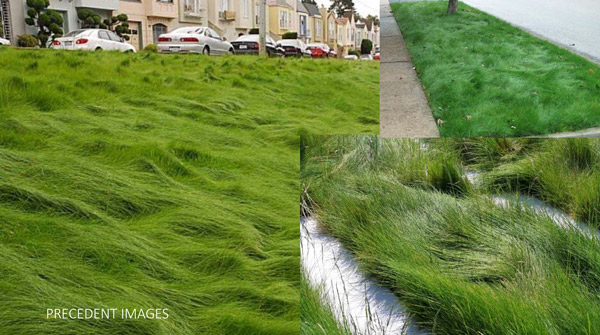
The natural features of the park will include meadowlands highlighting native Indiana species, old-growth forest areas that already exist on the newly acquired properties and new tree plantings. Special no-mow areas created with a blend of fescue grasses designed to grow about 5 to 10 inches tall and lay over will add to the natural aesthetics of the property.
Andriot explained a special wetlands area on the northern section of the property will create opportunities for science-based teaching field trips for local schools.
Future features not included in this initial cost include additional shelters and bathrooms, a science lab at wetlands, an amphitheater and a wedding garden that could be created with a partnership of KlubHaus 61.
Andriot stated the timeline on the project once it was approved would be about six to eight months for planning and engineering and then 12 months of construction once it started.
An attendee, Linda Burke, asked how large a line will be installed to maintain the lakes. Park Board President Roger Seger explained the country club had already ran city water to the lakes to be filled when they were features on the golf course.
Andriot didn’t expect filling them would be a problem but added he wasn’t sure what size pipe would be needed. He also added they had designed a similar feature for another city park in Indiana.
Another attendee asked about flooding issues due to new parking lots. City Engineer Chad Hurm explained the city had retention standards associated with parking lots and would have to abide by those standards.
Another resident asked about the impact on neighboring homes and access points near the school. Seger explained they are being very cognizant of the potential for individuals to access the park through private property that surrounds it. They are working on solutions to prevent or dissuade individuals from entering the park from anywhere other than the designated access points.
An attendee asked about revenue generation and was told the shelter house rental could generate income. Andriot estimated the new park would cost between $40,000 and $70,000 to operate annually.
The large park and its features were compared to several other destination parks in the surrounding area including Smothers Park in Owensboro. Several of those attending were familiar with the riverfront park and had travelled there with their families.
The city and park board want this park to become a destination park for the city and region.
 In regards to financing the park project, Mayor Seitz stated he felt that a strategic plan for the economic development income tax plans mapped a way for it to happen. “We have funds, not only because of not only thriftiness, but also because we have been watching every penny the last four years,” he said.
He added that the city has $4.9 million in economic development income tax funds available for 2016.
Director Ken Buck emphasized that the private donations through the years had created some of the city’s best features. The Train Depot, the Riverwalk, and the Habig Center being just three of those important features.
“We have dreamed of a large city park for years and years. Mike Oeding, who passed away last year, and I talked about this for years,” he explained. “Now, with this expanding to 75 acres, it is just unbelievable.”
He thanked all the families that had come together to move this project forward.
“The quality of life impacts this will generate will be unmatched,” Buck added.
The Jasper Park Board approved and forwarded the plans and cost to Jasper Common Council. Several council members were present with the 40 or so that attended the public meeting Tuesday.
The council allocated $300,000 for 2016 to pay for planning and continued maintenance of the park; $54,000 of that has been spent so far.
