
Roger Roger: Amateur radio hobby about fun and service
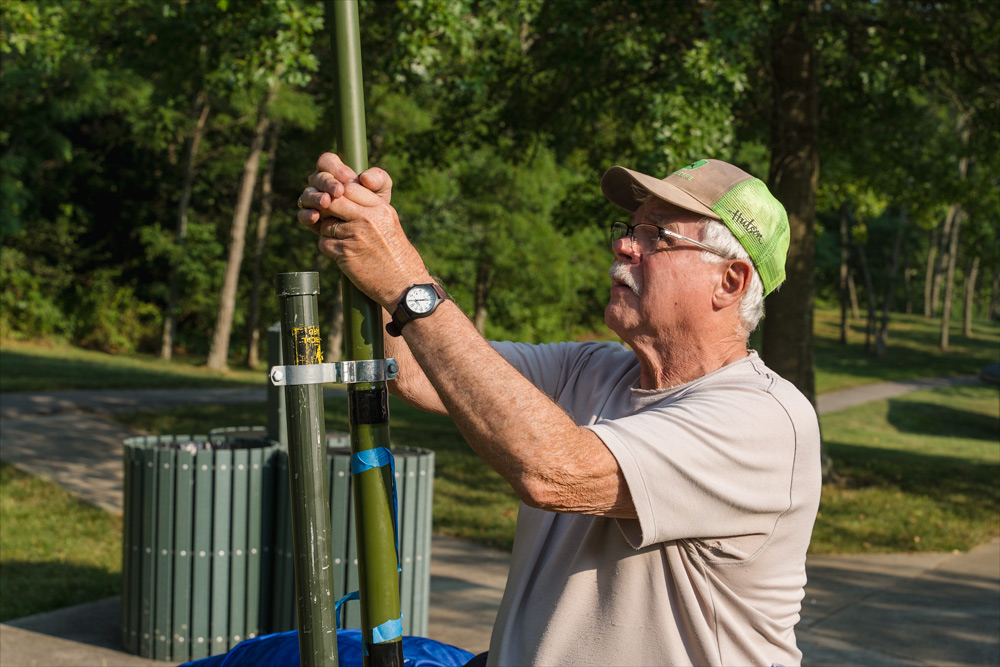
Saturday afternoon, the shelter house at 18th Street Park in Ferdinand became the local headquarters for an international communications site.
At least for 24 hours.
With wires running from the radio stations to several mobile radio antennae surrounding the shelter house, the group spent about a day testing their skills and equipment by making contact with other operators across the United States and Canada as part of the American Radio Relay League Field Day. This is the Patoka Valley Amateur Radio Club, a group of HAM operators that formed about eight years ago. However, most of the club’s members have been using their skills and equipment to assist emergency management and for the pure joy of reaching out to people all over the world for many years.
President Mike Vogler explained the hobby incorporates several areas of knowledge with skills that require the use of math, aeronomy, and even some astrophysics, as well as good communication skills and a bit of patience.
He’s been interested in it since he was a child and could see the radio antenna at the State Police Post. Being able to reach out and talk to anyone over the radio became a fascination. “I got my first radio when I was about 12 or so,” Mike said.
He still has that shortwave radio.
These days, Vogler just likes collecting catches (or contacts) around the world. There are contests that radio operators take part in which they have to record a number of contacts within a given geographic area. For example, a recent contest followed the route Lewis and Clark took across the United States. Operators had to make contacts in each state the group had crossed through in their historic journey.
Then there are the “rag-chewers” — the operators that are more about talking and less about collecting catches. Event organizer Stephen Goins got involved in HAM radio about two years ago, and so far, that is what he enjoys about the hobby.

While these are the fun aspects of the hobby, the basic function of this group of enthusiasts is to be available to provide emergency communications when everything else stops working. Amateur radio is recognized as one of the only viable communication means that would be available after a large-scale disaster.
“How do you know what’s going on in the world? Or what’s going on across the country?” said Reuben Montgomery, a member of Shoals. “We will be the first to know that.”
He pointed to natural disasters that can sometimes wreak havoc on the systems we take for granted. As demonstrated by the group’s ability to set up in the shelter house, much of their equipment is mobile and can operate on batteries and solar power.
“It’s about being able to go out on the fly and being able to set up and provide communications for an extended period of time,” he added.
“Some people say that HAM radio isn’t needed anymore, but we still have natural disasters that wipe out the cellphone networks,” Montgomery said. “Guess who gets called on to come in and bridge those gaps.”

You can learn more about the group at the following link.
