
Residents voice concerns with AES battery energy storage system
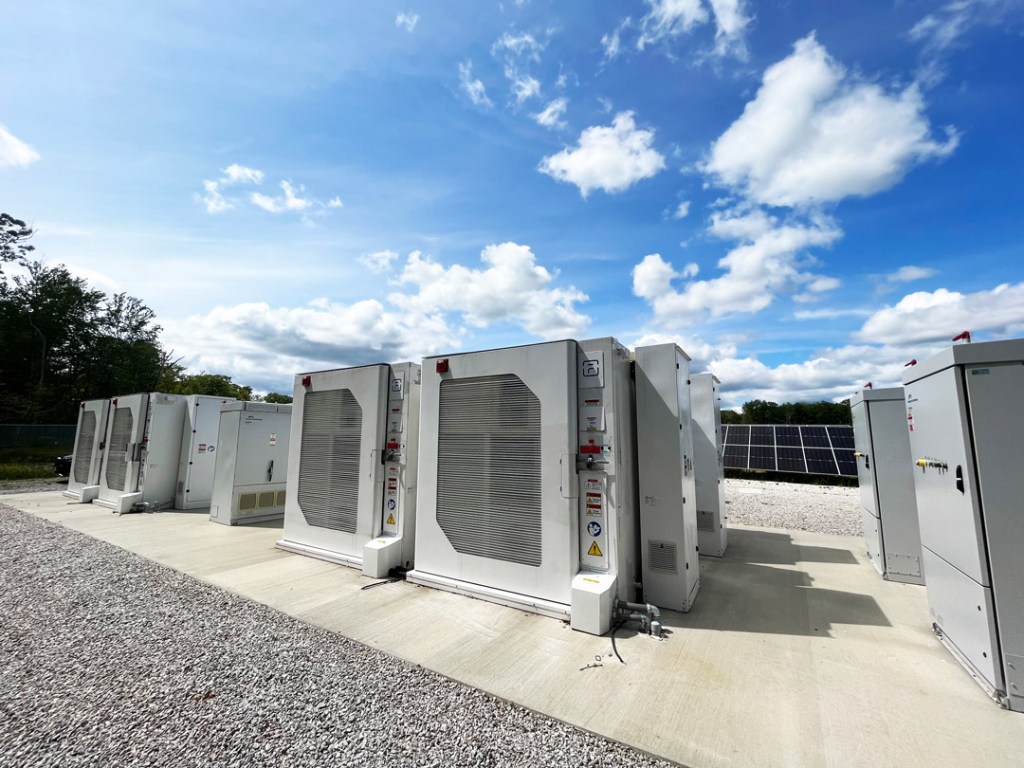
Answers were sparse as several Dubois County citizens presented safety concerns about the proposed AES battery energy storage system and solar project to county commissioners at Monday’s meeting.
The project would be located west of the airport near Old Holland Road, placing it within a two-mile radius of Southridge High School/Middle School, Holland Elementary and Huntingburg Elementary, according to Terri Bartelt, who spoke at the meeting.
“These battery systems are prone to thermal runaway, a condition where overheating causes chemical fires that are extremely difficult to extinguish,” Bartelt read from a statement at the meeting. “When batteries undergo thermal runaway or are otherwise damaged, they can release flammable and toxic gases.”
She cited recent incidents in Arizona, California and New York, including a July 2023 fire that “overwhelmed fire departments who lacked proper training and equipment to respond to lithium battery fires” and the world’s largest battery fire in Moss Landing, California in January 2025, which resulted in health concerns and soil contamination.
Randy Bartelt told the commissioners that his farm, which is adjacent to the battery storage site, would be ground zero in the event of a fire.
“If there would be a fire, the way I understand it we’d probably be wasteland,” he told commissioners.
Bartelt pointed out that the solar panels to support the project won’t be affected by any mishaps at the battery storage site.
“We’re going to be the buffer between the solar panels,” he said.
County commissioners acknowledged they have limited authority over utility-scale energy projects. According to state code research conducted by Commissioner Chad Blessinger, Dubois County is prohibited from imposing fees or requiring permits for battery storage systems, nor can it regulate their operation.
“I researched it, and the county doesn’t have any power to permit it or stop it,” said Blessinger.
He explained that the commissioners can exercise authority related to setbacks, road use and noise limitations.
“The agreements that are made between landowners are just that; they’re made between a private person and a private landowner,” Blessinger said. “As an elected official, I think one of our duties is to support people’s freedom to do what they want with their own property as often as possible.”
Mr. Bartelt informed the commissioners that the battery storage site should be considered differently due to the potential adverse impacts on adjacent properties and homes.
Not finding any relief from the commissioners, he asked where he should go.
Blessinger told him he thought AES would have to obtain regulatory approval from the state to install one, and “then the county would be able to say they have to have setbacks of a certain amount to protect people.”
Residents questioned whether emergency services are prepared to respond to chemical fires at battery storage facilities and whether evacuation plans exist for nearby schools and residences. These types of fires require specialized equipment and methods to extinguish or contain.
County Councilman Alex Hohl, a St. Henry resident, inquired whether the AES project would incentivize training for fire departments, noting that local fire departments may not be adequately equipped to handle these types of fires. He also pointed out that prevailing winds would carry smoke from any fire directly toward Huntingburg.
The property owners also expressed concerns about the project’s long-term environmental impacts and its economic viability. Mrs. Bartelt told commissioners that solar farms produce less energy per acre than existing agricultural uses and questioned whether the technology’s energy losses during charge and discharge processes make it economically competitive.
They also raised questions about decommissioning agreements and whether property tax rates would increase for land with solar panels or decrease for properties within the evacuation zone.
The residents reported that AES Indiana sent letters to some neighboring property owners on Aug. 18, 2025, but not all affected neighbors received communication about the project. The letter stated that AES Indiana plans to host a local open house later this year.
The AES project is separate from the Duff Solar project, which has been in contact with county officials. Michelle Carlton from EDP Renewables, who participated in the meeting by phone, clarified that she represents the Duff project, not the AES battery storage facility.
The commissioners indicated that they would review the information presented and continue to monitor the situation.
Mrs. Bartelt concluded her statement by asking commissioners to block construction of the battery storage and solar project, stating they “do not want the legacy of the county to become a solar wasteland.”
The commissioners invited residents to return to future meetings as more information becomes available about the project’s development and regulatory requirements.
The story incorrectly stated the battery system would be to the east of the Huntingburg Airport. It will be west. The story has been corrected.
