
Question: What the heck is a cooper?
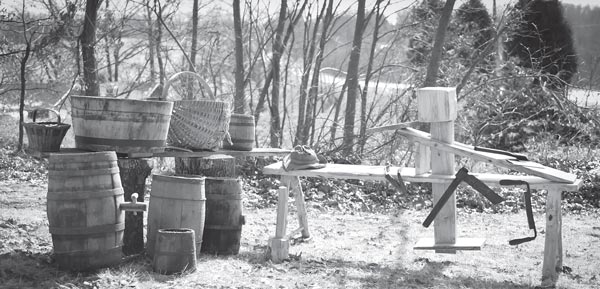
Answer: A cooper is someone who makes wooden, staved vessels, bound together with hoops with flat ends or heads.
Examples of a cooper’s work include casks, barrels, buckets, tubs, butter churns, hogsheads, firkins (small casks), tierces (a half puncheon), rundlets (a cask to hold 15 imperial gallons), puncheons (a container for wine and spirits), pipes, tuns (a large cask to hold four hogsheads), butts (traditional oak barrel), pins and breakers.
Coopers worked in a cooperage.
Today barrels and the like are mass produced but back in the day most communities boasted a cooper to produce items that were not a luxury but a necessity.
During Ferdinand Day at the Dubois County Museum, Randy Mathies will take on the role his great-grandfather once played in the Ferdinand community.
His great-grandfather, Charles Ehrman, was born at sea on January 2, 1854, while his parents, Joseph and Catherine (Arnold) Ehrman were en route to the United States from their native Bavaria, Germany. The Ehrmans landed in New Orleans and traveled the Mississippi River to Illinois, then the Ohio until they stopped for whatever reason in Spencer County.
In 1875, when Charles was in his 20s he opened a Cooper Shop in Ferdinand at the corner of West 13th and Kentucky streets. On June 14, 1880, he married Mary Klee in St. Ferdinand Catholic Church and to this union seven children were born.
He continued on into the new century until failing health prompted him to retire.
The Ehrmans celebrated their golden wedding anniversary in 1930 and Mary passed away May 13, 1933. Charles lived five years more, dying February 25, 1938 of a heart attack.
His great-grandson will share examples of Charles Ehrman’s work on Sunday, bringing a hand-crafted rocking chair along with a basket Charles made and examples of old tubs and barrels. The cooperage apple didn’t fall far from the tree as he is also sharing a schnitzelbank he crafted himself in the old style. Randy will also carve and demonstrate how some of his great-grandfather’s tools were used.
