
Property Rights Alliance proposes using due process to slow Mid-States Corridor progress
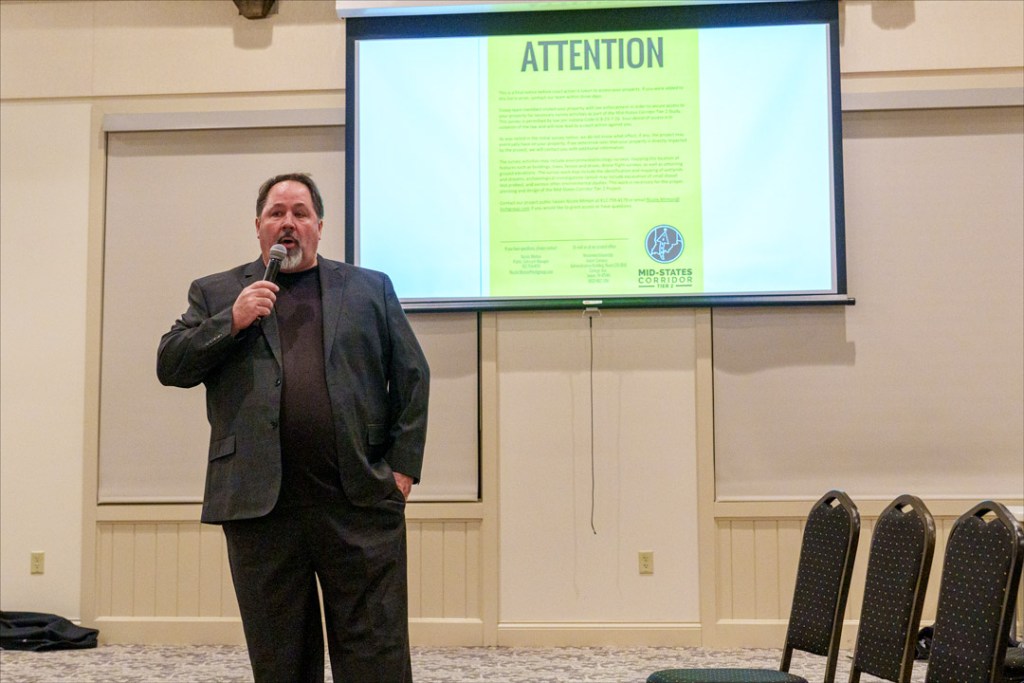
The 180 people who showed up to hear from a newly formed group called The Property Rights Alliance, a group dedicated to stopping the Mid-States Corridor, have a lot at stake.
The attendees at Thursday’s meeting represented the farmland, homes, environment, and heritage the proposed highway would destroy if completed. Searching for answers, they came to KlubHaus 61, a venue owned by the Hanselman family, whose homes are also in the highway’s path.
The Property Rights Alliance, an offshoot of the Stop the Mid-State Corridor Project grassroots movement, hopes this initial meeting broadens and strengthens the Alliance against the state and business interests involved in the highway.
The Alliance’s hope seems to rely on friction and funding.
The Mid-States Corridor is a proposed highway connecting Interstate 69 to Interstate 64 through Dubois County and Martin County. Proponents say it would improve transportation and boost economic development, but many landowners oppose it.
Momentum for the connector began when Governor Mitch Daniels turned the state’s focus from improving U.S. 231 to creating I-69.
In response, local industry leaders and business owners, like OFS CEO Hank Menke, then Meyer Distributing CEO/now Governor-Elect Mike Braun and others, began building support for creating this new route through the county. They cited the economic benefit of the new highway as a major factor for moving forward, as well as issues with safety and traffic congestion that it could relieve.
And, they had enough friction to get initial studies supporting the highway completed. They came to the Dubois County governments with the Mid-States Corridor White Paper 2017 (PDF), Conexus Report on SW Indiana Infrastructure 2015 (PDF), Governor’s Blue Ribbon Panel Report on Transportation Infrastructure 2014 (PDF) and I-67 Corridor Feasibility Study 2012 (PDF) as well as a new law, SEA 128, authored by then State Representative Mike Braun and State Senator Mark Messmer that allowed public and private partnerships to form over large transportation projects.
They got Dubois County taxing units to give $3.5 million in public money to support the $7 million Tier 1 study to determine if the corridor was needed and, if so, where it could go through Dubois County. At the time, comments among elected officials on these councils largely revolved around not knowing what they didn’t know and the Tier 1 study helping them forecast future needs, economic growth and planning.
However, the Tier 1 study was also necessary to meet the requirements for the Federal Highway Administration to greenlight the project to move beyond the concept to an identified route, and the Indiana Department of Transportation is now funding a Tier 2 study.

With the Tier 2 study well underway in Dubois County, the Property Rights Alliance, with help from Attorney Russell Sipes, is proposing a way to slow the millions of dollars of machinations in motion.
Property Rights Alliance Chair Jason McCoy, a Martin County resident, reached out to Sipes due to his history of representing the public in actions against overreaching corporate and government agencies infringing on personal rights.
After the meeting, Sipes explained that he was a trial lawyer and a fighter who had been involved in numerous cases involving land rights, civil rights, workplace injury and business litigation.
His first case was in 1981 when he represented landowners fighting a power company’s land grab in Spencer County to support an electric transmission line.
“I don’t like people being run over,” he said. “This (Midstate Corridor) is a railroad job, it really is.”
Sipes sees the road as a massive money-maker for bond attorneys, banks, and construction companies, but it will not benefit residents if it moves forward.
McCoy led Thursday’s meeting and called upon Sipes to help with the legalese of what alliance members see as one of their few options for stopping the highway.
McCoy urged attendees to send cease-and-desist letters to the project developers, saying it would force them to obtain court orders before entering private property for surveys.
Through Sipes, the group has created a cease and desist letter that could be taken home and filled out to be sent to the Lochmueller Group. The letter includes Sipes’ number for future contact. The Alliance also came to the meeting with a list of every parcel potentially impacted by the highway so landowners could fill out the letters on the spot.
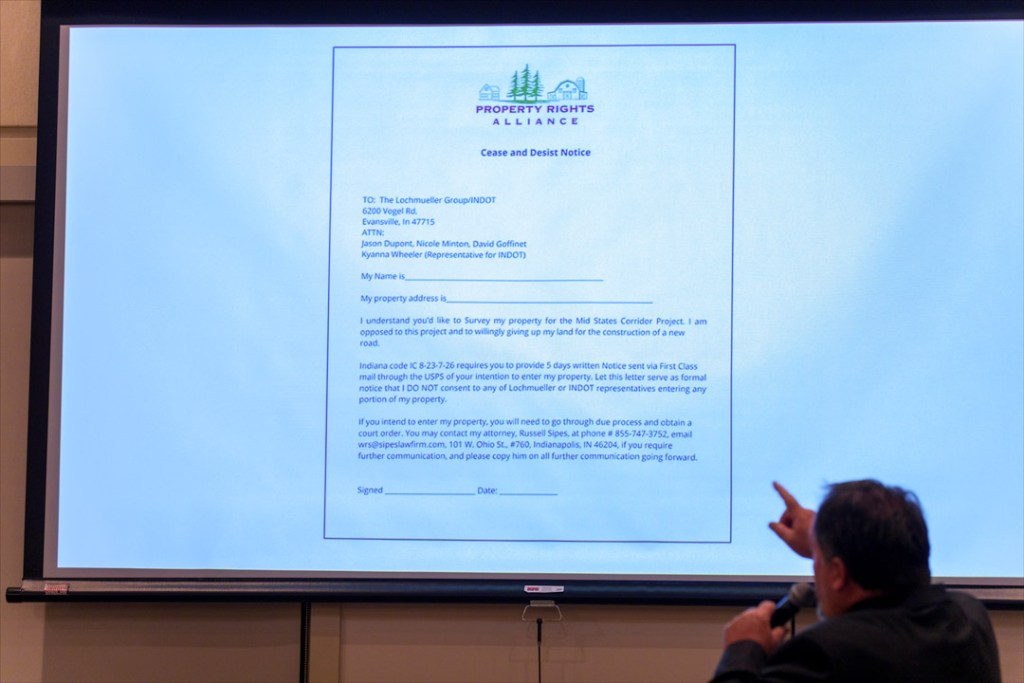
“This letter alone right now is the most powerful, effective, instantaneous tool available to all of us,” McCoy said. “If you don’t want the road, send that letter.”
Sipes explained that while the letters may not ultimately prevent surveys, they could significantly slow down the process. He said that each person has a right to due process and that due process takes time.
It creates friction.
So that those attending understood the process, Sipes spent time explaining what they should expect.
According to Sipes, once Lochmueller Group receives a cease-and-desist letter, it must get a court order to enter a property. This means the property owner and representatives from Lochmueller will appear before a judge to determine if the surveyors can come on the property.
He explained that the judge would likely issue an order allowing them to enter your property.
“If they show up and you want to say no, then you can be held in contempt of court because you are violating the court’s order,” he told the crowd, adding that he wasn’t advising they do that. “You shouldn’t disobey court orders.”
But if a property owner decides to go that route, Sipes explained, this means they will have to go back to the judge to determine why they shouldn’t be held in contempt.
“Judges have a lot of discretion. There could be fines. There could be all kinds of things,” Sipes said. “You should obey the court order, but some people won’t.”
This comment brought a hurrah from one property owner in attendance, while others questioned how that might go for the property owners.
“You decide how far you want to take it,” Sipes continued. “I’m not going to advise anyone to violate a court order, but if someone does, I’ll represent them in that action.”
The Property Rights Alliance is raising money to pay for Sipes’s representation as they bring friction to bear against the Tier 2 study in the court process. Court actions take time, tie up resources and cost money.
“What happens when Judge Verkamp has a hundred hearings to schedule just for people to come in and be ordered to let surveyors on their property, along with his regular schedule,” Sipes said.
Adding these new cases could be difficult given the number of other items and criminal cases brought before the court.
“Slowing down that process and making them do what they’re required to do takes time,” Sipes said. “They don’t really want to spend that time.”
Sipes said that time also benefits the Alliance as they find other ways to fight the corridor, including stalling them long enough to attack the project through future elections to achieve a political reversal on the support for the road.
“Let me ask you guys, by show of hands, how many of you are willing to [send] a cease and desist letter, if you don’t mind me putting you on the spot,” McCoy asked.
The majority of those in attendance raised their hands.

McCoy also asked those in attendance to support the Alliance in its efforts with donations.
“We need your money,” he said.
He explained that the group was registered as a legal entity operating with a board of directors to ensure donations are only used to fight the road and support property owners’ rights.
The group is registered in the State of Indiana as Property Rights Alliance, Inc., a nonprofit. The board of directors includes Jason McCoy, chairperson; Teresa Kendall, vice chair; Sheila Wendholt, secretary; and Cathy Wagner, treasurer. Board members are Dave Ring, Alan Hanselman, Mark Nowotarski, Carol Nowotarski, Sue Krampe, Tom Bartelt, Marissa Durcholz, Dave Pund, and Bob Pfister.
He told the crowd that more information was available on the Stop the Midstates Corridor Project Facebook page, where comments and questions could be made. Donations can also be sent to PO Box 64, Jasper, Ind. 47546.
After the meeting, he added that anyone could contact him directly for more information by phone at 317-250-8766 or by email at pra47536@gmail.com.
As the meeting concluded, organizers emphasized the importance of unity and persistence in their opposition efforts.
“Remember that we do have more power than they do,” said Teresa Kendall. “And you may not realize that now, but as time goes on, you’re going to find out that we are going to hang them up when we stick together.”
The meeting seemed to have an impact. McCoy reported collecting more than $10,000 in donations to support the alliance and Sipes representation.
More meetings and continued opposition efforts are planned for the coming months.

