
Property Rights Alliance planning for day in court
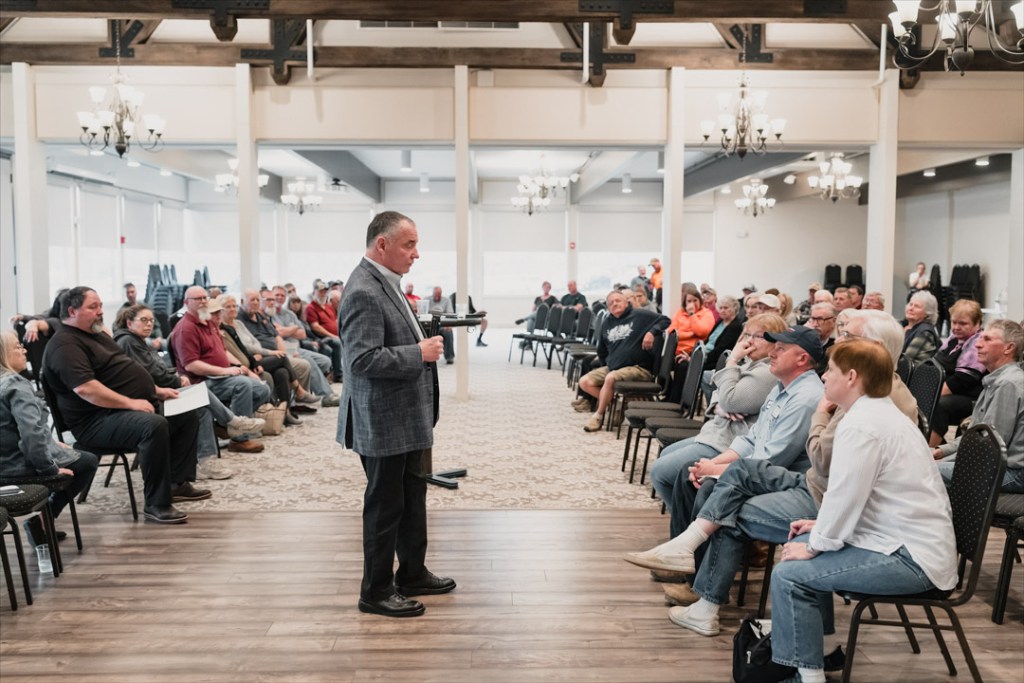
Attorney Russel Sipes answered questions from an audience of about 100 people opposed to the Mid-States Corridor who had gathered at Klubhaus 61 in Jasper on Thursday evening.
The Indianapolis attorney has been retained by the Property Rights Alliance to represent donors in its efforts to stop the Mid-States Corridor project from coming to fruition. The Property Rights Alliance is a grassroots not-for-profit led by Martin County resident Jason McCoy as its chair, and Dubois County residents serve on its board of directors.
Last December, Sipes presented a “Cease and Desist” form letter for property owners to use to slow the Lochmueller Group’s survey and sampling efforts as part of its contract with the Indiana Department of Transportation Tier II study of the corridor’s proposed route.
Residents who submitted those letters and have refused access to their properties for survey crews were sued by the Indiana State Attorney General’s office for access. You can read about the lawsuit here.
At Thursday’s meeting, Sipes noted that not all the 121 property owners listed in the lawsuit have been served, adding that some are deceased. As part of supporting the Property Rights Alliance through donations, Sipes is representing residents named in the lawsuit.
“I currently, as of three days ago, when I filed an appearance, represent 88 of the 121 people who were sued by the State of Indiana to force them to allow the surveyors to come on their property for this state’s corridor project,” Sipes told attendees at a recent meeting.
The lawsuit is an escalation in the ongoing battle over the proposed highway project, with property owners pushing back against what they describe as improper notification and concerning behavior by surveyors.
Sipes explained that while Indiana law does give surveyors legal rights to access property, they must follow proper procedures, including providing written notice and clear information about their activities.
“The folks who were trying to do this weren’t following the law,” he said Thursday. “They were showing up, they were scaring people, they were lying to people. No one knew what was going on for sure.”
The attorney outlines the next steps in the legal process, noting that hearings before Dubois County Circuit Court Judge Nathan Verkamp could occur within the next month.
“While it’s true that in the end, the surveyors have a legal right in Indiana to be on the property, they need to do it properly, and that’s what we’re doing here,” Sipes emphasized.
He describes the opposition strategy as a combination of legal and political efforts to slow down the project by ensuring all proper procedures are followed at each stage. He pointed to future elections in which the Mid-States Corridor could be attacked.
For now, the goal is to slow the process by using the legal means available to the property owners.
“There are responsibilities that they have to do this project properly. There are means to challenge what they’re doing and whether they’re doing it properly,” Sipes said.
He stated that there would be future junctures like the environmental impact statement in which the group could challenge the project.
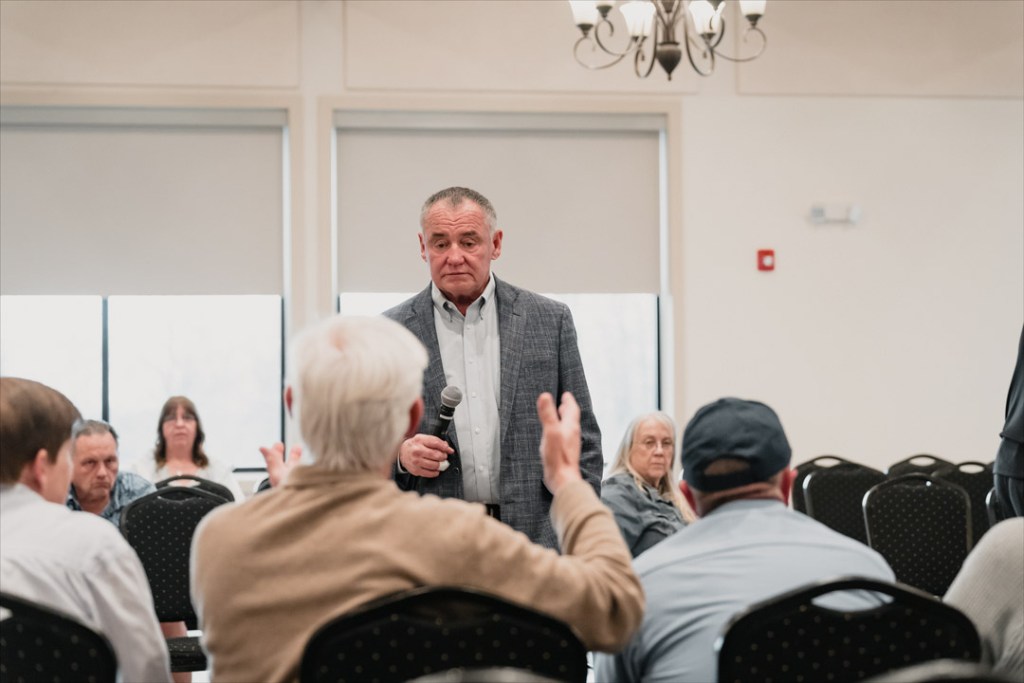
When asked about the odds of stopping the project by an audience member, Sipes acknowledged the challenge but suggested persistence could pay off: “What do you think our odds are, you know, if we’re still fighting this fight five years from now? Much better than it is today,” he said.
He adds that opposition efforts can be effective when sustained over time as the project potentially becomes too burdensome to continue.
Several property owners raise concerns about receiving multiple summonses or none at all. Sipes assured them his office is working to sort through these issues and will represent all property owners who have joined the opposition group.
When asked about challenging the project on grounds that it doesn’t serve the public good, Sipes explained the limitations of that approach: “At some point we’re going to make that argument, but when it gets down to it, the State decides what’s for the public good,” he said. “That’s where it becomes a political question.”
Sipes encourages community members to attend the upcoming court hearings, suggesting that a packed courthouse would demonstrate the seriousness of local opposition to the project.
“I’d be happy if the courthouse was packed with a couple [sic] 300 people because people need to know this is serious. The judge needs to know it’s serious,” he told the crowd.
McCoy has maintained there is a tipping point of opposition that will stop the corridor from becoming a reality. He said he had asked local officials how many property owners would have to “dig their hooves [sic] in to stop this thing.”
“They can’t really take on 50 percent of the property owners when it comes to eminent domain,” he told the crowd. “They can, but they don’t want to.”
Sipes also criticized the Regional Development Authority (RDA) involved in promoting the corridor project, raising questions about potential conflicts of interest. He said he was considering plans to research whether legal challenges to the RDA’s authority might be possible.
Throughout the meeting, Sipes emphasized that the primary goal is to ensure the state follows all required procedures, which takes “time, energy and money and makes it just that little bit more likely that in the end it might” stop the project.
