
Problem solver, designer, entrepreneur, and teenager
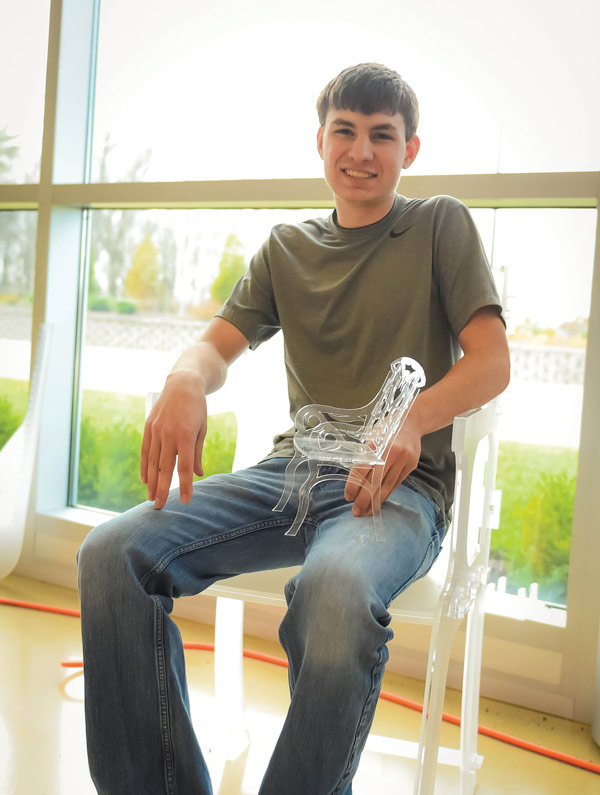
The owner of Crystal Water Designs is hard at work on his latest project, inside the Center for Innovation and Technology at Vincennes University, Jasper.
The Center is an impressive place, its multi-storied atrium commanding attention and admiration. It could appear daunting to the uninitiated, but Austin Rothgerber is as at home there as he is in his family’s living room.
Austin is rather slight of stature, with intelligent eyes, dark hair and a winsome smile. He also boasts a winning personality and a confidence that puts his customers at ease.
Still, to look at him one would probably never guess he is a budding entrepreneur building a thriving business empire — but has not yet graduated from high school.
On a recent afternoon he was hard at work on several projects. Off to the side is a contemporary-style chair he crafted entirely of Plexiglas.
A chair? Made from Plexiglas? Why?
According to Rothgerber, “Ray [Niehaus] said ‘build a chair.’ So I built a chair.”
Was his first go round a success?
“No, the chair was my biggest failure. It took me 23 tries to get it right.”
Austin already recognizes something business people don’t always appreciate — and the old adage applies: If at first you don’t succeed, try, try again.
Niehaus, in his role as Director of the Center for Innovation and Technology, has become Rothgerber’s mentor. “Austin always had the talent,” he explains. “He just needed the opportunities. He is unique because he has a very great mechanical aptitude, but also because he knows how to get things done.”
That, coupled with his willingness to try again when a project fails and a winning personality, has made this 18-year-old an entrepreneur who is way ahead of the game.
Austin is already becoming a force in the local furniture manufacturing industry. The Jasper Group was seeking a more efficient way to measure quality control. Someone on the plastics floor had an idea but the execution posed a problem. How could one device measure a seat back and height, the correct curve —all the components in one fell swoop?
“Austin is a problem solver,” says Niehaus.
He applied logic and, through trial and error, came up with an adjustable curved tool that could quickly measure everything so only one quality check would be required. He figured out what sort of material would best serve and made a prototype. The end result was just what was needed. “This is probably going to be a viable product [for the furniture manufacturing industry],” Niehaus adds.
Austin exudes a confidence not usually prevalent in a teenager. He knows, through trial and error, he can make something work.
[quote]“No, the chair was my biggest failure. It took me 23 tries to get it right.”[/quote]
He spends quite a bit of time perfecting the design of whatever he is creating, choosing the right fonts if given a free hand and often improving the product as a plan unfolds. He recently worked with Huntingburg Mayor Denny Spinner, who wanted to have an item to present to attendees at a mayoral round table. Together they agreed upon acrylic coasters made of two clear circles, with an image of the Old Town Hall in red and the date etched inside.
His first effort would work, but he wasn’t satisfied as the glue holding the two parts together added some opacity. Austin knew he could do better. Instead of using an adhesive to connect the two sides, he designed a star to hold the discs together — similar to those used in the construction of 19th century brick houses — except these are small and acrylic. The end result could probably command a decent price in shops on Huntingburg’s 4th Street if he wanted to go into mass manufacturing, but that is not his goal.

Why work at VUJC?
The answer is simple: Vincennes University Jasper was the first higher education facility in Indiana to purchase a Speedy 500 laser capable of photographic quality imprinting. Indiana University owns the only other one.
Austin works in many mediums besides acrylic, including leather, wood and about 12-15 other materials. He often uses scraps from Dubois County manufacturers that would otherwise have gone to waste. And now those manufacturers are calling him seeking other innovations. Sometimes they work together via phone and computer, never actually meeting face-to-face.
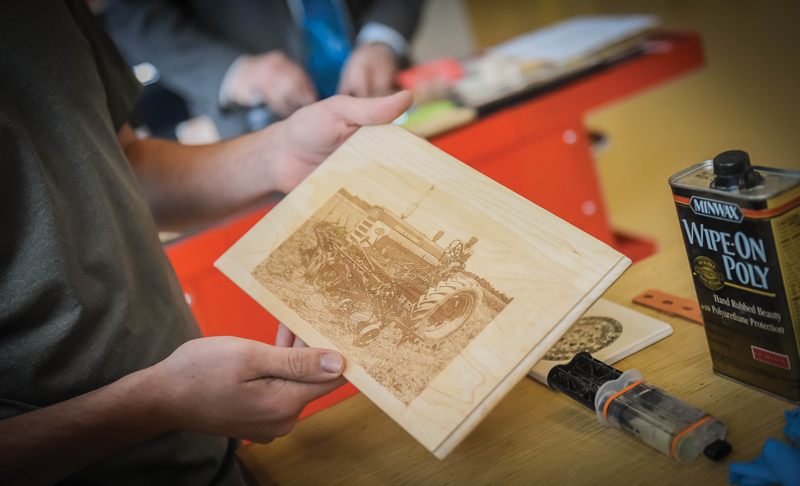
Very detailed wood plaques that appear to have been etched with a wood-burner lay on his work table. These will be given to employees of Englert’s Home Comfort Center when completed. Austin has added a flourish to some by cutting the distinct Englert’s logo from red acrylic and fitting it into the groove in the wood. The plaques are attractive — something anyone would be proud to hang in a home or office.
As with other projects, trial and error led to the final design, and Austin learns from each new venture. His exceptional grasp of mathematics is a boon, as is his ability to ponder what could be.
 On this day he is etching a man on a tractor into a piece of wood. The image came from a photograph and Austin has to adjust the brightness and contrast of the image to make it work. He made several attempts before he was finally satisfied. The result is breathtaking!
To create most of what he does, Austin designs on a computer in 2-D but must be able to visualize it in 3-D, which doesn’t seem to pose a problem for him. For fun, he drafted St. Paul’s Cathedral and a battleship and cut both — out of paper.
Crystal Water Designs is a registered Indiana business. Austin says it took him longer to come up with a name than it did to design the chair.
So how did he get started?
“I took a Gateway Class [introduction to engineering] in eighth grade,” he explains. He also participated in Project Lead the Way. But Niehaus’ arrival in 2012 made a huge impact, especially when he recognized Austin’s potential and took him under his wing.
What does the future hold?
“I plan to go to college,” he says, naming some of the schools he is considering. “I like engineering. Our family has a small farm and when I was growing up I wanted to have a large farm so initially I wanted to go into agriculture. I love [the idea] of designing equipment, problem solving, turning manual labor into technology so I may opt for agricultural engineering.”
He is already fascinated with the advances in agriculture derived from precision farming technologies and GPS field mapping data that monitors each seed.
But he also recognizes the multitude of opportunities already opening up for him in the manufacturing sector.
Only time will tell, but meanwhile, Austin Rothgerber will continue growing his existing business while finishing his final year of high school. Whatever path he chooses, it is a pretty safe bet that Austin Rothgerber — business owner, designer, high school senior, part-time farmer and entrepreneur (at age 18) will have a bright future.
