
Power hour of code introduces students to big career path

Arin Deich, 11, a fifth-grader at Cedar Crest, raised her hands triumphantly in front of her Chromebook’s screen.
She had successfully built a program that told an Angry Bird how to hop through a maze to catch a piggie.
Arin was likely joining hundreds of thousands of kids in schools across the country who were successfully piloting their birds to pigs, telling Anna and Elsa of Frozen fame how to ice skate in intricate geometric shapes or instructing Steve from Minecraft on how to build a house. All through a special program through Code.org called Hour of Code.
Designed to introduce coding logic to students at all grade levels, the program provides a visually stimulating game-inspired teaching technique that immediately engrosses students. In Terri Bell’s fifth grade class at Cedar Crest, other than whispered exclamations of success and a few huddled questions, the room was nearly completely silent for the 42 minutes the students worked through the various challenges.

This is the third year for the Hour of Code and the second year Southeast has taken part in it. Cheryl Verkamp, the technology integration and media specialist for the Southeast Dubois School Corporation, said she learned about the program from her son who is a computer programmer.
“This is a good fit since we are one-to-one Chromebooks grades three through 12,” she said. “The kids love it. As they are doing it, you can hear a pin drop in the classroom.”
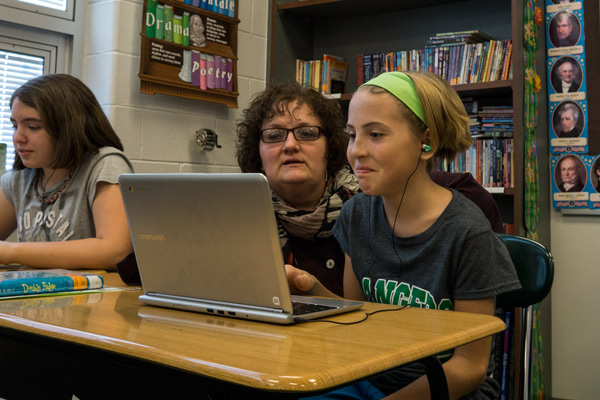
Back in the classroom, after Verkamp informs the students what they will be doing during class, the students that were involved last year cheer.
A quick video starring known tech personas Bill Gates, Mark Zuckerberg and more is shown and then the student launch into the coding. They advance through challenges by creating a series of commands using Blockly, a code application that allows them to build with Lego-like pieces that snap together programming commands.
They hit run when they think their code is complete and their character completes the actions according to the instructions. And, just because their character reaches its goal, that doesn’t mean the student can move on to the next level. The program teaches logic and efficiency — an important aspect in writing code for programs — in a fun and interactive way. If it took too many steps of code to get to the goal, the program points it out, tells them how many steps it should take to get the solution and sends them back to the same level.
According to Verkamp, computer science drives innovation throughout the U.S. economy, but it remains marginalized throughout K-12 education. “Only 27 states allow students to count computer science courses toward high school graduation,” she added.

Besides introducing computer science to kids at a young age, the program is especially impactful at introducing programming to girls. Only about 18 percent of computer science graduates are girls. With over 600,000 open jobs in programming and only 38,175 computer science graduates last year, the field is wide open for students to earn a great income in an ever-expanding field.
At current trends, by 2020, the number of jobs in computer science will exceed the number of students by a million.
Every school corporation in Dubois County took part in the Hour of Code program this year.
