
Opinion: The Hoosier NF Buffalo Springs Project – conservation vs. preservation
Submitted by the Four Rivers Forestry Committee
Recently, at a March 14 Commissioners meeting, the Crawford County Commissioners voted to add their names to the letter voicing opposition to the proposed Buffalo Springs Project by the Hoosier National Forest (https://www.madisoncourier.com/commissioners-continue-opposing-burn-plan/article_87acca40-4ccd-5d8b-8fc9-ad7bab66cff1.html). Our committee was disappointed by this news. It felt the need the explain why a decision like this is not in the best interest of local residents, or the Hoosier National Forest.
For insight, the Four Rivers Forestry Committee is comprised of several area forestry experts. This includes government employees working for local, state, and federal government branches, as well private foresters and individual landowners. Some of members have spent their careers managing public natural resources, while others have advised or directly helped private landowners manage their land to improve forest health and wildlife habitat. Some have even done both. That is why it makes us particularly upset to see such misinformation and propaganda coming from a nonprofit like the Indiana Forest Alliance (IFA).
While there are multiple issues, we take with the IFA and their lobbying efforts, much of it can be boiled down to two different terms, conservation vs. preservation. While on their face, these terms seem very similar, those in natural resource management have seen how very different they are.
These days, the majority of public land managers believe in the conservation of our Natural Resources and wild spaces. This means they actively work to conserve those resources, using various management activities to protect natural areas, improve forest health, even restore wildlife habitat.
They often also manage these properties for multi-use, balancing the need for these properties to provide for wildlife habitat, human recreation, carbon storage, and other environmental functions.
On the other side, the goal of preservation is to preserve a landscape exactly as it currently is. Those who believe in the preservation land ethos, such as the founders of the IFA, take a hands-off management approach, often to the extreme. They believe that we should let nature be to manage itself, which sounds good in theory until you consider the impact we have already had on our natural resources and the consequences of not managing them.
The truth is, as much as we all love the Hoosier National Forest, it is not a forest of virgin timber untouched by man. Humans have had a large impact on our landscape, and it is naïve to believe that our forests should just be left to fend for themselves. In the past, great swaths of land were cleared for farming and development, including portions of what is today the Hoosier National Forest.
In response, many areas were planted with fast-growing pine trees to combat erosion. While this successfully stopped the erosion, the pine trees used were not species native to Southern Indiana. Unlike our native hardwood forests, as these trees matured, the forest habitat around them did not improve. Since the pines were planted outside of their native range, they have started to decline in health as they mature and are not producing the next generation of young trees (regeneration).
Some of our members saw this for themselves during a field tour by the Hoosier National Forest related to the project. These pine stands are in obvious poor health, and even the forest understory is suffering with low plant diversity and high numbers of invasive plants. In fact, that is why part of the Buffalo Springs Project has proposed to remove these pine trees and follow-up by controlling the invasive plants present so that native trees can reclaim these areas.
The other problem with a preservationist mindset has to do with the management of native Oak-Hickory hardwood forests. These forests have historically been the dominant ecotype in southern Indiana, and as such, a wide variety of wildlife rely on them. However, forests are not static; they will change over time even if we take a preservationist stance and stop managing them.
As oak forests mature, the large trees dominating the forest canopies prevent new young oak trees from growing beneath them since oak seedlings need a large amount of sunlight to grow. Instead, more shade-tolerant species like maple and beech trees naturally start to take over the forest understory. Eventually, even without timber harvest, the mature oak trees eventually die, but if they only have maple and beech trees ready to replace them, the forests will change.
Now, in an ideal landscape, natural forces like wind storms and wildfires regularly disturb portions of the forest, opening up the tree canopy and allowing new young oak trees to grow. This creates a mosaic across the landscape so that wildlife can utilize the resources of both mature forests, as well as new young forest which provides increased plant diversity, shelter, and food. Fires are also particularly beneficial for oak trees since their thick bark and deep roots help them rebound quickly after a fire, even when the thinner-barked maple and beech trees are killed.
However, human intervention means that wildfires are now suppressed (a good thing for those that live by the national forest). However, it also means that with fewer overall forested acres, when wind storms occur, they are less likely to hit a forested area to create a new young forest. Our best tools to recreate these forms of “good disturbance” are to use prescribed fire and a variety of sustainable timber harvest methods.
Prescribed fire has a long history of benefits for forest management and was even used regularly by Native Americans prior to European settlement. In fact, during the public comment period, several Native American tribes with ties to the region were consulted, and all submitted public comments in support of the project. In addition to providing benefits to oak forests, fire can also be used to combat invasive plants and reduce fuel loads, decreasing the likelihood of a severe wildfire in the future (another good thing for those of us living near the forest).
In summary, the modern management tools of timber harvest and prescribed fire will not destroy the forest as the IFA would have you believe. Instead, they will improve the health and diversity of our forest for decades to come.
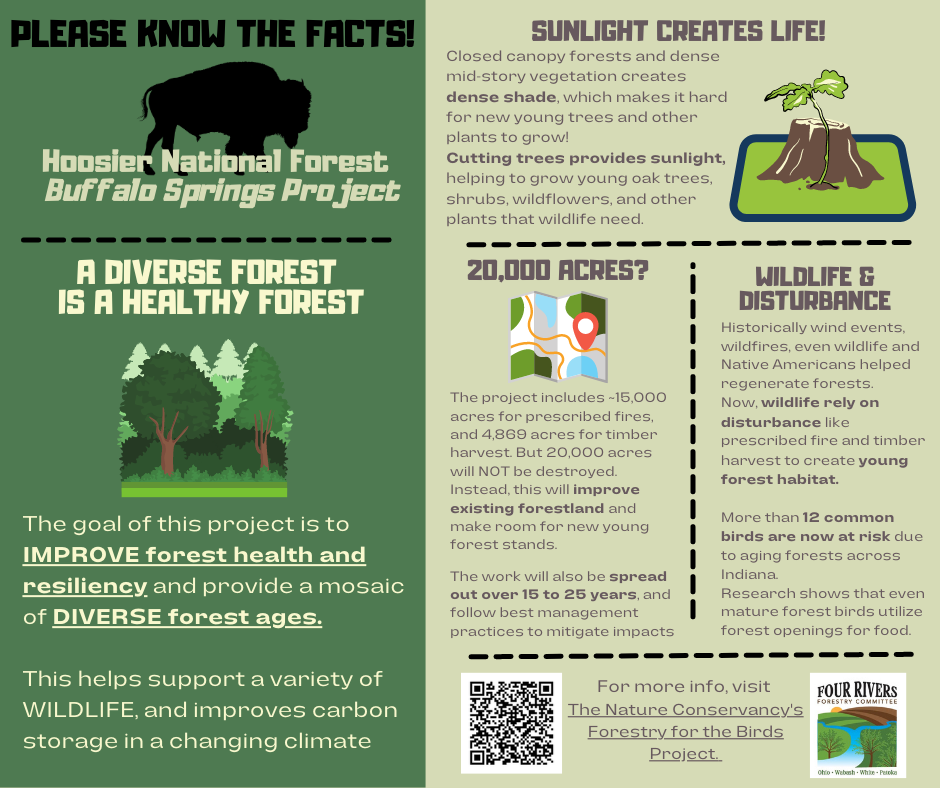
In fact, another point the IFA overlooks when they try to scare people, alleging that 20,000 acres of forest will be “destroyed,” is that this project is planned to take place over DECADES. The 4,869 acres proposed for timber harvest activities will be stretched out over 15 years, whereas the approximately 15,000 acres slated for prescribed fire will take place over 25 years. The project will also employ a variety of mitigation efforts to limit any negative impacts from this disturbance. Which is why despite allegations of impacts to water quality, neither the Hoosier’s own environmental impact analysis nor any local watershed authorities have found that the project will negatively impact Patoka Lake.
We urge the Commissioners and any other area residents that care about the health and longevity of their National Forest to look past the propaganda and really learn about the benefits of this project.
While the public comment for this project has legally ended, experts at the Hoosier National Forest are ready and willing to answer questions and concerns, and have many materials, including videos from Forest Specialists, on their website at https://www.fs.usda.gov/detail/hoosier/home/?cid=fseprd872762.
Public comments are also available to view online, along with the Forest Service’s response to every concern voiced during the public comment period. Several Environmental Organizations provided public comments in support of this project, including the Indiana Forest and Woodland Owners Association, the Indiana Chapter of the Backcountry Hunters and Anglers, the National Wild Turkey Federation, and the American Woodcock Society.
We provided two previous letters to the editor regarding this project, and the need for it, https://duboiscountyfreepress.com/letter-many-benefits-are-gained-from-managing-the-forestland-around-us/ and https://duboiscountyfreepress.com/letter-endangered-bat-consideration-in-buffalo-springs-project/.
Lastly, we have included with this letter a new educational resource we recently created, providing a brief overview of the benefits of this project. The attachment also links to a website by The Nature Conservancy, highlighting the importance of forest management projects like this to save Indiana Birds https://www.nature.org/en-us/about-us/where-we-work/united-states/indiana/stories-in-indiana/forestry-for-the-birds/.
Sadly, the impact on our forest birds is a consequence we are already seeing. But it is consequence we can stop, if we are willing to look past the propaganda and support sustainable and active management of our southern Indiana forests.
Discover more from Dubois County Free Press, Inc.
Subscribe to get the latest posts sent to your email.
