
New monitors provide real-time air quality data
Ohio Valley Safe Air (OVSA), a joint venture of Southwestern Indiana Citizens for Quality of Life (SWICQL) and Valley Watch, announced additional air quality monitoring through about 20 new monitors is now available for Southern Indiana.
The groups purchased AirVisual Pro monitors with grant money from the AEP Mitigation Money Fund, a fund of Central Indiana Community Foundation, and have been installing them throughout southern Indiana. The monitors collect real-time levels of air quality index (AQJ), small particulate matter (PM 2.5), CO2, temperature, and humidity.
The new network of monitors is important for several reasons according to the groups.
Air Quality Effects on Your Health
According to Air Now, air pollution can harm anyone, but it can be especially dangerous for children and teens, people with asthma and other lung diseases, anyone over 65, anyone who exercises or works outdoors, people with diabetes, cardiovascular disease, high blood pressure, or heart attack or stroke survivors. Even healthy adults who physically exert themselves outdoors during poor air quality days can be harmed. Changing what you do on bad air days can reduce your risk of dangerous exposure.
What is AQI?
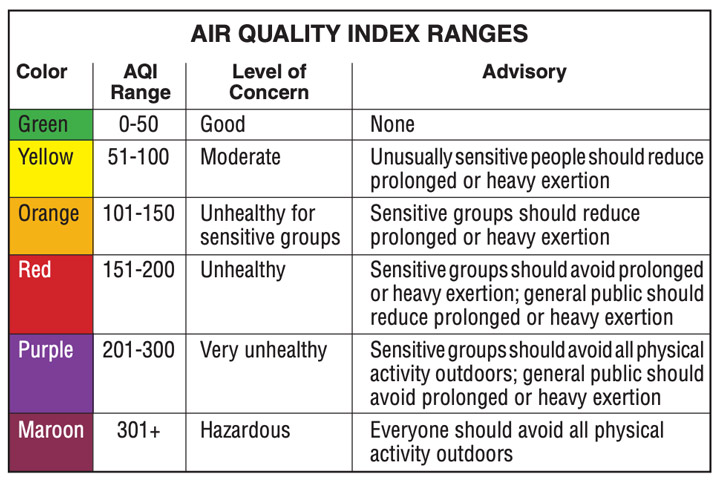
AQI, or Air Quality Index, is a scale from 0-500 that represents the health risk posed by the air in a given area. In most cases, the main pollutant is PM2.5, which is measured by the AirVisual Pro monitors.
What is PM2.5?
Particulate matter (PM) is a mixture of small particles found in the air, including dust, dirt, smoke, and liquid droplets. PM2.5 refers to microscopic particles that are 2.5 microns in diameter or smaller: (The average human hair is about 70 microns in diameter.)
Common sources of particulates include emissions from coal-fired power plants and industrial boilers, smoke from open burning activities, and vehicle exhaust. PM also includes dust from unpaved roads, fields, and construction sites. (Particulate Matter (PM) Basics I US EPA)
PM2.5 is so small that the particles can be inhaled deep into the lungs and cause health problems, particularly for sensitive groups such as the very young, the elderly, and those with heart or lung disease. Adverse effects on the lungs and heart include
Increased respiratory symptoms:
- Irritation of the airways.
- Coughing or difficulty breathing.
- Decreased lung function.
- Aggravated asthma.
- Development of chronic bronchitis.
Other symptoms include irregular heartbeats, heart attacks, strokes, cancer, and premature death in people with heart or lung disease
Particulate matter also has negative environmental impacts. Airborne particles can settle on any surface and may adversely affect lakes, streams, and soil, sensitive forests, crops, and ecosystems and damage or stain buildings and monuments. Airborne PM2.5 also causes haze and reduces visibility. (IDEM’s 2019 Fine Particles Summary Report; Particulate Matter (PM) Basics I US EPA)
Following Real-Time, Local Air Quality
Individuals can follow any of the Ohio Valley Safe Air (OVSA) air monitors for free using the AirVisual app or through IQAir.com. To view OVSA’s area monitors, visit https://www.iqair.com/us/profile/ovsa.
To follow any OVSA monitor on your phone, download and open the AirVisual app, sign in to your account (you will need to sign up first), and use the map to zoom in on our area. Click on any monitor, then click the heart to add it to your favorites list.
To add monitors on your computer, go to IQAir.com, and follow the same steps for the app.
Southwestern Indiana has already seen a few air quality alert days this summer and as temperatures increase and drifting particulate matter from western wildfires mix with existing regional air pollution, there is a chance there will be more alert days. Both SWICQL and Valley Watch encourage individuals to take advantage of the IQAir app and take safety precautions when they receive alerts.
