
NE Dubois schools: Cuts, school board benefits and community pride discussed
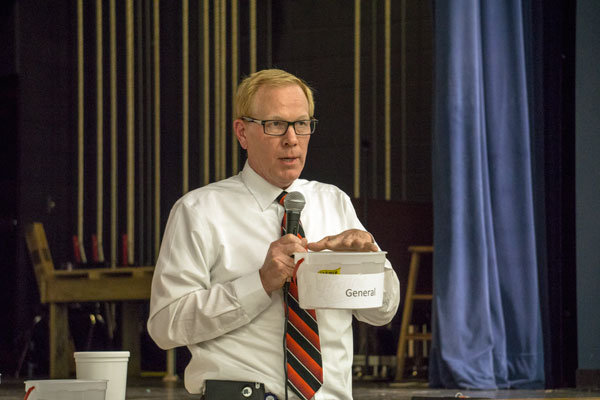
NE Dubois Superintendent Bill Hochgesang has resorted to his bucket demonstration several times recently while explaining school financing.
He did so again at the beginning of the community meeting held to take input and questions from the public regarding the school corporation’s $300,000 deficit.
Hochgesang’s buckets are labeled Capital Projects, Debt Service, Transportation, Pension Debt, Bus Replacement, Rainy Day Fund and General Fund.
The school corporation controls the funds that go into five of the buckets — capital, debt service, transportation, pension debt, and bus replacement — through the property taxes. The general fund bucket is controlled by the state and since 2004, that has been regulated by the number of children enrolled in a corporation’s schools.
The buckets can’t be mixed together. “I have been asked why are we are making the improvements that we are doing if we are hurting for money,” Hochgesang said. “It’s because of what these buckets can be used to pay for.”
[adrotate group=”16″]
Here is what they can be used for:
The capital projects bucket is used for long-term equipment purchases like chairs, desks, lawn mowers, and technology. “Our biggest expense is technology,” Hochgesang said. “All the computers staff uses and the software. Printer and copiers, those are paid for out of the capital projects fund.”
The transportation fund bucket goes to the transportation of the children. The fund is used to maintain and fuel the school corporation’s four large buses and three mini-buses. It also pays the 14 contracted drivers the corporation has on a four-year contract.
The bus replacement bucket is to replace buses. “We get enough in that fund a year to basically replace one bus,” Hochgesang said.
The pension debt fund bucket pays the debt that schools were allowed to take on to pay teachers’ pensions. In 2004, the state allowed school corporations to take out loans to pay for those pensions. The 20-year loans are up in 2024. That debt is paid from the capital projects and transportation funds buckets.
The debt service bucket pays for the mortgages on the corporation’s buildings and building improvements like pouring concrete and adding air conditioners. “This is the only bucket that we have out of the five that isn’t full,” Hochgesang said. “We are not capped in this bucket; we can go to you, the taxpayers, and put more in this bucket.”
The general fund bucket pays for the school’s operating expenses like teacher’s salaries, benefits, paying the bills and consumable supplies like paper, pencils, ink, and the like.
Prior to 2008 the state supplied about 85 percent to the general fund bucket and local tax dollars provided the remaining 15 percent. In 2008, the state made changes to level the financial playing field for the schools.
Since school funding was attached to property taxes in the area the schools served, some schools thrived while others struggled.
Representative Mike Braun, who attended Tuesday’s meeting, said it was created to benefit the donut, or those counties immediately surrounding Indianapolis as well as other counties bordering larger cities that were underperforming and underfunded.
The funds began to follow the kids; schools would receive money for the general fund bucket based on how many children were enrolled in the corporation’s schools. The only way corporations could increase the general fund was through a referendum.
For Northeast Dubois, the new legislation caused the school corporation’s general fund to be eroded. Not only did the school lose funds from the loss of property taxes but the corporation lost students. It is down by about 71 since then.
Realizing some schools would be damaged by the loss in funds, the state created the rainy day fund bucket. “They said you can take leftover money from the capital projects, transportation and bus replacement buckets and dump it into the rainy day bucket to take care of your general fund needs,” said Hochgesang.
Northeast Dubois School Corporation dumped about a million dollars into the rainy day fund bucket in 2009 and since then, they have been taking out more than they can put back into the bucket. “We are using more on the average than we can put in,” Hochgesang said.
They have about $450,000 left in the rainy day fund bucket and is facing a $300,000 deficit in the general fund bucket.
The corporation has hired Brookston-based Administrator Assistance to help guide the school corporation through a feasibility study. Bruce Hatton, representing the firm, told the crowd gathered at the middle school community room that he was there to hear questions or comments.
Nothing has been decided but options include closing Celestine Elementary, increasing staffing efficiency, or hold a referendum to increase taxes.

Several attending the meeting took turns returning to the microphone to voice their concerns.
Kaddy Merkel went from laughter to tears as she explained how her family lived right on the line between the Southeast and Northeast school district. Her dad had said her brother Leon Wehr couldn’t be on the school’s basketball team because of the distance from the family’s home but the principal at Dubois drove him home so he could be on the team. “This is such a great school district and we don’t want to see Celestine close,” she said. “It’s not Celestine and Dubois. We are all one and we are Jeeps.”
Gary Sherman, of Haysville, said he would do anything for his three grandchildren and offered to donate $1,200 to the school corporation every year. “If enough people donate money, it can help,” he said.
Melanie Lockard of Celestine questioned whether closing Celestine would do much for the deficit shortfall. It is estimated closing the school would likely save the corporation around $100,000 annually.
Mike Zehr commented that he didn’t understand why the school board had full benefits from the school corporation if they weren’t full-time employees. “I understand you cut the hours of the cooks and maintenance people so you wouldn’t have to pay health insurance,” Zehr said. “My question is, the board does not put in as many hours as the cooks or maintenance people and they get the benefits. I don’t quite understand that.”
Board members have had insurance benefits for over 30 years, according to Ruth Leistner the corporation treasurer. But, the recent increases have increased the impact on the general fund.
Of the five board members, four have family policies and one has a member and spouse policy. Annually, the family policies cost the school corporation $20,676 and the member-spouse policy costs $16,272 for each policy for a total annual expence of $98,976 from the general fund bucket. The board members agreed to increase their deductible from zero to $1,500 recently but they do not pay premiums.
By comparison, the corporation will pay $6,400 for a family plan for a teacher. The teacher pays the remaining $14,276 premium annually.
According to board president Mary Pankey, the board has discussed more cuts to their benefits.
Board members Brennan Schepers and John Siebert both agreed that board benefits will be part of the funding discussion.
“I wouldn’t be opposed to it,” Siebert said about cutting the benefit.
Siebert said when he was appointed, the benefits were a surprise to him. He has been on the board about six years.
Schepers indicated he would not oppose cutting benefits either.
In the meantime, an online survey will be published on the school’s website on October 26 and be available for residents until November 6.
According to Hatton, his firm will take the data and comments and make recommendations to the school corporation in time for them to make decisions in January.
For reference:
Celestine Elementary has 94 students and five teachers. Dubois Elementary has 221 students and 14 teachers with one being shared. The elementary schools have classes from kindergarten through fourth grade and Dubois Elementary has a preschool program.
The middle school has 288 students.
The high school has 276 students.

This school board insurance benefit, combined with the (dis)parity thing with teachers, is absurd – even if IS done similarly elsewhere. Why should full-time teachers have to pay two-thirds of the premium for the same coverage that board members – barely even part-time – get for free??? Nothing against board members but c’mon – get real – who’s minding the store? No wonder it’s going broke. Voters better pay attention. I mean, this is even worse than the county’s numerous personnel and wage (mis)management fiascos where it’s apparent the chiefs think they deserve better than the indians! Absolutely absurd – hard to believe – and that it’s existed this way for so long! You bet your bippy it needs to be changed, if not cut completely – and who are the other school districts and local governments who pay their less-than part-time board member’s full coverage but charge their full-time employees, or charge them more than the board’s???
Agree. This is absurd when these board members are not elected and insurance benefits should have never been an option as they have full time jobs with benefits. Finding this information out is very disappointing that this school corporation leaders have not made wise decisions and is another reason to have an elected board.
The buckets as described appear to be a red herring. “They said you can take leftover money from the capital projects, transportation and bus replacement buckets and dump it into the rainy day bucket to take care of your general fund needs,” said Hochgesang. This means that every dollar not spent in the first 3 buckets can go toward the general fund, where the shortfall is.
That being the case, every dollar spent in the other categories should be under review. Here are some sensible ideas for how to come up with the missing money:
1. Close Celestine Elementary. If Dubois has lost 71 students since 2008 and Celestine only has 96, it shouldn’t be too hard to find the space to integrate them. Yes, people will be sentimental about where their kids go to school, but top priority should be that they are attending a well-funded school that has the means to educate them. Savings: $100,000
2. Roll back insurance for board members. Equality for all employees of the school corporation is important, even beyond this budget shortfall issue. The board members should be offered the same insurance deal the teachers have, which is to pay approximately 69% of their premium, should they choose to have that insurance. That will save at least $68,000, assuming nobody on the board drops the insurance. This policy should also be applied to principals, superintendents, and any other staff getting better than a 31% break on their benefits.
3. According to Hochgesang, the bus replacement fund gets enough money to replace 1 bus each year, and the school system has 7 buses. That means each bus is being replaced every 7 years. According to http://www.nasdpts.org/Documents/Paper-BusReplacement.pdf , The National Association of State Directors of Public Transportation Services recommends that school buses be replaced every 12-15 years. Since we are replacing them at twice that rate, we can effectively take that bus replacement money and move it to shore up the general fund. A bus costs about $65,000 – $85,000 (http://www.al.com/news/mobile/index.ssf/2014/11/how_much_for_a_brand-new_schoo.html), so let’s just call it $70,000 to be fair. That’s a savings of $35,000 each year on average.
There. I just saved you $203,000 of the $300,000 shortfall. Make these changes and you’ll still have another 4 years of sucking the rainy day fund dry to figure out how to cover the rest (Hint: You should incorporate with the rest of Dubois County into a single school system.)
Like your “Hint”…seriously…but it’s not like the choice is theirs. It’s more like, the rest (all) of Dubois Co. should incorporate into a single school system. However, we all know that the “Greater” Jasper schools are already “consolidated” and there’s no way they would humble themselves. Without their participation it wouldn’t be possible.
The Kernan/Shepard report of 2007 reccomends that school corporations should combine if the enrollment is less than 2000. All small school corporations are struggling, especially with teacher retirement funding for teachers that were not covered by a regular type retirement account. In 2006, there were 293 school districts in Indiana. More than half had fewer than 2000 students. 46 districts had fewer than 1000. All the corporation in Dubois County other than Jasper had fewer than 2000.
As Mike Braun said Tuesday night”the worst thing you can do is shut down a school””. Look within and instead of buying new fix things up. They farm out mowing of schools and fixing buses-jobs maintenance used to do! 3 people were hired to replace the head cook. Money wasted everywhere. 4 tech people. Our superintendent makes 4000.00$ less than Jaspers and she has 5 schools plus busses. Wasted money everywhere! I realize if you are not from Celestine you don’t care but we get great ratings and it is a big part of our town! We support it fully!