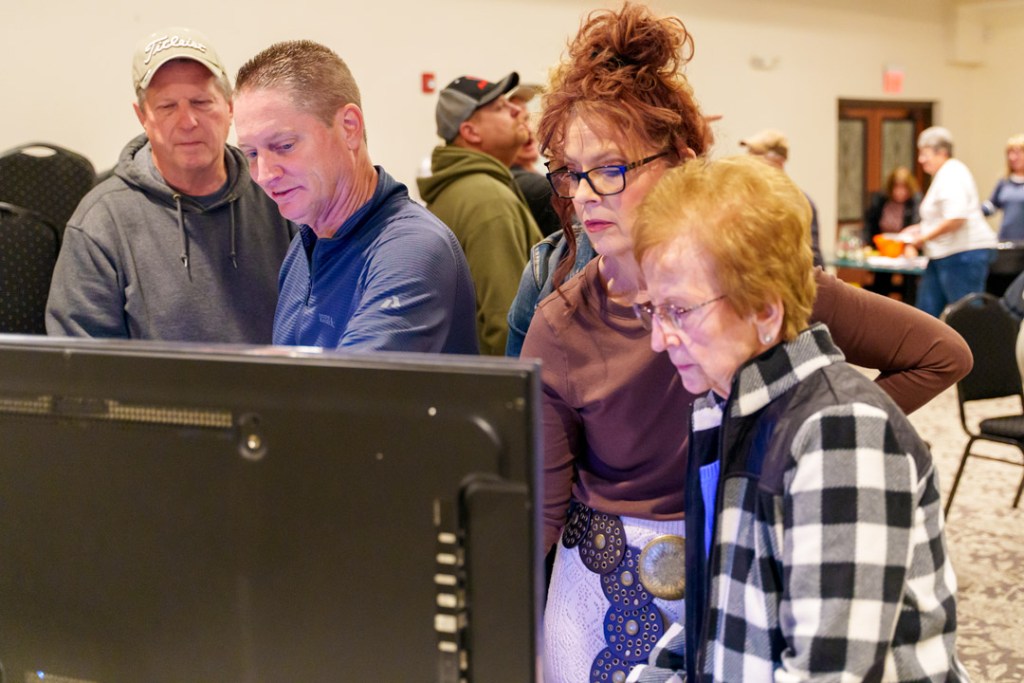
Mid-States Corridor opposition group finishes series of informational meetings
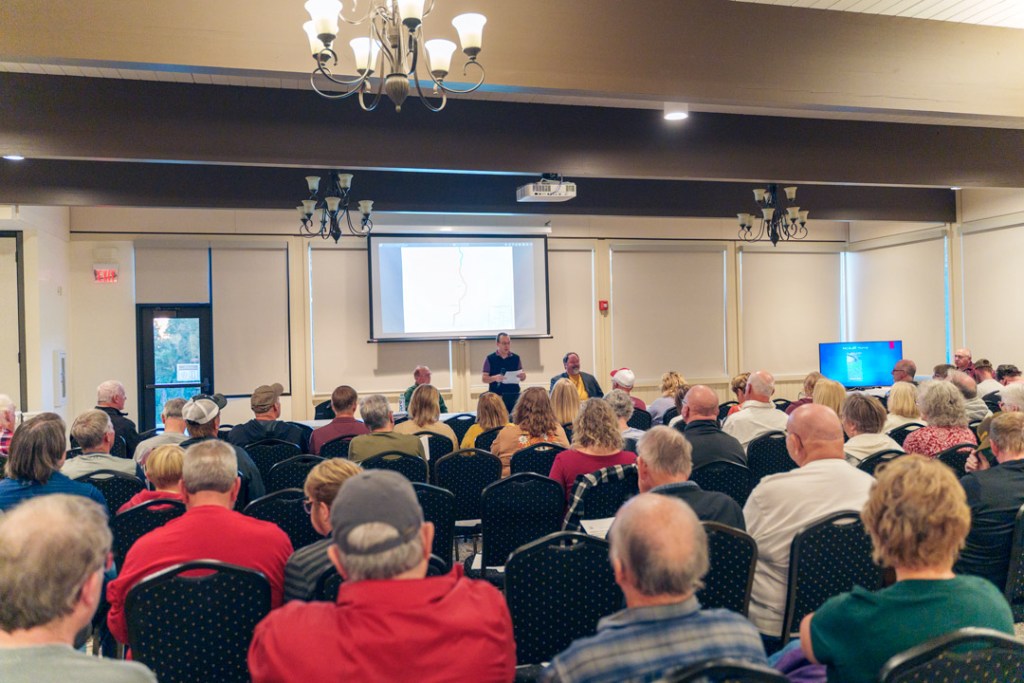
Local residents packed a town hall meeting at Klubhaus 61 in Jasper to hear information and voice opposition to the proposed Mid-States Corridor, a four-lane expressway that would run through Dubois County from I-64 to I-69.
The meeting hosted by Mid States Update, Property Rights Alliance, and the Coalition to Stop the Mid States Corridor was the seventh and final in a series across the county designed to highlight growing concerns about the project’s cost, safety implications, and impact on local quality of life.
The Indiana Department of Transportation and its contractor, Lochmueller Group, are currently conducting a Tier 2 study through Dubois County. Recently, they identified two alternatives for the route through the county that would divert from U.S. 231 south of the Huntingburg Airport, travel east of Huntingburg and Jasper, and reconnect near Haysville to cross the White River.
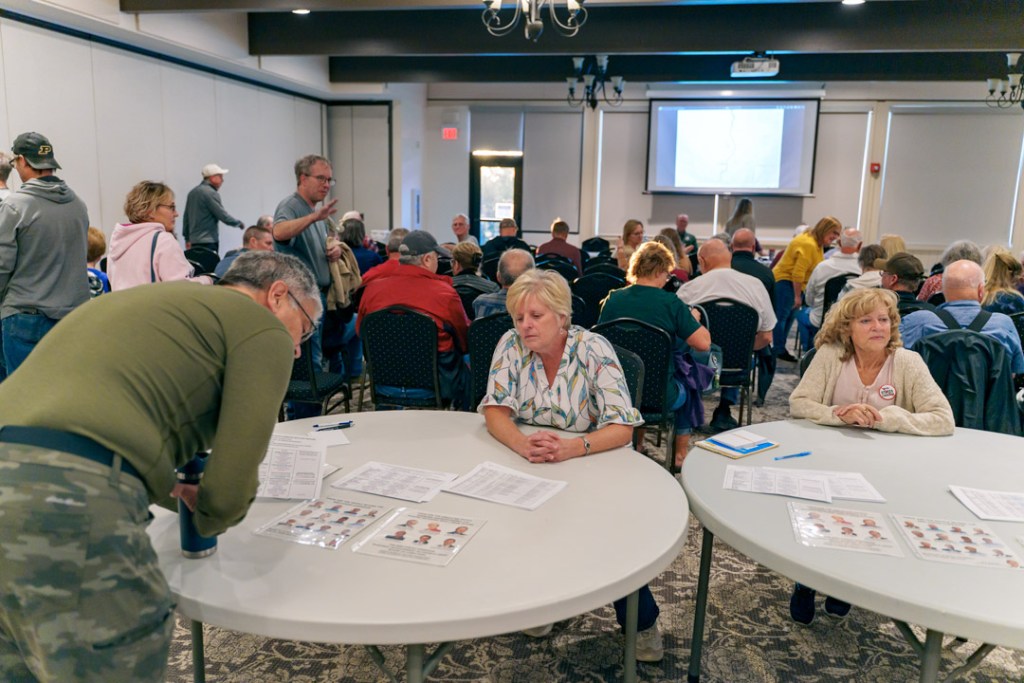
Brad Hochgesang, a Jasper resident, moderated the informational portion, which was joined by Jason McCoy, president of the Property Rights Alliance, and Mark Nowotarski, a member of the coalition and alliance.
During the meeting, the three walked the more than 100 attendees through a presentation outlining their reasoning for opposing the corridor.
The two routes have varying degrees of impact and would require demolishing 27 to 46 homes in Dubois County, according to project opponents. The corridor would also consume nearly 1,500 acres of right-of-way land, including 900 acres of farmland and 333 acres of forest.
The project’s estimated cost has increased from an initial $1 billion to as much as $3.4 billion for the entire 55-mile stretch from Dale to Crane. For the 24-mile Dubois County section alone, costs could reach $45 million per mile, according to Nowotarski.
Along with the destruction of homes, the environment, and farmland along the corridor, McCoy pointed out that the road would cut off areas of the county and require local commuters to cross the expressway at reduced-conflict intersections that INDOT has called J-turns.
“I don’t like to call them J-turns…If you’ve been down to Dale, you know that it’s a U-turn,” McCoy said. “But if you’re the one studying this road, trying to justify it, you can’t use that word because we all know that, you know, how many times have we come up to an intersection that says no U-turn? There’s a reason for that.”
A video during the meeting demonstrated the time it took to cross two lanes of traffic and proceed through a reduced conflict intersection to cross U.S. 231 near Dale. INDOT constructed the J-turn intersections after several crashes that resulted in deaths occurred in this section of U.S. 231 in Spencer County. The crashes occurred after INDOT widened U.S. 231 to four lanes. In the first three years, there were four deaths and nine injuries at the Indiana 62 intersection.
The plans call for up to nine such intersections/turns through the Dubois County section of the expressway.
Using the Dale example, organizers estimated it would take up to 1.5 minutes to traverse a J-turn. According to Nowotarski, this would cumulatively result in up to 40,000 hours of lost time for local motorists at some of the expressway’s busier intersections.
Also, referring to the existing example in Dale, Nowotarski demonstrated that emergency response distances for at least one residence had tripled, from less than a mile to 3.29 miles.
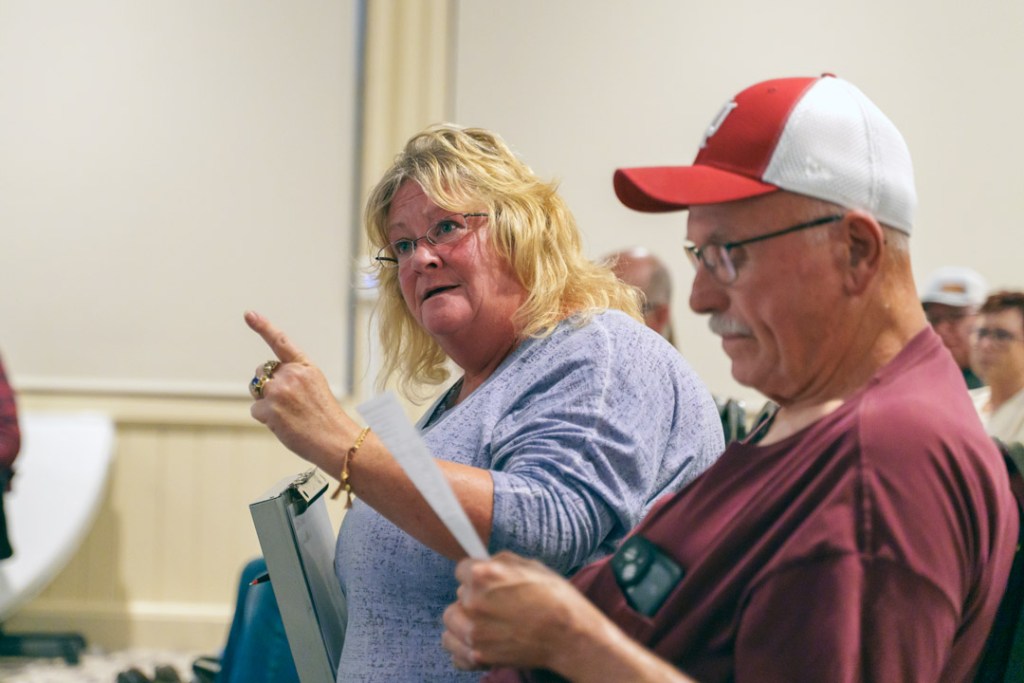
This prompted Mary Beth Edwards to share a personal story about her father’s car accident, emphasizing the critical importance of response time. “Had he been one minute more, one minute, 60 seconds, he would have not survived,” Edwards said. “So when it comes to your family, your father, your son, your daughter, your wife, let me tell you something. One minute, 60 seconds matters.”
Concerns have been raised by local emergency responders, and INDOT has stated that they are taking those concerns into consideration in planning for the expressway.
Along with cost and safety concerns, the organizers also outlined how the project’s justification has shifted over time. Originally presented as addressing safety and congestion issues, the Federal Highway Administration determined that no such problems exist on the current route, according to Nowotarski. The focus then moved to travel-time savings and connectivity, primarily for commercial vehicles.
“So what they did at that point in time was they took some of their secondary goals that they had, and they moved them up,” Nowotarski explained. “They changed them so now it became travel time saved and connectivity, and now they’ve just kind of merged it into everything about connectivity.”
According to Lochmueller’s study, the time to most assessed destinations was about 3 minutes from two locations in Jasper — downtown and the north side.
The project would also require local governments to assume maintenance responsibility for the existing U.S. 231. Huntingburg would be responsible for about 3.5 miles, Jasper for about six miles, and Dubois County for the remaining 10.5 miles. This includes all the infrastructure beneath the road, as well as traffic signs, stop lights, line painting, and more.
Questions from the crowd included the Mid-States Corridor’s impact on school bus routes, its impact on population density, and how to continue opposing it. While most were referred to attend Wednesday’s open house to ask INDOT and Lochmueller representatives directly, Chris Thyen, who was sitting in the crowd, stood and told the crowd to respectfully speak to their representatives to urge them to oppose the corridor.
And to do so quickly.
He explained that although the project timeline shows environmental studies completing in 2028, the project documents indicate property acquisition could begin as soon as a preferred route is identified, potentially next year.
“I think they want to start turning dirt on this in the next two years because Mike (Governor Braun) doesn’t want this to be a re-election issue,” he said.
The Jasper native whose family farm in Hayesville would be impacted urged residents to take action. “If you agree that this road is not good for the county, it’s not good for Jasper, it’s not good for Huntingburg, you’re gonna have to be courageous,” Thyen said. “You’re going to have to talk to your family members based on the facts you have now, you’re going to have to talk to your neighbors, you’re going to have to talk about it at church. You’re going to have to talk about it at work and educate the rest of the public.”
Thyen said this was necessary to ensure everyone understands the impact the Mid-States Corridor will have on the county. He also urged them to contact their representatives, as residents don’t have a say in the project beyond those who represent them on councils and commissions in Dubois County.
The Indiana Department of Transportation will hold a public meeting on Wednesday (tonight) from 5:30 p.m. to 7:30 p.m. at the Jasper Middle School to present additional project information and field questions. This is not a public hearing. It is an open house.