
Library board places ball in city’s court in regards to Hoosier Desk movement
The future of the library was the topic of discussion for over three hours over two separate meetings last Thursday.
The first meeting involved a 2-hour discussion between about twenty representatives from the many parties involved in a potential partnership over the Hoosier Desk building. The mayor and representatives from the Louisville firm CityVision and Boston firm Gamble Associates — the two firms developed the downtown master plan and are scheduled to deliver a plan for The Parklands in the near future — discussed their efforts to pursue a combined examination of the building involving the Jasper Public Library and the Jasper Arts Commission.
The Jasper Library board heard the offer from the city to split the $28,000 cost of a conceptual plan for the Hoosier Desk building in January. Lacking the details of what they would be receiving with the conceptual plan in addition to details regarding the condition of the building, the library declined the offer and counter-proposed the city split the cost of an engineering study and code analysis to be conducted by Universal Designs of Ferdinand.
The cost of the code analysis and engineering study was unknown at the time of the January meeting but at the meeting Thursday morning, at which representatives of Universal Design were present, the combined cost was estimated to be $20,000.
This cost came after representatives from the firm had conducted a walk-through of the building earlier this month.
Under the auspices that the city was unwilling to work with any other firm than CityVisions and Gamble Associates, the meeting between the parties was scheduled to allow for better communication between the entities involved.
A reminder, the City of Jasper is a taxing entity that regulates the budget for the arts department. The Jasper Public Library is its own taxing entity that exists within the city limits. The two are separate entities with separate budgets. To proceed with any partnership involving the Hoosier Desk building, or any other property, will require the approval of the Jasper Common Council as well as the Jasper Library Board of Trustees.
Mayor Terry Seitz opened the meeting echoing his 2011 electio platform of exploring the possibilities of improving the city. “Let’s start to explore how might we…,” he stated before turning the presentation over the Barry Alberts and David Gamble.
Alberts and Gamble for their part went through a 30 slide presentation that appeared to extend from the completed downtown master plan. They explained that during the development of the plan, the interviewed stakeholders expressed interest in developing Jasper’s downtown and riverfront to attract more activity. The proposal included great housing opportunities in downtown as well as the renovation of empty buildings in the area.
Their completed plan had the Hoosier Desk building intrinsically involved in this quest to create more downtown activity. It could serve as a multi-use facility hosting the art department, restaurants, housing and shops.
They considered the space ideal for rehabilitation due to the building’s historical and unique qualities.
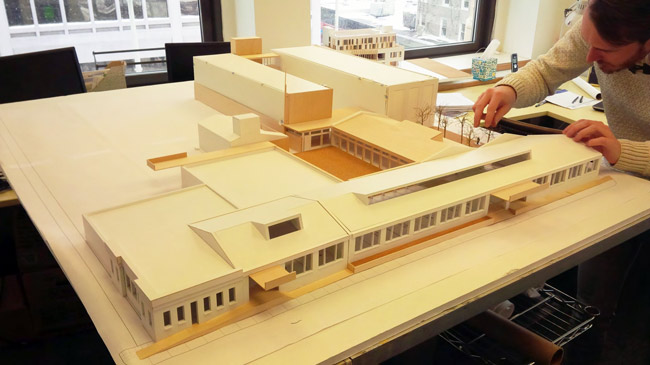
Here are several of their proposals for its use including the Jasper Library.
They also pointed out there are challenges with the Hoosier Desk property. It’s in a flood plain (they specifically stated it in the presentation that the property has “flood elevation issues”); it could have potential costly environmental remediation requirements; and certain structural conditions will have to be overcome. They also pointed out that the large building — 130,000 square feet — will be hard to develop all at one time and that there may be a lack of experienced developers in the area for this property.
Universal Designs’ Tom Schipp expressed many concerns about the cost to rehabilitate the building citing the likelihood of remediation of lead-based paint as well as potential asbestos. He also pointed out that the building could have an expensive environmental cleanup associated with it since it was a manufacturing facility.
Alberts pointed out that environmental cleanup is just a cost to rehabilitate old buildings. “It is just one cost. When we look at reusing an old building, we have to do a budget for the entire cost,” he said.
Schipp pointed out that he felt the library should know those environmental costs and code factors before moving forward with any other studies or designs.
Attorney Bill Shaneyfelt, counsel to the library board, told the city officials the library board would be more amiable to moving forward with the city if the initial studies suggested by Universal Designs were completed before the conceptual design was completed. He also pointed out that the library would only utilize up to 25 percent of the space and therefore should only be financially responsible for 25 percent of these studies.
It was suggested that the Community Arts Commission would then be responsible for about 25 percent of the study. The remaining 50 percent of the cost and who would be responsible for that was never discussed.
According to Shaneyfelt, the library board also expressed some concern with proceeding forward without an option to purchase. A price for the building has not been made public and appraisals have not been completed.
“I know the Sternbergs (owners of Hoosier Desk building). They are good citizens of Jasper and I think they have good intentions. I don’t doubt that in any way, shape or form,” Shaneyfelt said. “We have heard from other property owners in the past who have had good intentions. We would like to have as much nailed down as possible to protect both groups with respect to cost.”
The library accepted the donation of 16 acres at 445 Third Avenue from property owner Ron Schneider after he offered it to the library board in July 2008. Three months later Schneider withdrew his offer, citing hard times.
Shaneyfelt stated he didn’t think it would be possible to get an option to purchase the property at this time but he requested the library or city get a right of first refusal.
Gamble and Alberts both felt that by creating the concept at the same time the structural and code studies were being completed would assist in fleshing out the design and garner more support from the public. “You are not going to get people excited unless they see the potential,” Gamble said. “It is impossible to look at this incrementally. You have to think about it comprehensively. It provides the mechanism for the conversation to emerge.”
Shaneyfelt then turned the decision over to the library board members who were present by asking their thoughts on completing the design, studies and analysis as one project.
Board member Catt stated she felt the library board would support moving forward with both aspects of the project if they would only be responsible for 25 percent of the cost.
Library board president Dean Vonderheide stated the library needed to explore the potential for the use of the building. “We have to do our due diligence. We have committed to doing whatever is necessary to make a good decision for the future of the library,” he said. “If that means going through this together and taking these steps together, it is something the board needs to consider.”
Vonderheide, Catt and Shaneyfelt presented the synopsis of the discussion to the rest of the public library board Thursday evening.
During the discussion, newly appointed board member Carol Hodell stated that as the conversation about the Hoosier Desk building has progressed, she has been approached by individuals expressing disdain to the idea of trading one old building — the current location — for another old building.
Board member Lisa Kincer stated all of the contacts she has received have been positive in regards to exploring the Hoosier Desk building.
After over an hour of discussion, the board made a motion agreeing to move forward with a redevelopment study for the building but not before receiving a proposal with a detailed statement of work and a detailed timeline showing specific costs and specific cost sharing arrangements. Additionally, the board stated they would only be responsible for 25 percent of the total costs and the work would need to completed by May 1, 2015.
The timeline was established so the board could meet deadlines for a potential referendum by May of 2016.
Shaneyfelt estimated that the total cost of both studies could be as high as $60,000. If the offer was accepted, the board would be responsible for about $15,000 of those studies.
The motion passed with five members voting in favor and Hodell abstaining.
The Jasper Common Council and Jasper Arts Commission will likely discuss and consider the issue in their upcoming regular meetings. The common council meets this Wednesday for their regular meeting at 7 p.m. in the council chambers at City Hall. The Jasper Arts Commission’s next meeting is March 3 at 4:30 p.m. in the council chambers at City Hall.
