
Judge Verkamp arranges survey work on Pfister property
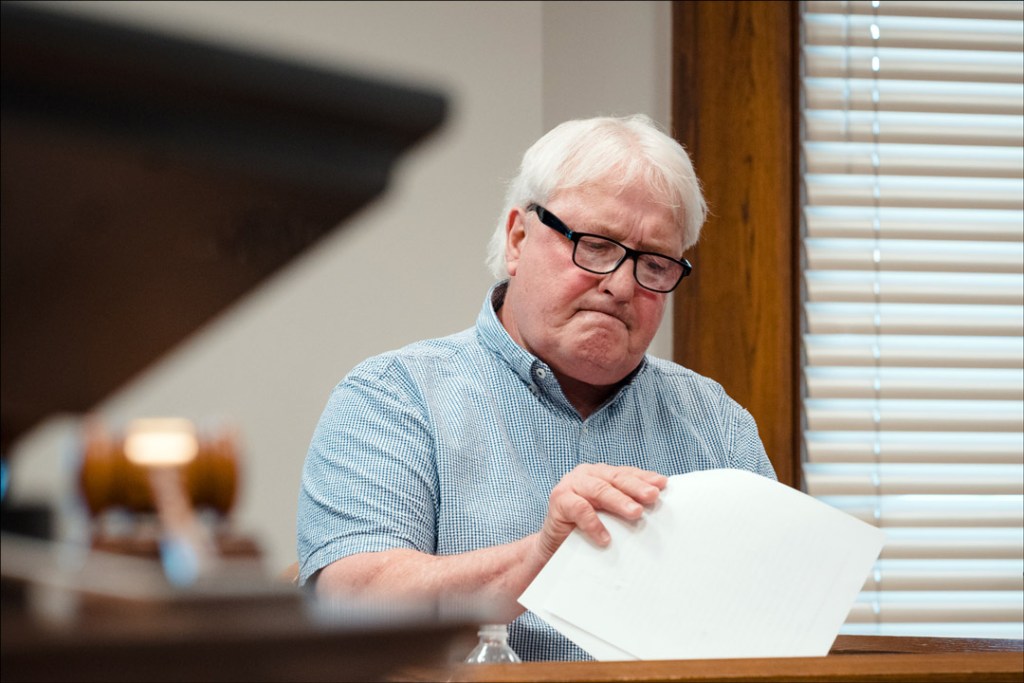
Bob Pfister’s testimony from the witness stand in the Dubois County Circuit Court was marked by tears and anger on Wednesday afternoon.
Mr. Pfister made his first appearance on allegations that he was in contempt of the temporary injunction that Dubois County Circuit Court Judge Nathan Verkamp had ordered, allowing INDOT’s contractor, Lochmueller Group, to continue surveys on properties related to the Tier 2 study of the Mid-States Corridor.
On two occasions, one personally on May 23 and through members of the Property Rights Alliance on June 5, Mr. Pfister had denied surveyors access to his property in the path of the corridor. INDOT, through the Indiana Attorney General’s office, had filed a complaint with the court about those actions by Mr. Pfister.
Judge Verkamp allowed Mr. Pfister to read from a multipage written statement as part of his testimony during the proceedings.
Mr. Pfister opened his statement with a comment regarding the contempt claim.
“Please let me apologize to the court and to the Honorable Judge for any misunderstanding which may have occurred,” he read. “I believe in no way that I, Robert S. Pfister or my wife, Kathy Pfister, are in contempt of this court or have any contempt for you, Judge Verkamp, or for that matter, anyone, anywhere, nor do we intend to ever in our hearts.”
“It is simply not a way to live, judge.”
Mr. Pfister, who owns multiple properties in Dubois County, including the 57-acre property in question, testified that his resistance stems from his family’s deep roots in the area dating back to German settlers who arrived in the 1860s.
“This fight started 170 years ago when a group of Alemanish, Swabian, Bavarian, Alsatian and Hessian Germans in our family arrived and settled in the area,” Pfister told the court. “They came to stay. We came to stay.”
Mr. Pfister explained that he and his wife, Kathy, have spent 25 years acquiring the property, which they maintain as a classified forest and a certified Tree Farm. He emphasized the land is not for sale and is meant to remain in its natural state for future generations.
“Every tree, every stone, every creek and every wild animal on this property is cherished,” he said from the witness stand. “This land is not for sale or will ever be for sale.”
He cited improper notification as his reason for denying access, referencing Indiana Code Title 8, which requires written notice by first-class mail at least five days before entry.
“It does not say you can call, text, holler or simply leave a notice,” Pfister argued, adding that in previous hearings, the state could not provide the judge with a list of who was contacted, when they were contacted, or how they were contacted.
Pfister described two incidents where he denied access to surveyors. Initially, on May 23, he directly refused entry. In the second incident on June 5, members of the Property Rights Alliance acted on his behalf to prevent access while he was out of town.
He explained that afterward, they sent a deputy to inform him that he was in contempt of the judge’s order.
“There is nothing the state’s attorney, the Lochmueller Group or the RDA can say to the Pfister family that means anything,” he said. “They do not decide who is in contempt. The Honorable Judge Verkamp decides.”
Pfister expressed frustration with the communication process, noting that his attorney, Russell Sipes, received notice that surveyors would visit his personal residence address rather than the farm property.
“It sickened me to think that they would come to my home and that my home was on the chopping block,” Pfister said. “Then they ended up at the farm, they have so little respect for the property owners and are so inept that they cannot even get their correspondence correct.”

During cross-examination, state attorney Wesley Garrett confirmed that Pfister was aware of the judge’s order and had deliberately denied access on both occasions.
After both parties were done, Judge Verkamp worked with them to determine a date and time Mr. Pfister would allow surveyors on the property.
Mr. Pfister requested court protection for future property visits, proper written notice, verification of receipt, specific timing within 30 minutes, and the presence of a deputy for his safety.
“We should not be scared on our own property when we receive a vague notice and are surprised to find them in the fields and forests,” he said. “On our property, all are welcome, but not those who would be part of stealing it.”
When asked directly if he would comply with future court orders allowing access to his property, Mr. Pfister confirmed that he would follow the judge’s directions.
“If the honorable Judge Verkamp asked me to let them on our property and could see to answer some of our concerns which we have for our safety, I will absolutely,” Mr. Pfister responded.
Judge Verkamp scheduled the preliminary survey for July 10 at 8 a.m., with July 15 as an alternate date, and arranged for a deputy with the sheriff’s department to be present during the survey work.
The judge noted that federal wildlife regulations may require additional overnight bat surveys on the property, potentially extending the survey process beyond the initial one-day assessment.
Lochmueller Group representatives indicated that they could complete the initial survey in one day, but acknowledged that U.S. Wildlife regulations regarding bats in the area might necessitate additional overnight surveys, depending on the initial findings.
After the hearing, Mr. Pfister stated that he would welcome the wildlife surveys with open arms, expressing his hope that they would find the “rarest Latin American bat” on his property.
“I might have a beer for them,” he added.
During the hearing, Judge Verkamp addressed the political nature of the case, explaining why he chose not to recuse himself despite the controversy surrounding the Mid-States Corridor project.
He looked at Mr. Pfister on the stand and noted they knew each other. And though Mr. Pfister had reached out to speak directly to him last year, he had refused to do so because of his involvement in the case.
“The reason I stayed on this case is for this very reason,” Judge Verkamp said, indicating the divisive nature of the corridor while acknowledging the concerns of the residents in its path and the applicable law. “Politically, it would have been very expedient for me to just dump the case, let a special judge from another community come in here, grab the hammer, grab the gavel and bang it down. I don’t want to do that.”
He pointed out that the surveyors were also employees simply trying to do the job they were hired to complete. He reiterated his previous ruling on the temporary injunction, confirming that Mr. Pfister understood the ruling and the order.
“Last thing I ever want to do is see anybody’s mug shot; that I have to find someone in contempt and have them jailed,” he said.
The judge also acknowledged awareness of social media criticism for his previous decision but emphasized his commitment to upholding his judicial oath.
“I can assure you all that I’m not on the take, not receiving anything monetary in any way, shape or form regarding this matter,” Judge Verkamp said. “I am simply here upholding my oath.”
The hearing concluded with arrangements for the scheduled July survey work, with Pfister agreeing to cooperate with court-ordered access while maintaining his request for proper notification procedures and safety protections.
After the hearing, Mr. Pfister stated that he was unsure whether he would be sent to jail when he entered the court.
“I’ve never been to jail,” he said. “But I wasn’t afraid, I knew I was innocent. They (Lochmueller) can’t just put a tag on the door. The law says first class mail. They use the law against us. I’ll use the law against them.”
