Judge considers permanent injunction for Midstate Corridor Property surveys, asks for better communication between parties

Dubois County Circuit Court Judge Nathan Verkamp is considering whether to grant the state a permanent injunction, allowing surveyors to access private property for the Midstate Corridor highway project, after several property owners denied entry to their land.
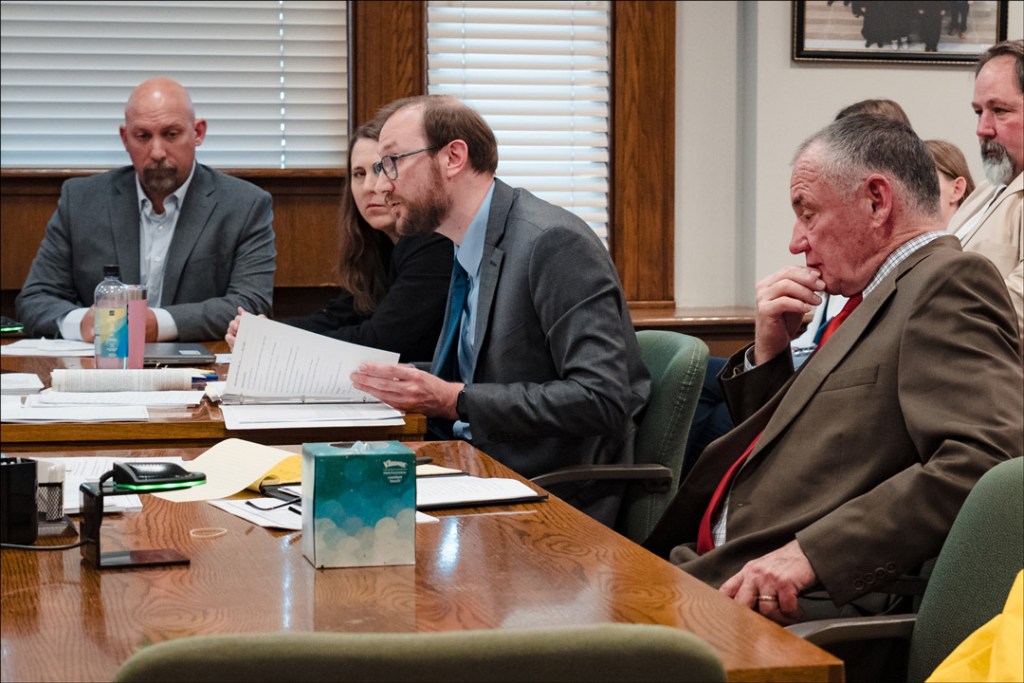
Judge Nathan Verkamp heard testimony during a declaratory judgment hearing in which the Indiana Department of Transportation, through its contractor, Lockmueller Group, is seeking court backing for its statutory right to conduct required environmental and topographic surveys on private property as part of the Tier 2 study of the Mid-States Corridor.
The Midstate Corridor project is a proposed improved highway connection between State Route 66 and Interstate 69 across a two-county study area. The current phase focuses on defining specifics for the corridor’s section of independent utility number two within Dubois County.
Before proceeding, Judge Verkamp reminded the full courtroom and spillover in the county’s third courtroom of the issue he was considering.
“This is not about condemnation or eminent domain or the taking of property at this point, that’s somewhere down the line if it ever comes to that,” he said. “It’s not whether the Mid-States Corridor is appropriate for this community or not. “That’s not what we’re here for today. We’re simply here to determine whether the Indiana code applies and how it applies to the property owners.”
After property owners in the path of the proposed corridor refused survey crews access to their properties for the Tier 2 studies and sent cease and desist letters to INDOT and Lochmueller Group, INDOT filed for injunctive relief in the Circuit Court to allow surveyors on the identified properties.
In May, Judge Verkamp granted a temporary injunction for the surveyors to continue their work. Wednesday’s hearing was for a permanent injunction.
Wesley Garrett and Meredith McCutcheon, deputies with the Indiana Attorney General’s Office, represented INDOT in the court proceedings. Attorney Russell Sipes is representing more than 80 of the 121 named property owners in the injunction.
Jason Dupont, Director of Environmental Services for Lockmueller Group, testified that the company is conducting various ecological surveys, topographic surveys, and cultural surveys to support National Environmental Policy Act (NEPA) evaluation for the proposed highway as part of the Tier 2 study.
Dupont stated that conducting these surveys represents standard practice for highway construction projects and that the state and its agents have statutory authority to enter private property for this purpose under Indiana law.
“Without the surveys, we would not have the data to document the impacts to address regulatory agency reviews through that process,” he said when asked about potential delays.
According to Dupont, initial survey notices were sent to property owners in July 2024, following the requirements outlined in Indiana Code Section 8-23-7-26. When some property owners denied access, the state sent additional notices warning of potential legal action, followed by door hangers and final notices.
“The survey efforts have been delayed,” Dupont testified. “Essentially, the lack of access has precluded us from being on the ground to conduct those specific surveys and compile data to document resources.”
He stated that the delays hinder the state’s ability to comply with federal law and meet deadlines required for federal funding, resulting in project cost increases that will affect Indiana taxpayers.
Even after a preliminary injunction was entered allowing access, Dupont said denials continued. He described one incident where surveyors were approached by sheriff’s officials and other individuals while conducting work on a property and ultimately departed.
That incident involving defendants Bob and Kathy Pfister was on the docket after this hearing on Wednesday.
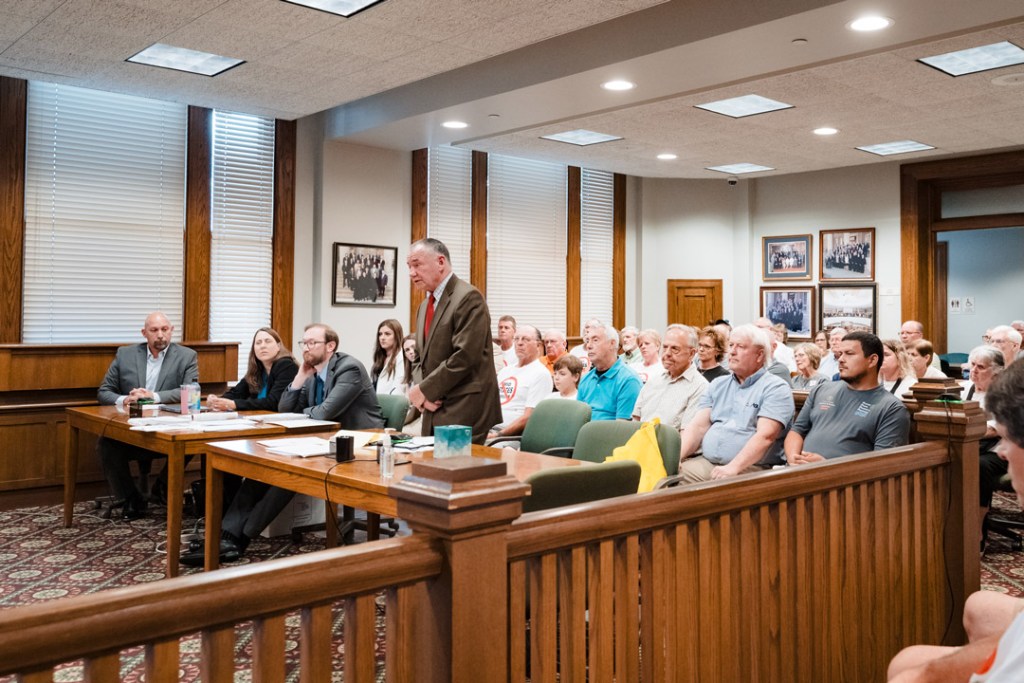
Attorney Russell Sipes, representing a majority of the property owners named in the injunction, questioned Dupont about the involvement of law enforcement in accessing properties.
“There were multiple property owners where we went with law enforcement after there had been a denial to make them aware that state law did afford the access for the state surveyor,” Dupont testified.
Sipes asked Dupont to state what property owners were told by the Lockmueller Group and law enforcement during those encounters. Garrett objected to the question as Dupont did not have personal knowledge of the actual events in question.
“We have people who say they were threatened by law enforcement with jail if they didn’t comply, and Lockmueller representatives were standing by,” Sipes stated to Dupont and Judge Verkamp.
He asked for the names of those who would have been involved in the incidents, and Dupont provided him with two names: Nicole Minton, the public outreach manager for Lochmueller Group, and Peter Petzier, a staff member with the company.
Sipes finished his questions at that point.
In closing arguments, the state requested both a declaratory judgment and a permanent injunction. The state cited the Indiana State Highway Commission vs. Lilly case as supporting precedent for infrastructure projects taking priority over private property interests for injunctions.
Sipes acknowledged not challenging the state’s statutory authority but raised concerns about the process and communication with property owners.
“My clients have told me and would if asked on the stand, talk about significant failures in process of notice,” Sipes said. “What I do want to make clear to the court is the people that I represent and others that I’ve talked to are concerned about the process.”
Judge Verkamp inquired about the survey progress, learning that the initial surveys are over 95% complete, with follow-up surveys still pending.
The judge suggested requiring Lochmueller Group to provide advance notice to property owners before conducting surveys, proposing door hangers or other communication methods to give residents a heads-up about when crews would be on their property.
“I think that would go a long way so that people wouldn’t just walk out their back door and all of a sudden there’s a pickup truck and a crew of people,” Verkamp said. “Going forward, if we could coordinate with property owners so that they know at least within some timeframe.”
Dupont agreed the company could provide advance notice within reasonable time windows, acknowledging that exact times and dates would be cumbersome due to weather and project variables.
Garrett pointed out that some studies of the bat populations in the areas impacted by the corridor would have to occur at night and require crews to be on the property multiple times.
Sipes stated he is advocating for reducing the friction between surveyors and property owners.
The judge asked Lochmueller Group to provide as much advance notice as possible to property owners through door hangers or contact with Sipes’ office about upcoming survey work.
Garrett explained that, due to the nature of the surveys, the window of time could be broad, as he and Dupont seemingly agreed they could comply with the judge’s request using multiple means to communicate with landowners, including door hangers if necessary.
Verkamp gave both parties 30 days to prepare proposed findings of fact and conclusions of law. His previous preliminary injunction order remains in full force and effect while the court considers the request for a permanent injunction.

In closing, Judge Verkamp emphasized his obligation to follow the rule of law regardless of personal feelings about the decision.
“The court is obligated to follow the rule of law. That’s what I was elected to do. To follow the rule of law, whether you like the decision or not,” Judge Verkamp told the court. “Sometimes you make a decision, and it stinks. You just have to hold your nose, but that’s what the law says I have to do.”
As noted in his previous decision regarding the preliminary injunction, Judge Verkamp pointed to the word ‘may’ in the statute allowing the work.
The Indiana Code at issue in this matter is I.C. 8-23-7-26, which reads as follows:
Right to enter property for survey or investigation.
An authorized employee or representative of the department engaged in survey or investigation authorized by the commissioner or the commissioner’s designee, including survey or investigation for purposes of IC 8-23-5-9, may enter upon, over, or under any land or property within Indiana to conduct the study or investigation by manual or mechanical means, which include the following: (l) Inspecting.
(2) Measuring.
(3) Leveling.
(4) Boring.
(5) Trenching.
(6) Sample-taking.
(7) Archaeological digging.
(8) Investigating soil and foundation.
(9) Transporting equipment.
(10) Any other work necessary to carry out the survey or investigation.
“I hope you all understand that this is nothing personal. This is just we do what we do and we have to follow the law,” the judge told those present.