
Jasper Middle School student’s app wins top prize

Update:
On Tuesday, Austin’s app won first prize at the App-E- Feat contest sponsored by the Institute of Electrical and Electronics Engineers USA.
He competed in the 13- to 17-year-olds category in the contest to create apps that help solve local or global problems.
Austin will receive an Apple iPad Air and the opportunity to work with an IEEE mentor to help him develop his technology skills.
Jasper Middle School student creates app to help find abducted children
Original Story:
While Austin Rawlins and his mom, Stephanie, were stranded on the side of the road, an idea hit them to create an app to help people who find themselves in similarly difficult situations.
The two had visited family in Indianapolis while Austin, 13, attended a soccer match last August, but a blowout somewhere between Martinsville and Indianapolis stopped their progress home.
“We popped a tire, and there’s no way my mom and I were going to get the spare tire on our car,” Austin said. “It took us 7 or 8 hours before we could get back on our way home. We had no idea where we were at.”
He related how at one point there was a car that slowly pulled up behind them and then slowly drove around them. “It kinda freaked us out,” the seventh grader said. “Maybe we should have called 911 but we didn’t.”
 Austin decided to pursue creating the app as an entry in the Jasper Middle School Invention Convention. With little knowledge of coding though, he really didn’t know where to begin.
Stephanie was able to connect Austin with Karl Hinson, a geometry, business math and computer science in engineering teacher at Forest Park who is also involved with Project Lead the Way. Hinson met with Austin and advised him to use a free program developed by MIT called App Inventor, a program he uses in the computer science and engineering class he teaches. “App Inventor is a drag and drop style of programming that does take time to learn,” Hinson said. “This is just one way to accomplish this [building an app] … what makes it nice is that it is easily available and one can see results quickly.”
App Inventor allows anyone to log on the MIT site using the Google Chrome browser and immediately begin to build an app for Android. This is due to Android being a largely open platform unlike Apple’s IOS platform, which requires access to Apple products to create apps for the iPhone or iPad.
Stephanie had also read about an app building class at VUJC and met with Ray Niehaus, the director of the Center of Technology, Innovation and Manufacturing on the Jasper campus, to connect Austin with more resources for him to complete his project.
“I think as a parent I can’t do things for him, but I can provide him all the resources to be successful,” Stephanie explained. “There is a fine line between parents who want to do it for them and parents who want to give them the opportunities when they see there is an interest.”
“My mom is the support and the driving force behind the project,” Austin explained. “She was able to get the resources for me to do it and encouraged me to keep doing it. If it weren’t for her I probably wouldn’t have got past the texting [in the app].”
The resources were found but the hard work really belonged to Austin. He began spending hours becoming familiar with App Inventor by completing the tutorials and small projects provided by MIT. “I did many, many, many app builds to learn,” Austin emphasized.
But he was driven to complete the app and after working through the tutorials, was surprised to find how easily he took to the program provided by MIT. The project didn’t come without its own problems though. At one point MIT updated the App Inventor software. The update broke what Austin had created up to that point, but he persevered and worked with Ryan Schuetter, a programming student at VUJC, to get the app build back on track.
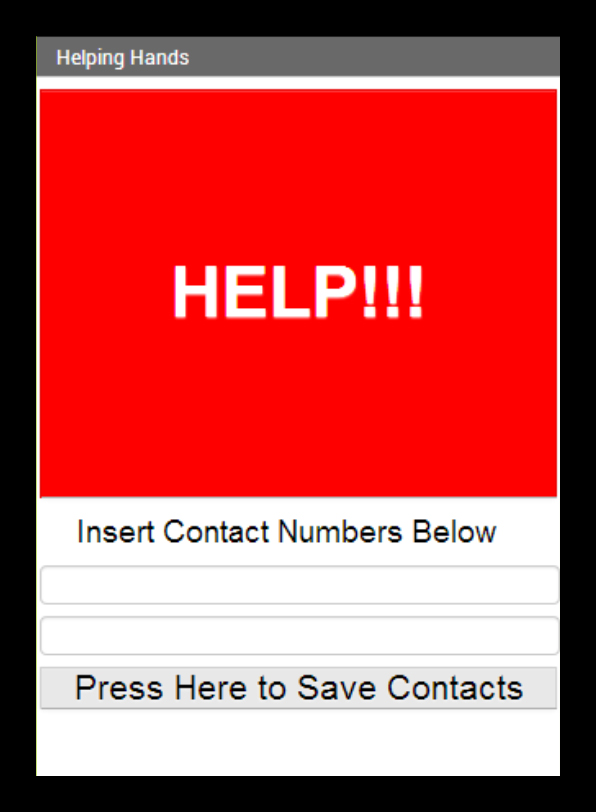
In January, Austin finished his first app, Helping Hands, and published it on Google Play. It can be purchased for $1.99 and downloaded to most Android-based cellphones. Any money from the app will go toward Austin’s college fund, according to Stephanie.
 Once the app is downloaded on a device, the user can open it and enter two emergency phone numbers into the spaces provided. After they are entered, all the user has to do is hit the “Help!!!” button that takes up the majority of the app’s screen to send a message to those two numbers.
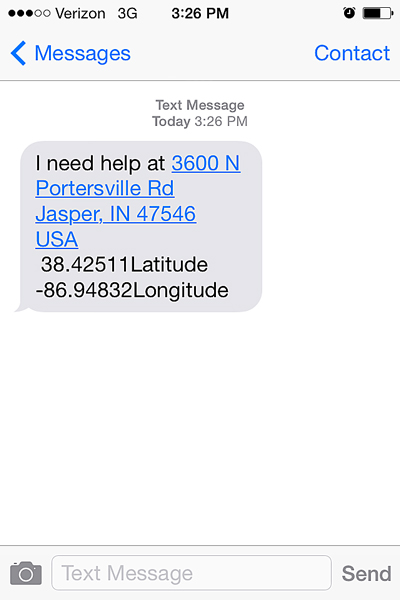
Nearly immediately, the recipients of the emergency call will receive a text stating, “I need help at,” with an address and the latitude and longitude coordinates of the phone that sent the message. If the address appears in the message, the recipient can touch it to open a map to the location. “Say you are on the Jasper Riverwalk, instead of an address you can use the latitude and longitude,” Austin explained.
It seems fairly simple when viewing the end product but what Austin learned as he was going through the process was that he had to create all of the individual processes that make the app do those few simple tasks.
At one point, it took Austin and Ryan Schuetter a month to work through the process to just get the text message to be sent. “When we got the first ding and the message “hello world,” showed up on a phone, we were like, ‘We did it!'” Austin said.
The project did well at the Invention Convention at Jasper Middle School. He received an honorable mention at the Tristate Science Fair held at the University of Southern Indiana and went on to the State Championships held at IUPUI in Indianapolis.
The app has a slight bug that Austin is still working out but it completes the task he designed it to do. Some improvements he has planned include adding voice activation and more options.
The app can be used by an elderly person to notify help if they happen to have a problem or by someone just stranded on the side of the road, but Austin really thinks it could help a child being abducted send out a message with their location attached to it.
“I feel so lucky that I have a family and that I have never really had any problems in my life, I have never really been in trouble,” Austin explained, “you know, like even if I’ve gotten lost in the mall or something, I’ve been able to find my way out. But some kids don’t and that disturbs me. I want to help them.”
Austin has aspirations to create a company that brings people together to come up with ideas and work together to create new apps or solutions for perceived problems. “Programming is up there on the list of things I would like to do as a career but it isn’t one of things I most want to do,” he said. “I feel good that I have created an app that could help someone in the future.”
He has an idea for an app to help people suffering from Alzheimer’s since his family has a history of the disease and will likely enter an app for his eighth grade Invention Convention project.
Austin has been is a Star Scout in troop 185 and has been in scouting for six years. He takes part in drama at Jasper Middle School, plays soccer and hockey, and has held a role in the Young Abe Lincoln production for the past two years as Lincoln’s boyhood persona.
Austin’s parents are Brian and Stephanie Rawlins of Jasper, and he has an older brother, Aaron.
