
Jasper Council hears all sides on Mid-States Corridor
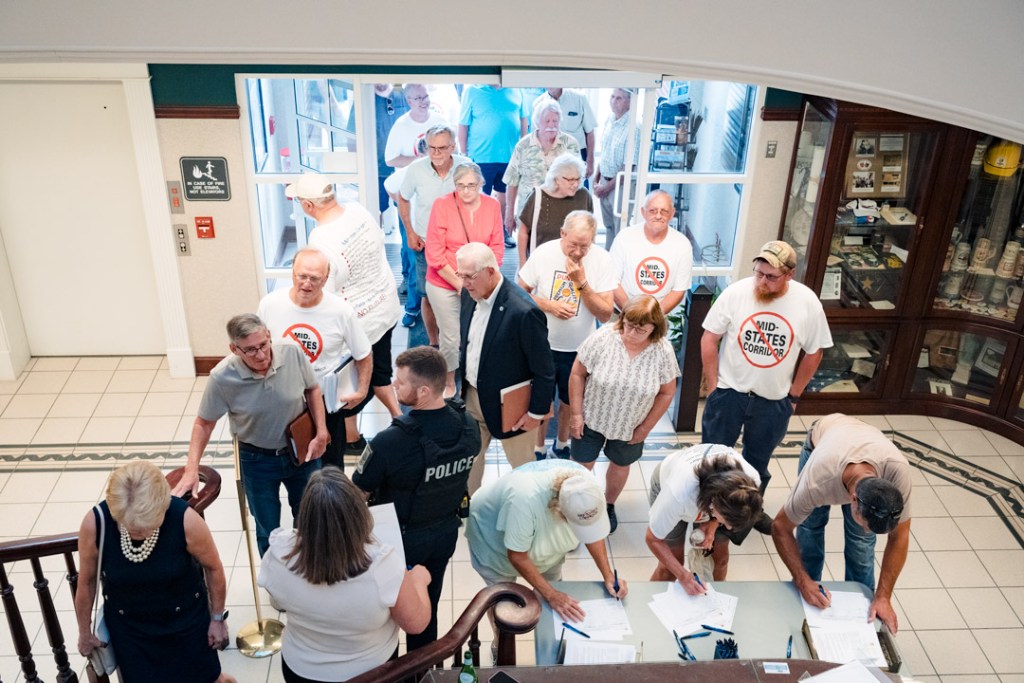
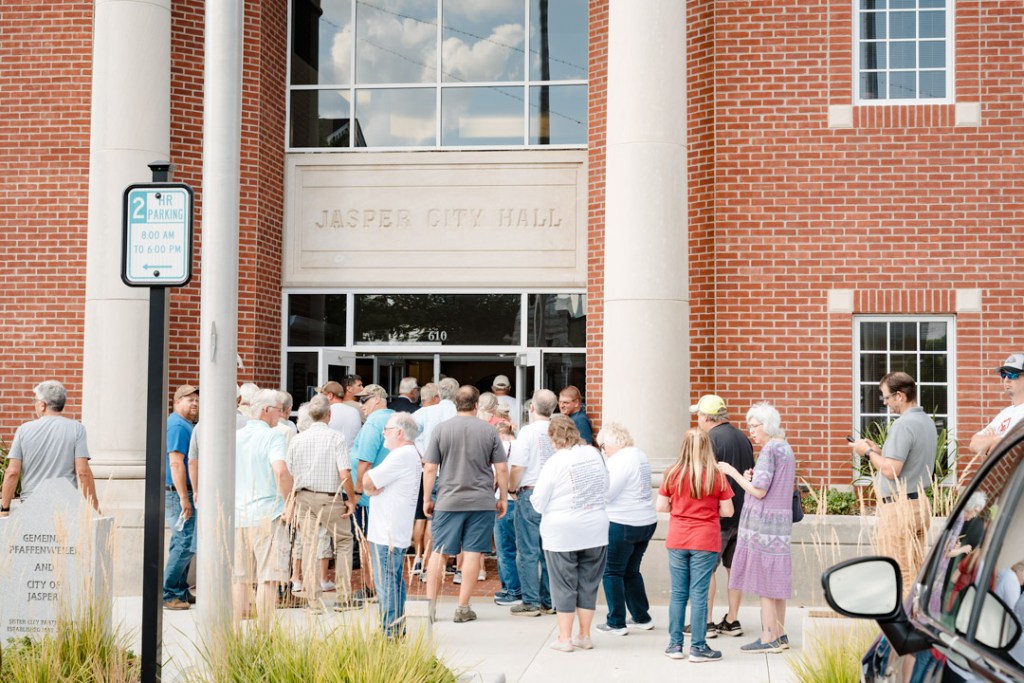
Thursday night, more than 150 people crowded into the Jasper City Hall to hear an overview of the Mid-States Corridor project, followed by comments from proponents and opponents to the highway.
With the council chamber at capacity, the overflow of attendees watched remotely from the Pfaffenweiler Room.
The meeting opened with the Lochmueller Group and the Indiana Department of Transportation giving an overview of the project’s status. This was followed by members of the Mid-States Regional Development Authority, local business owners and supporters providing evidence for the need for the highway. Opponents to the highway followed, largely providing rebuttals to the proponents’ claims and the study’s validity. Each group had 30 minutes and then additional time to take questions from the council.
We have a rundown of comments provided to the council below.
Both groups are asking local governing bodies to pass resolutions in favor of or against supporting the Mid-States Corridor, a proposed roadway connecting the improved portion of U.S. 231 in Spencer County to I-69 that will travel east of Huntingburg and Jasper.
The council held the special meeting to give plenty of time for each presentation and for the council to ask questions and provide comments.
At the end of the nearly two-hour meeting, Councilman Paul Lorey said he appreciated the dialogue and gave them information to consider.
Councilman Phil Mundy agreed, adding that the more discussions around this topic they have, the better. He said that though the two groups seem to be working around the same facts, they have opposing views on those facts.
“(These discussions) give us information and allows us to probably ask the right questions,” Mundy said.
Councilwoman Nancy Eckerle said these meetings were important because they allowed both groups to speak in a public setting that can be recorded and rewatched in the future as these decisions are made.
She and the other council members reiterated that the public can see all the city’s meetings on its YouTube channel.
Here is last night’s meeting in its entirety.
After a brief introduction and some housekeeping items from Clerk-Treasurer Kiersten Knies, INDOT and Lochmueller Group opened with Kyana Wheeler, project manager for the Indiana Department of Transportation (INDOT), giving an overview of the Tier 1 study and decision-making process.
Wheeler explained that in the Tier 1 study, U.S. 231 improvements were considered as an option, along with the no-build option, and both were eliminated as options.
Wheeler stated that the study supported the new highway, while improving U.S. 231 would be more impactful than the alignment that was eventually chosen.
“So some of the reasons that a build decision was made and the approved corridor was selected were due to travel time savings to key destinations, travel time savings to intermodal centers, truck hours saved and lower potential relocations with the corridor that we selected,” Wheeler said “I say lower potential relocations because upgrading existing 231 would have had a substantially larger number of relocations to property owners and businesses.”
According to the study, improving U.S. 231 would have meant 418 possible relocations (property acquisitions) compared to the chosen route, which has 114 to 156 relocations.
Wheeler added that though U.S. 231 was ruled out early in the study, the route was reconsidered due to the large amount of public feedback regarding its consideration as an option. “We brought it back into the study and did a further analysis of it, but it was still screened out because of those poor performing criteria,” she said.
She explained that the Federal Highway Administration approved the build decision and the Tier 2 study after review by the Environmental Protection Agency, U.S. Fish and Wildlife, and the U.S. Army Corps of Engineers.
“So we had four federal agencies along with INDOT reviewing and approving the work that Lochmueller was doing,” Wheeler said, before giving the podium over to Jason Dupont with the Lochmueller Group to talk about progress on the Tier 2 study currently underway.
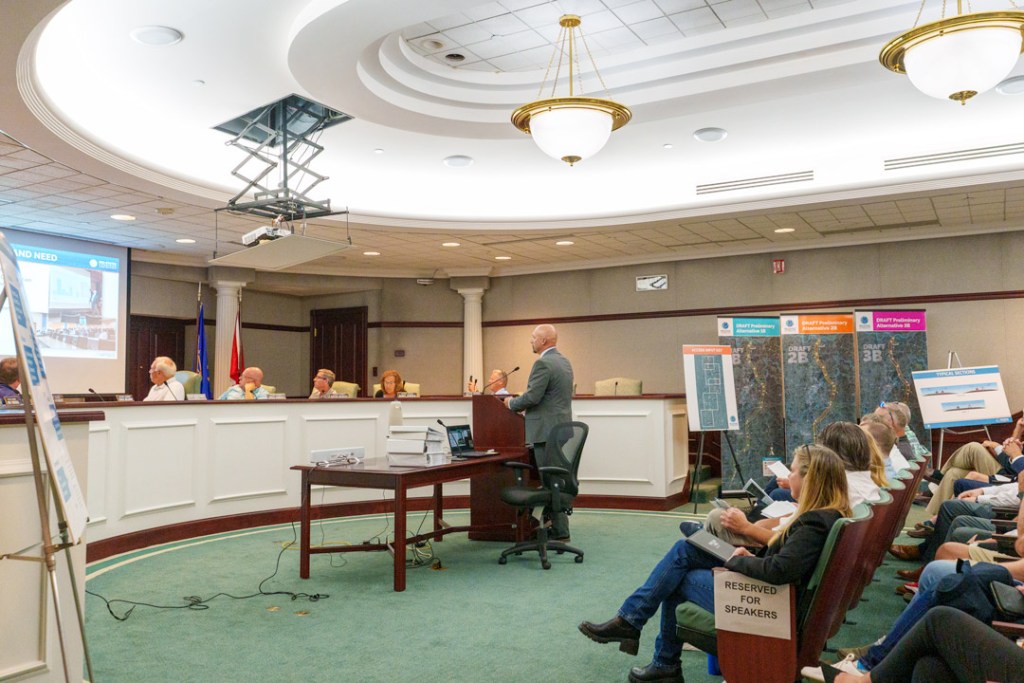
Dupont told the council they’re now narrowing down the six alignment options within the 2,000-foot-wide corridor approved in the Tier 1 study. Those alignments will determine which roads the highway will impact, and the group expects to be able to introduce those alignments at a public meeting planned for this fall.
“We expect to focus on one or two alignments in most areas,” Dupont said about what they would present at that time. “Some spots might have just one option, while others could have a few different variations.”
After that, a draft preferred alternative is expected to be completed by the fall of 2026, with a final environmental document in summer 2027. Dupont noted right-of-way acquisition could start as early as 2026, after identifying a preferred alternative.
A major topic of discussion was the potential transfer of U.S. 231 to local control. INDOT prefers not to maintain two parallel corridors, but no agreements have been made yet with local entities to take over the existing highway.
Jasper City Councilman Kevin Manley raised concerns about U.S. 231’s condition within the city. “231 is probably the worst road in the entire city,” Manley said. “If there’s an expectation for the city to take it over, that road almost needs to be completely rebuilt.”
Wheeler acknowledged these concerns and said INDOT is open to various options to address the road’s condition before any potential transfer.
“INDOT can improve that road to a condition you’re satisfied with,” Wheeler said. “We’ve had other agreements with local entities where we bring the road up to a certain standard.”
Mayor Dean Vonderheide asked when INDOT would be approaching local taxing units (Jasper, Huntingburg and the county) for financial support for the project.
Wheeler explained they haven’t had those discussions to determine when or if local participation may be needed to help fund the project. “But INDOT is already working on funding future phases for the project,” she said.
Wheeler also addressed the $75 million allocated for upgrades to U.S. 231 in 2021, stating that these are designed to “complement the project benefits of the corridor.” Improvements within the scope of the $75 million can be found on INDOT’s online work schedule.
Proponents of the corridor were then given 30 minutes to present reasons to support the project.
Mark Schroeder, chairman of the Midstates Corridor Regional Development Authority, led the presentation and addressed anticipated opposition arguments before other speakers could respond.
Before doing so, he addressed the impacted property owners.
“I do want to preface my comments by stating that we take no exception to those who are directly impacted by the Dubois County portion of the deferred alternative route,” he said. “We recognize these individuals are desperately trying to find a way to keep the road from being built as a means to keep their property from being impacted.”
He then noted they do take “great exception” to the leadership of the two groups, the Property Rights Alliance and the Stop the Mid-States Corridor Coalition.
“The leadership to these groups, who each have their own personal agendas, have presented pure fabrication of facts without providing any documentation or proof,” Schroeder stated, pointing out that these individuals also don’t have property in the path of the proposed highway in Dubois County or are not residents of Jasper.
Schroeder told the council that none of the impacted properties were within Jasper’s city limits.
“At the end of the day, whose interest are you going to represent? Are you going to represent the interest of your Jasper constituents or represent the interest of those opposed to the road, almost all of whom live outside the Jasper city limits?” Schroeder asked council members.
The Mid-States Corridor RDA has presented a resolution to local councils to support the road and is asking for them to approve it. To this point, Schroeder told the council they needed to take a position on whether or not this is in Jasper’s best interest.
“Both sides are going to keep hammering you for a decision,” he said.
Sue Ellspermann, a Midstates Corridor RDA board member and former State Representative and Indiana lieutenant governor, emphasized the project’s long-term benefits for the region. She noted that Dubois County currently ranks 69th out of 92 Indiana counties in growth over the past five years.
“Stopping now means being satisfied with the status quo and likely a mediocre future for Jasper and Dubois County,” Ellspermann said. “Why should companies further invest or choose to locate here? Why should top talent stay or move here?”
Ellspermann served on Governor Mike Pence’s Blue Ribbon Panel on Transportation Infrastructure in 2013, which included the Midstates Corridor as a Tier 2 project in its 2014 report.
Doug Bawel, President and CEO of Jasper Engines, drew comparisons to previous controversial road projects that later proved beneficial to the community. He explained the construction of U.S. 231 in the 1970s was personal because it split his family’s property in half, and then pointed to the completion of Interstate 64 in 1977.
“People were complaining it was not being used. Look at it today. Both roads were built by forward thinkers some 45 plus years ago,” Bawel said. “I truly thank those women and men who had the vision to look to the future and plan for the future, even when there were naysayers. Just look at how these two roads have improved the safety in our community and have helped grow our community.”
Retired Dubois County Commissioner Elmer Brames compared the project’s importance to Patoka Lake, which faced similar opposition in the 1950s and 1960s.
“The lake probably took five times as many acres as what this project will take, including whole towns,” Brames said. “I ask you, who would say that Patoka Lake was a mistake? Who would say that today?”
He also cautioned the council to listen to anyone stating that the majority of residents are against the project.
Mike Ackerman, CEO of Ackerman Oil, addressed concerns about the corridor’s distance from Jasper affecting its usefulness for local companies.
“We run a small fleet of trucks, and one of our runs that we make regularly. We’ve got a choice of running 120 miles through small towns with railroad crossings and stoplights. Or we can take a longer route of about 150 miles with very few small towns, very few stoplights, very few rail at grade crossings,” Ackerman explained. “We take the longer route. It saves time, it saves money, it saves fuel.”
Dubois Strong presented data showing recent job losses in local manufacturing. According to the presentation from Colten Pipenger, wood product manufacturing saw a 34% decrease in jobs over the past five years, while furniture and related product manufacturing declined 2.8% during the same period.
Despite these losses, manufacturing still comprises 34% of employment in Dubois County, followed by education, healthcare and social assistance at 16%, and retail trade at 11%.
“We can argue what those factors are for a multitude of reasons, but the fact is, we’ve seen job decline in those past five years from 2017 to 2022,” Pipenger said.
He pointed to recent mergers and acquisitions that have changed the manufacturing landscape in Dubois County, noting that “companies today are looking for every single operational efficiency that they can find and they will capitalize on it.”
Attorney Bill Kaiser read statements from U.S. Rep. Mark Messmer and Bryant Niehoff, chief executive officer of the Upland Science and Technology Foundation at Westgate Crane Technology Park.
Messmer’s statement emphasized the project’s benefits for heavy manufacturing businesses and the Naval Surface Warfare Center Crane.
Niehoff’s statement highlighted Westgate’s growth, noting the facility employs just over 1,000 people with a $92 million payroll, up 20% in employment and 37% in payroll since 2022. He projects 3,750 net new jobs and approximately $3.6 billion in payroll impact over the next decade.
“Any transportation improvements that enhance north-south connectivity between surrounding communities and our growing defense tech hub, improving safety, reliability and commute times will directly support the broader region’s defense sector, supplier base and long-term competitiveness,” Niehoff’s statement read.
Kaiser concluded the presentation by emphasizing workforce mobility, noting that approximately 7,000 workers commute into Dubois County daily while 2,000 county residents work elsewhere.
“Doing nothing is not a choice,” Kaiser said. “It is the responsibility of this city council to plan for the future of this community, its current citizens and its future citizens.”
Though Mayor Vonderheide lightly contested Ellspermann’s statement regarding Jasper’s population growth, she offered up her source before the group moved on to the statements from the opposition.
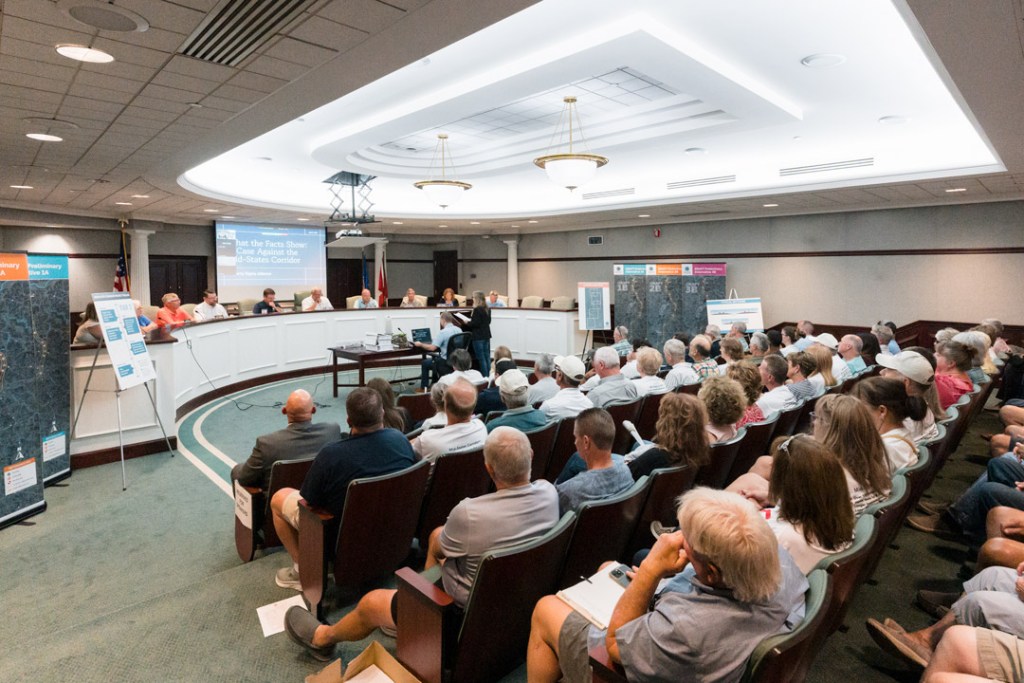
The Property Rights Alliance presented a detailed opposition to the proposed Midstates Corridor project, arguing the initiative would cause more harm than good to the community.
Maggie Marystone, representing the alliance alongside Jason Fleck and Anna Jones, told council members the group has studied state and city project documents and experiences from other communities that have implemented similar highway projects.
“We believe the facts show this road will take more from Jasper than it will ever give back,” Marystone said. “By the end of this presentation, we believe that you will see that the cost is too high, the benefits too small, and the risks too great for our community to bear.”
The alliance argued the project would result in the taking of 149 homes and businesses by the state, along with 1,800 acres of farmland and nearly 1,000 acres of forest.
Marystone said with inflation and construction cost overruns, it was unlikely the road would cost $1 billion as initially estimated.
“We’re not even sure how much land acquisition would cost over and above the $1 billion official estimate, but we’re certain it’s going to cause a lot of tears,” she added, saying it would all fall to taxpayers to cover.
Marystone emphasized that many affected stakeholders, including farmers, small business owners and longtime resident families, have not had adequate opportunity to weigh in on the project. She noted that as people become better informed about the proposal, opposition appears to be growing.
The alliance challenged the project’s stated goals, pointing out that while early public meetings focused on safety and congestion relief, the official documentation lists connectivity as the primary objective. Safety and congestion improvements were designated as secondary goals because federal reviewers determined those concerns were not severe enough to warrant such an expensive project, according to Marystone.
“Even though connectivity is supposed to be the primary goal, the only conclusion about that we can come to is that talking about safety and traffic relief makes for better sound bites,” she said.
Jason Fleck presented research from universities including Kentucky, Texas and Ball State showing that bypasses often harm local communities by increasing downtown business vacancies, reducing retail activity and lowering per capita sales.
“Promise boom rarely arise but the cost certainly will,” Fleck said, referencing the University of Texas analysis that found bypassed cities suffer per capita sales declines across multiple sectors.
Fleck pointed to real-world examples, including a stretch of US 231 in Spencer County that was widened to four lanes and completed in 2011. After 14 years, only one new business – a Dollar General – has been built along that section, he said.
He also highlighted that Dubois County’s unemployment rate stands at 2.8% as of May 2024, questioning the economic necessity of the project. The county has experienced consistent population growth of 1.7% annually over 50 years and job growth of 68% since 1980, all without the proposed corridor.
The alliance argues that Governor Holcomb’s 2022 allocation of $75 million to improve US 231, including passing lanes and safer intersections, would address safety and traffic concerns at a fraction of the corridor’s cost.
Anna Jones focused on opportunity costs, arguing that investments should go toward projects residents request, such as local amenities, healthcare improvements, housing, and childcare.
“One mile of the proposed highway equals more than five Parklands,” Jones said. “That’s real return on investment.”
Jones noted that the City of Jasper’s 2019 comprehensive plan identified the south side of Jasper along US 231 as the most feasible location for industrial development, precisely the area that the new road would bypass.
The alliance also raised concerns about infrastructure impacts, showing maps indicating the corridor would close numerous existing roads and create longer emergency response routes. Fleck showed a slide of the improved U.S. 231, which now blocks the most direct access to a residence in Spencer County, forcing emergency services to drive 3.29 miles to reach a residence that used to be less than a mile.
He then presented an extensive graph of potential road closures due to the project.
“This road will literally divide Dubois county in half,” Fleck said. “It’s a physical barrier.”
The group also questioned the amount of business influence in the decision-making process, noting that many of the early monetary contributors to the Tier 1 study were allowed to remain anonymous.
In closing, Jones left the council with a final thought.
“The truth is simple. For every test that matters — cost, benefit and trust — this road fails,” she said.
The alliance concluded by offering to meet with council members anytime to discuss the project further and provided detailed materials for review.
Council members thanked the presenters for the information, with Councilman Phil Mundy stating they have received numerous emails and messages from residents on both sides of the issue, and they are reviewing them.
“We appreciate those inputs,” he said. “It helps us in our perspective.”
