
Jasper Cabinet building and tax increment district discussed
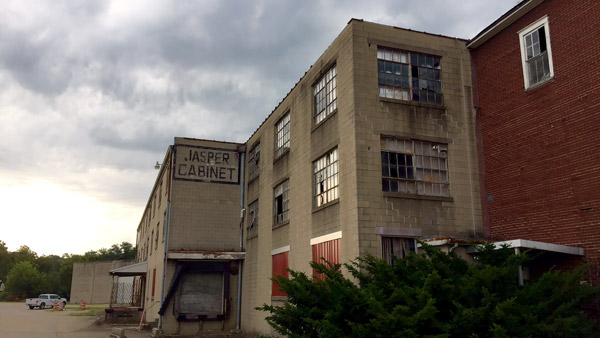 Earlier this month, the Jasper Redevelopment Commission revealed a developer had an option to purchase the Jasper Cabinet building.
Redevelopment Commission President John Bell gave a brief presentation to the Jasper Common Council on the upcoming process with the proposed development.
Ed Curtin, principal at CWC Latitudes LLC of Columbus, appeared before the Jasper Redevelopment Commission in August and requested the commission create a separate tax-increment finance district for the property located along the Patoka River behind the Jasper Train Depot and flanked by Third Avenue and Jackson Street.
At the time, Curtin did not present any plans for the building but explained the unidentified developer would turn it into a mixed-use building featuring housing and commercial/retail establishments.
According to Bell, although a comprehensive tax increment district had been established in the city in March, the developer would not proceed with the program without a separate district being created for the property.
Bell explained this was for several reasons. By completing the project, the assessed value of the property will increase and according to Bell, the developer does not want that increased assessed value being diluted through the larger tax increment finance district.
The developer also wants to ensure the increased property taxes stay with the project on the property. “We would know that only those TIF dollars would go to that project,” Bell said.
Additionally, the tax increment finance district created around the property would also protect the life of the tax increment finance district. By state law, TIF districts can be established for up to 25 years. At the end of that time, they must be reassessed to create a new base assessed value if the district is continued.
Bell explained the clock would only start ticking on the Jasper Cabinet property when the TIF funds were allocated.
To clarify, tax increment finance districts collect property taxes that accrue based on the increased assessed values of commercial properties in the districts. When the city created the district in March, a base assessed value was established. Those funds established at the base value are still collected for use by the civil city, schools, and county. However, funds above that base assessed value can be captured by the district and used by the redevelopment commission for projects that influence growth in the district.
In the case of the Jasper Cabinet property, the developer would like to use the increased property taxes captured to pay back construction bonds or economic development bonds associated with the project.
Bell told gave the council a timeline in regards to moving forward.
In September, the redevelopment commission will likely pass a declaratory resolution to establish the separate TIF area. This doesn’t establish the new district; it simply begins the process.
Then, the Jasper Planning Commission would review the resolution in October to ensure it fits in the city’s master plan.
Once approved, the council would consider the resolution for approval at their October meeting.
During this time, a study will be conducted to determine how much tax increment could be captured by the project. The developer and plans would likely be revealed sometime around the time of the October council meeting.
The issue would then come back to the redevelopment commission for final approval in November.
Bell also let the council that the developer had paid a structural engineer to assess the building and it was found to be structurally sound.
Councilman Tom Schmidt asked if the project was viable. “I do,” Bell said. “It is always a little unsettling when you don’t have the full scope. We have to respect and understand that the developer won’t totally disclose what they want to do.”
“Even if we carve this area out and they [developer] back out, I don’t think we can’t get hurt at this point,” he said.
Councilman Kevin Manley said he supported using the tax increment finance funds to develop infrastructure and improvements to support the project. “The TIF dollars that they try to borrow money against, I am not for that,” he said. “There is serious debt in our state. Carmel is over $200 million; Marion is $173 million; and Evansville’s in third place with like $160 million in debt because they bonded and borrowed against money that was coming.”
Bell stated he felt the same way originally, but he explained that the city should be open to the process as they move forward with the project. “There is a couple diffent ways to bond but it has to be very conservative, and we have to be confident that we are not going to get stuck,” Bell said. “I am just saying, don’t be close-minded yet. Let’s just explore it and see what happens.”
City Attorney Renee Kabrick pointed out that the city would not be borrowing the money.
“As long as we are not put at risk,” Manley said.
