
Jason McCoy: A foundation of trial and error

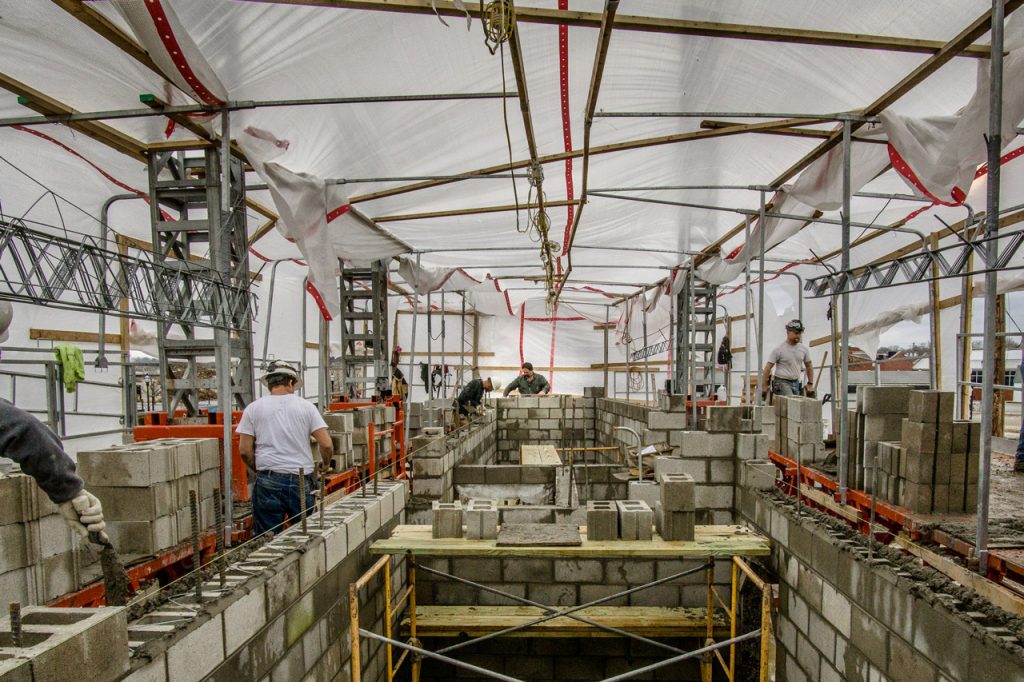
Jason McCoy places a block at the northwest corner of the east tower for the hotel being built at the River Centre.
“Watch these guys,” he explains motioning around with the trowel in his hand, “I just put that block there and they love to catch me making a mistake.”
It looks like any other block on the growing four-story supporting structure for the future 84-room Fairfield Inn and Suites. But Jason explains that a steel beam providing support for the second story floor has to sit inside the block. The correct block has a side broken out to create a u-shaped cradle for the beam to sit in.
Jason waits as the 15 or so men continue working under the temporary tent that provides marginal protection from the rain and wind. But no one has caught the block yet.
One block-layer is making his way along the 550-footwall towards the corner where the errant block sits. His head is down as he works methodically while hod carriers keep him flush in mortar and blocks.
Jason is confident the crew will catch his “mistake.” On a nearby platform, the correct block sits in plain view among the other blocks.
Laying a thousand blocks a day to meet the deadline, the crew hustles on the cross members of the hydraulic scaffolding. A call goes out for everyone to brace themselves as it is raised to accommodate the rising tower. Work stops and hands grasp anything solid for support as the platform raises about a foot.
As everyone confirms things are set and work picks back up, Jason takes a phone call. After hanging up, he explains the history behind hod carriers and the reason graduation hats are called mortarboards.
Before hydraulic platforms could be raised to the level the masons were working along with their materials, hod carriers, or laborers, balanced a three-sided box that held mortar on the end of a long pole to bring the building materials up to the masons. The scoop, or hod, of mortar, is then poured onto the flat — like the hats — mortarboard next to the mason.
“I’ve never carried a hod,” the 51-year-old mason explains. “The generation before me didn’t use them, nor the one before them but we still call the laborers hod carriers.”
Abruptly, Jason turns and climbs down the ladder stepping into the muddy mix of rock at the base of the tower. He heads toward his car parked along the RiverWalk.
Interview over, back to work.
“Hey, did you put that block there,” a crew member asks the man ending his run on the wall.
Jason is a self-made, self-taught successful business owner, sought-after expert and renowned lecturer regarding anything masonry related. At the foundation of these achievements is a self-assuredness that comes from a lifetime of figuring things out on his own.
This incredible self-confidence brought on by his trials and errors is likely what gave him the hubris to take on his first masonry project soon after high school.
With plans to become a trial lawyer, Jason joined a masonry crew to earn money to go to Indiana University. He was a hod carrier mixing mortar and supplying the masons just like his new employees these days.
As he developed his skills, his employer gave his blessing for Jason to take on small jobs of his own. It so happened that his first solo job likely cemented his own love for the trade that he had inadvertently stepped into looking for a way to pay for college.
“There has been no other job harder than that job,” Jason explained. “It was the most technically difficult job I have ever done. The hotel, the Jasper Lofts, the Vine Street Lofts, it all pales in comparison. Jacking up a house, moving a house, converting a crawlspace. It’s all easy compared to that job.”
He was asked to build two flanking curved wing walls of limestone block leading from underneath a bridge along a sloped concrete path. If he could have started from scratch, the foundation blocks would have stair-stepped the slope of the path, but with the concrete already poured, the job required leveling the blocks by cutting the slope into their base. Then, to make it even more difficult, he had to create curve the walls to follow the path.
Other masons had already turned the project down but Jason — too young to know better — decided he could do it. “I was the mortar guy,” Jason laughed. “I was ambitious though. I didn’t come from money; we came from nothing. The opportunity was there and at the time I was making $200 a week and the offer was $800 a week.”
32 years later, the walls are still standing in Ellettsville in Monroe County.

He continued to take on jobs and soon had his own crew.
“In a very short amount of time I had a staff and a lot of work lined up,” he explained. “At the time I thought I would finish this work and use the money for school.”
He was earning a lot of money for a kid just out of high school and was thankful his boss supported his endeavors.
“One year after the next, one job after the next, more employees, better jobs, more interest in the trade,” Jason said. “A lot of my friends went on to law school and are practicing law now.”
But he continued in masonry.
That ingenuity and resourcefulness amplified with self-reliance likely comes from his upbringing as a middle child raised by a single-mom who let him explore the world on his own.
“When my mom divorced, she told the realtor to find us an apartment next to a creek,” Jason said.
Living by the creek provided a route to adventure and exploration for Jason. Water is a key component in masonry failure (combined with gravity and time). So, in a way, the water that shaped his boyhood also enabled his success in masonry.
He teaches the course he created on the causes of masonry failure to architects and engineers annually. He can tell you exactly why your chimney leaks and water is infiltrating your crawlspace. Recently, he testified as an expert in a case involving the removal of a bush and how it impacted water drainage next to a home leading to masonry failure.
His expertise in success and failure came about from a mom that had to raise three kids and couldn’t necessarily hold his hand through all the facets of his growth. She moved them next to the creek, a conduit to an outdoor classroom, and Jason figured things out on his own.
“There was never a man around to guide or to teach me, but my mother never said no.” he explained.
Having never been told, “no”, “you can’t” or “maybe you shouldn’t” enabled him to experiment and fail. It never occurred to him that he couldn’t become a highly successful business owner because he never saw obstacles that couldn’t be surmounted.
“You know, I’m just doing my thing. The rest of it just happened organically,” he said. “But it didn’t occur to me that I couldn’t build that wall.”

As a kid, the outdoor classroom with life as his teacher led to revelations that, although not necessarily unique, did empower him to take on new things with a different perspective. For example, he got tired of turning screwdrivers manually while he worked on his bike, so he knocked off the handle of a screwdriver and stuck the business end into an electric drill. “I was probably five when I did it and I thought I invented the first drill gun,” Jason said.
There was also that time he thought he invented fishing. He was watching a buddy feed bread from a sandwich to the fish in the creek and saw an opportunity. He decided to stick some on a safety pin with some kite string and dangle it in the water. He caught his first fish with his invention.
“I thought, ‘I’m onto something here,’” he laughed. “But then I saw my first fishing pole at the Woolworths and was kinda disappointed thinking someone else had figured it out too.”
These early experiments aside, Jason built a successful business around the expertise that he acquired until deciding to retire and return to the more than 100-year-old family farm in Haysville about four years ago. He came back to the area to be a gentleman farmer with the acreage of orchards, horses and millions of bees.
“My mother told me that being a gentleman farmer isn’t something you aspire to, it’s something you arrive at,” he said.
But it wasn’t long before he started receiving calls for his masonry skills.
It’s his ability to solve problems. So when they were trying to figure out how to put windows in the solid brick walls of 70-year-old furniture factories or wondering if a leaning three-story wall attached to Hoosier Desk would be safe, they called Jason.
“I guess there’s more for me to do masonry-wise,” Jason said.
He opened Bramwell-McKay (you’ll have to ask him the source of the name) and put an office in The Vine on Vine Street. His crew of about 20 employees is now working on many of the residential and commercial projects going on in Dubois County.
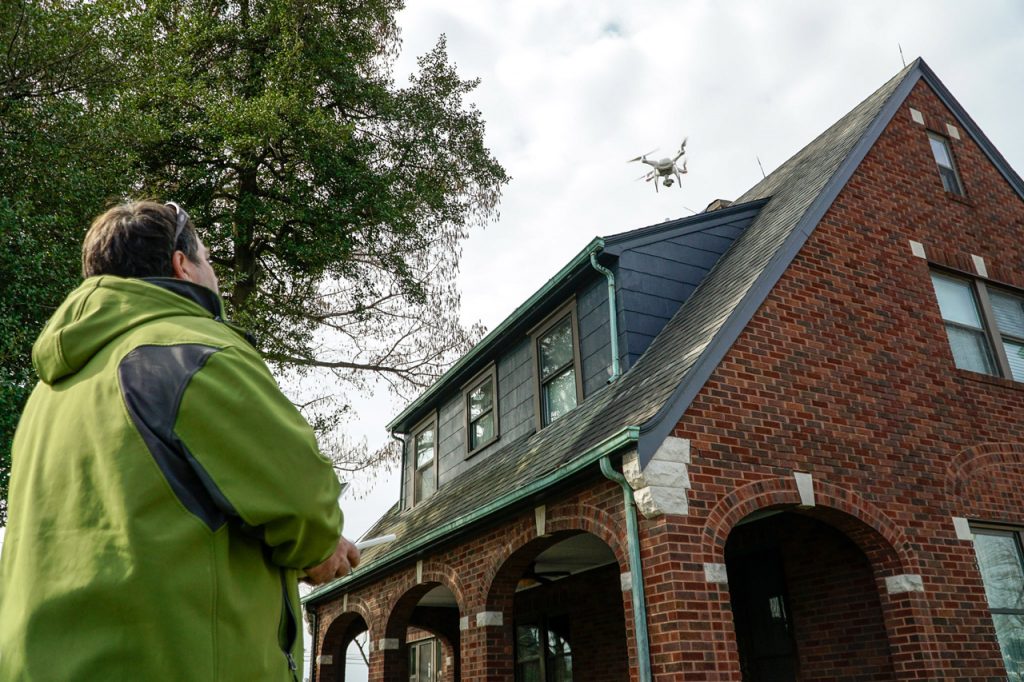
You’ll see his company name in the front yard of a historic home being jacked up to have a new foundation built underneath it as well as the rising buildings at the River Centre. He’s also restored a portion of the brick facade of the Sisters of St. Benedict Monastery, a building he has deemed the nicest historic building in the State of Indiana.
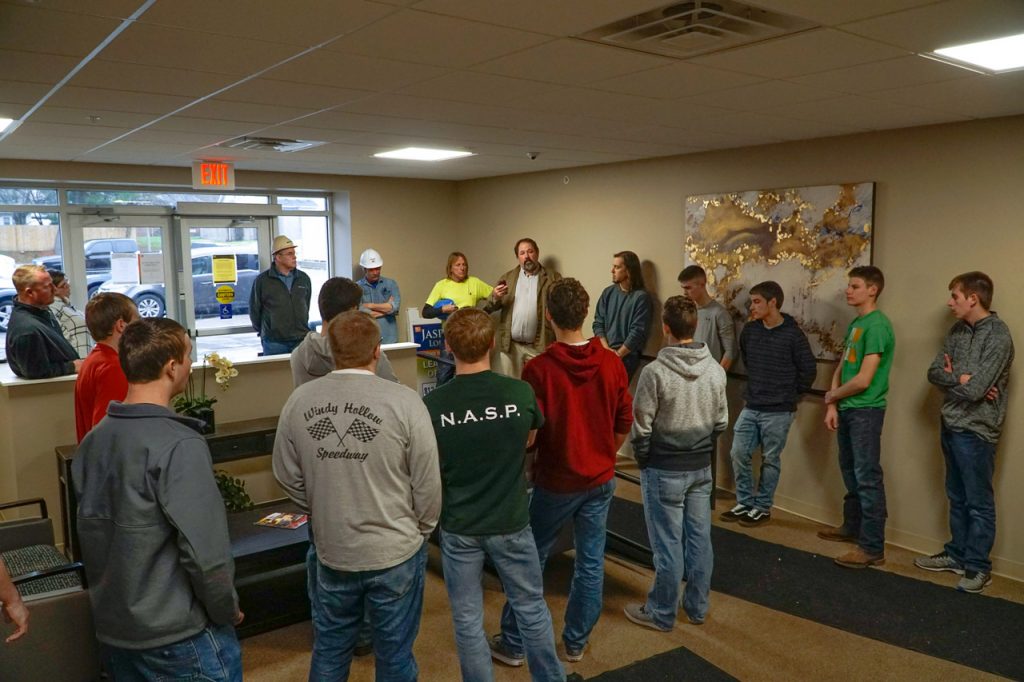
On top of raising his children, riding horses and making wedding cakes (he’s found a proclivity for working with fondant), he’s working to introduce high school students to the different career paths that are available in the construction trades while teaching his own kids about masonry.
He and his wife Robin live on the historic farm with two of their three children, Harrison and Kathryn. Their oldest, Jordan, is attending Colorado State. There’s a creek that runs through the property with a bedrock bottom that nature has fissured to look like runs of mortar.
He attributes all of his success to his mom, Frannie Arvin-Schmitt and his grandmother, Eleanor Arvin.
“I’m as happy and content as I can be with the career that chose me,” Jason said.
Learn more about his business here http://www.bramwellmckay.com/.

Great story.