Indiana Senate District 48 Q&A with Sen. Daryl Schmitt and Brad Hochgesang
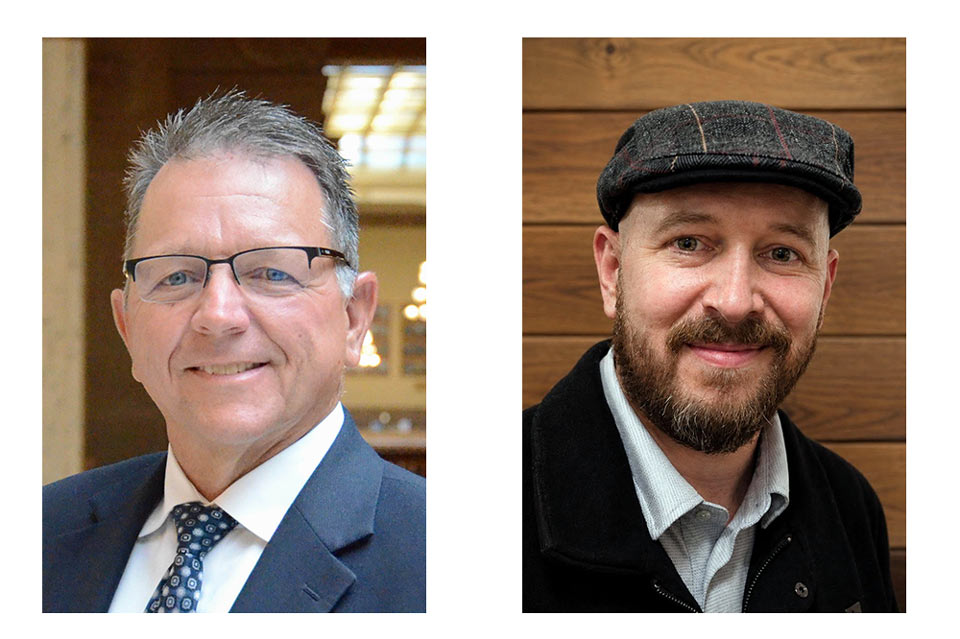
Voters in Indiana Senate District 48 will choose a state senator in this year’s general election between Republican incumbent Daryl Schmitt and challenger Democrat Brad Hochgesang.
Schmitt, a farmer, former UPS employee, and former Dubois County Council member, was chosen by a Republican caucus in September 2024 to finish Mark Messmer’s term after Messmer won the GOP nomination for Congress. This is Schmitt’s first general election for the seat.
Hochgesang owns Ninja Mojo LLC and works as a software engineer. He has been actively campaigning against the Mid-States Corridor.
What a state senator does
The Indiana Senate has 50 members. Senators serve four-year terms with no term limits, and half the seats are up every two years. Together with the 100-member House, the Senate makes up the General Assembly, which writes state law. The legislature meets every year starting in January: about four months in odd-numbered years and about two and a half months in even-numbered years.
District 48 covers all of Crawford, Dubois, Gibson, Perry, Pike and Spencer counties.
The Free Press asked both candidates the same eight questions. Their answers appear below as submitted, in alphabetical order by last name.
Question 1
What is your single top priority for this district, and what specifically would you do to deliver on it?
Brad Hochgesang
Our state government should work for the people who pay for it. For too long, the Statehouse has worked for its own members and a small network of well-connected people and businesses, and the rest of us have paid for it. We saw it with the Mid-States Corridor, which the state kept pushing after 81 percent of Dubois County voters said no, and we see it now as the biggest, richest companies in the world ask regular families to help pay for the power their data centers need. My top priority is to help change how the Statehouse works, so it works for the people of Indiana and of District 48 inside a culture of transparency, accountability, and true representation. I’ve spent my whole career using technology to solve problems, and I want to bring that to Indianapolis. Every bill should come with a plain-language explanation, a place for any Hoosier to comment, a record of who gave money to whom and how each lawmaker voted, and an alert when it touches our towns or our schools. The same light belongs on big projects: the county where one would be built should get a vote, the numbers behind it should be public, and no public official should sign a secret agreement on a deal we’re paying for. Our representatives should amplify our voices, but right now we can’t even count on them to stand with an overwhelming majority of the people they represent.
Daryl Schmitt
Affordability! Key areas to focus on in the next legislative session that speak to affordability include making inroads in reducing utility costs, continuing the reduction of individual state income tax, the reduction of homestead property taxes and continuing to reduce the number of costly unelected boards and commissions at the state level. I have worked for the last two years at the Statehouse to cut the state income tax. In 2015 the Indiana individual income tax rate was 3.4% and by 2027 it will be 2.9% We have suspended the state gasoline tax to give Hoosiers over one billion dollars in immediate tax relief. We cut burdensome regulations on homebuilders to increase the availability of affordable housing.
Question 2
SEA 1 cut homeowners’ property taxes but has squeezed local governments and schools. What would you change, if anything, in 2027 to protect police, fire, EMS and schools?
Brad Hochgesang
A tax cut should leave families better off, and it shouldn’t cost them their school or their fire department. At most of my town halls, I ask anyone whose property tax bill went down to raise a hand, and so far only two people have. Now Dubois County’s local governments have recommended raising our local income tax from 1.2 percent to 1.9 percent, as soon as 2029, to make up what the 2025 property tax law took. Someone earning $50,000 would pay about $336 more a year, more than they’d save even with the largest credit that the property tax bill offers. A family renting in Jasper or Huntingburg gets no property tax break and pays the whole increase. The governor and the legislature said this law would move decisions closer to the people, but they took away the tools our towns, counties and schools use to pay for the things we all need. In 2027 I would push for three changes. First, the state should cover the shortfall for schools, police, fire and emergency medical services from its reserves while the legislature writes a lasting fix. Second, cities and counties should keep a dedicated income tax for police, fire and ambulance service, which the law ends after 2027. Third, the legislature shouldn’t pass another tax change until every county knows what it will lose and how the state will cover it. The state took the credit for cutting taxes, but a lot of families here will come out behind.
Daryl Schmitt
Hoosiers have overwhelmingly demanded property tax cuts. I will not allow our seniors, veterans or other Hoosiers that are struggling to be forced out of their homes because of high property taxes. According to the latest revenue projections, Dubois County and every municipality in Dubois County will receive a minimum 4.1% increase in revenue from 2027 through 2029. All four county schools are projected to receive between 1.9% to 5.4% increase from 2027 through 2029. Guided by our family and faith-based values, I will ensure that we adequately fund all essential services and continue to increase funding for the education of our children.
Question 3
A record 38 districts, including Southeast Dubois and Pike Central, are asking voters to raise property taxes to offset SEA 1. The state’s reserves are projected above $5 billion, per Gov. Braun’s office. Why should schools rely on local referendum votes to get funding?
(Editor’s note: We should have clarified in our question that Southeast Dubois is asking voters to continue its previously approved referendum, not asking voters to raise property taxes)
Brad Hochgesang
They shouldn’t. Whoever makes a mess should clean it up. The state created this shortfall. The legislature cut what our towns, counties and schools can collect, and it never had to cut a dime of property tax from its own budget, because the state doesn’t collect any. Then it dictated rules governing how local governments can raise and spend what’s left. Towns under 3,500 people, like Ferdinand, Petersburg and Rockport, can’t set an income tax of their own, so they have to rely on the county, and the county can keep up to three-quarters of the money set aside for them. County councils can’t share that tax with their own schools at all, and a school gets one shot at a referendum every two years. That isn’t local control. Southeast Dubois is asking voters to renew up to $1.2 million a year to keep class sizes down and keep its teachers because of lost property tax revenue. Rural schools are getting shortchanged by the state. Southeast Dubois County School Corporation ranks 19th from the bottom in Indiana in state funding per student, so a single lost referendum could cost that community teachers and programs for years. I’d vote to use state reserves to make schools whole. I’d give county councils back the choice to share their local income tax with their own schools. In short, I believe we should equip our schools, towns, and counties with every tool we can, not take them away. No voter should have to choose between their property tax bill and their kids’ and grandkids’ school.
Daryl Schmitt
In my opinion these are three separate questions that need three different answers.
3a) A record 38 referendums:
Part of the reason for the record number of referendums this fall is that SEA 1, from 2025, required all referendums to be in the fall, rather than split between the primary and general election. The thought process being there is normally a higher turnout in the fall where more voters will participate in the decision-making process. Southeast Dubois Schools referendum isn’t a tax increase. It’s a continuation of current funding. SEA 1 did not reduce overall average state school revenue. It just slowed down the rate of revenue growth.
2023 average school revenue increased over previous year+11.8%
2024 average school revenue increased over previous year+6.9%
2025 average school revenue increased over previous year+6.5%
2026 average school revenue increased over previous year+3.2%
3b) $5 billion in reserves
Property taxes are collected, managed and distributed locally. The state of Indiana receives no property tax revenue. It’s in the Indiana State Constitution that Indiana must have a balanced budget. Indiana tries to keep between 3-4 billion dollars in reserve. State revenues in 2026 have been coming in better than projections, which has given us a 1-1.5-billion-dollar surplus. Sound financial management and increased state revenue has given Indiana the opportunity to suspend the state gasoline tax and save Hoosiers approximately one billion dollars.
3c) Why should schools rely on local referendum votes
I think school referendums are an important opportunity for residents to be involved in the decision-making process and have their voice heard. I want to see as much local control as possible. I would rather have us make more decisions locally, not pushed down from Indianapolis or from bureaucrats in Washington DC.
Question 4
Should the state regulate the development of data centers? Should the state limit data center tax breaks/abatements and ban nondisclosure agreements? What should state versus local government decide?
Brad Hochgesang
If a data center comes to a town, it should benefit the people living there. They should have a say, and the data center should pay its own way or build someplace else. The state should regulate any new or expanding data center that draws 20 megawatts of power or uses 100,000 gallons of water a day, counting the whole campus. The state should give our communities their say: the county council where one would be built should have to vote yes after a public hearing, public officials should be barred from signing nondisclosure agreements on the deal, the real company and owners behind the data center should be named, and every study and every number on power and water use should be public. Right now a 2025 law only requires these companies to cover 80 percent of the cost of new power plants built for them. Regular people, ratepayers like you and me, are charged for the rest. The companies should pay for new power plants connected to the grid, and the power those plants produce should cover the needs of the data center plus an additional ten percent to lower electric rates in the county where each one sits. Diesel and gas generators on site must be for emergencies only and wouldn’t count toward the power they produce. The developer should also pay for studies showing that nearby wells, the local water utility, and the sewer system can handle the demand. This year, Republican lawmakers filed one bill to end the state’s sales tax break for these data centers and another aimed at the electric rate increases they cause, and the legislature stripped the first and never heard the second. Counties should decide what local tax breaks they offer, but the state’s sales tax break should end unless these companies pay their own way. I won’t take money from these companies. Our electric bills shouldn’t pay for a giant tech company’s power plant.
Daryl Schmitt
I think that data center development should be a local community decision. There should be no state tax breaks or abatements for data centers. I believe that nondisclosure agreements should be eliminated or extremely restricted.
Question 5
Do you support the Mid-States Corridor as currently proposed, yes or no? Why?
Brad Hochgesang
My answer is no. When over four out of five people in a county say no, their senator should say no with them. According to the poll I commissioned, 81 percent of Dubois County voters oppose the corridor, and our statewide poll found 85 percent of Hoosiers say the state should respect local opposition to a highway project. The state kept planning it anyway. A board made up mostly of local business owners steered the first study, about 50 private companies paid for close to half of it, and most of them kept their names secret. Taxpayers will pay for the road. The state has canceled over 300 road and bridge projects, and even the Republican who chairs the House roads committee asked how the state could do that and still spend a billion dollars on a brand-new roadway. Spencer County got its four-lane to I-64 in 2011, and since then they have lost about 4 percent of their population while Indiana grew almost 8 percent. I don’t call that progress. I’d rather fix the roads we already drive on than hand the bill for someone else’s highway to the people who said no.
Daryl Schmitt
I have never taken a position for or against the Mid-state’s corridor. The Legislative branch of state government is prohibited by the Indiana State Constitution from determining where roads and bridges are located. Anyone that runs for a position in Indiana Legislature and suggests they are going to change a version of a specific potential road are misrepresenting their influence. Road placement is determined by the Executive branch of Indiana government.
Question 6
If there is another push for congressional redistricting in 2027, would you vote for it, and why?
Brad Hochgesang
You don’t change the rules in the middle of the game just so your team can win. Most Hoosiers opposed redrawing the maps, and in December 2025 the Indiana Senate voted 31 to 19 against it. Then outside groups spent millions in this spring’s primaries to defeat Republican senators who voted with their constituents, and five of those senators lost. Those groups wanted every senator to know that voting with the people back home can cost them their seat. I’d vote no in 2027. Indiana draws its maps once every ten years, after the census, and I would keep it that way. The people of District 48 are my boss, and no amount of outside money changes that.
Daryl Schmitt
It is not prudent to speculate on potential legislation that has not been written. Any potential legislation would require a thorough review before I could comment on my support or objection.
Question 7
Should the state set statewide rules for license-plate-reader cameras like Flock, such as requiring a warrant to search stored data, limiting retention, and requiring audits?
Brad Hochgesang
Yes. Where you drive is your own business, and we can’t trust shareholders with our private data. I support all three. I don’t want government or out-of-state investors watching everything we do. I’ve spent twenty years building and managing databases. Any database that holds where people drive will get searched for the wrong reasons, and sooner or later someone will break into it. In Indianapolis, five police officers have been accused of using these cameras to track romantic partners and spouses. I’d support a bill that requires a warrant to search stored data, deletes plate data within a week unless it’s tied to a case, bans selling or sharing it with data brokers, and requires regular audits with the results made public. Our police departments should have the best tools available to fight crime, and they can have them without handing our private data to private companies. Police could still get an alert on a stolen car or a missing child.
Daryl Schmitt
The license plate readers are a valuable tool for law enforcement. However, if they are allowed to continue, there needs to be increased transparency with guardrails set in place to provide both safety and privacy to our residents. Ben Frankin is quoted as saying: “Those who would give up essential liberty, to purchase a little temporary safety, deserve neither liberty nor safety”
Question 8
Many voters say politicians don’t listen. What specifically will you do in Dubois County to change that?
Brad Hochgesang
If you want to know what people think, you have to ask them. I’ve held nearly twenty town halls, most of them in Dubois County, in Jasper, Huntingburg, Ferdinand, Ireland, St. Anthony and Dubois, at night and on weekends when most working people can come. Republicans and independents have moderated some of them and sat on the panel at others. I’ve commissioned multiple polls to find out what my neighbors think, but polls and town halls aren’t enough. You have to seek out the people most affected by a decision. You have to tell the entire district what’s going on at the Statehouse. Then you have to act on what you hear. If you send me to Indianapolis, you can be assured that I will come to you on issues that affect Dubois County. I won’t assume I know how you want me to vote. I’ll ask you first. I won’t wait until I’m campaigning to hold a town hall. I’ll hold them in Dubois County every year, and after each one I’ll publish what people asked and what I did about it. Representation is the foundation of my candidacy and this campaign. If I’m elected, I’ll use my skills to find and build ways for anyone in District 48 to easily weigh in on the bills I’ll vote on, because my vote belongs to the people I represent.
Daryl Schmitt
During my first two years as your State Senator, I have attended at least one meeting of each fiscal unit; including town, city, and county councils, and commissioner meetings, across all six counties. I have been to many of these councils and commissions multiple times. Additionally, I have attended many township advisory board meetings, many fire department meetings, many fire district meetings and had individual town hall style meetings in all 6 counties. I have visited 9 of the 14 school systems in district 48 with a goal of visiting the rest in the next year. I’ve worked diligently to be present in each county two or more times each month by attending many church, community, and individual non-profit organization events each month. Most elected officials in District 48 have my cell phone number and I encourage them to reach out with questions, concerns, and requests. I truly am here to listen, learn, and advocate. I intend to continue showing up to understand the needs of Senate District 48 and be a megaphone for District 48 residents at the Indiana State House.
How to vote
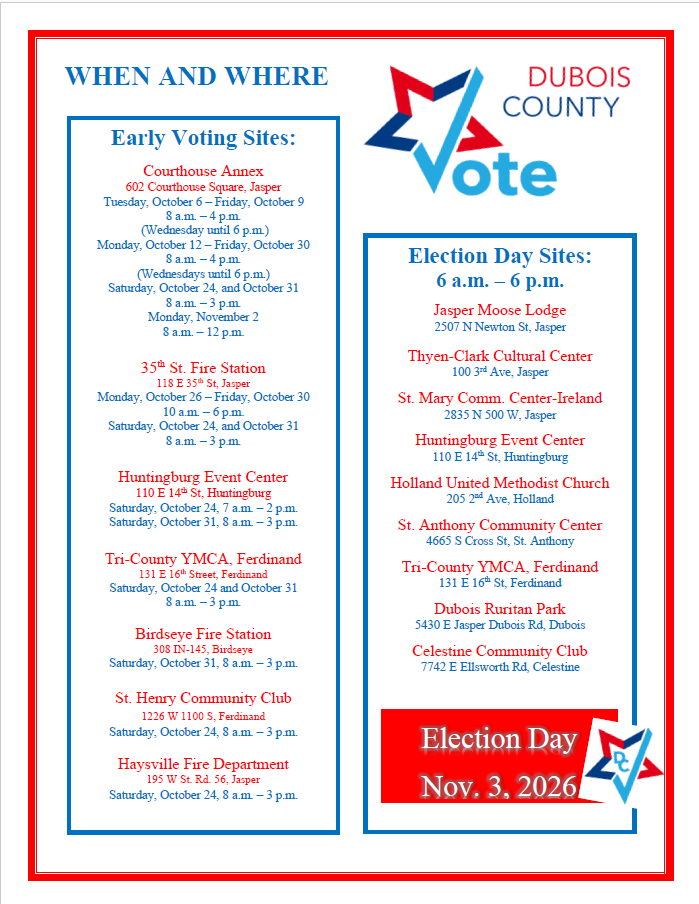
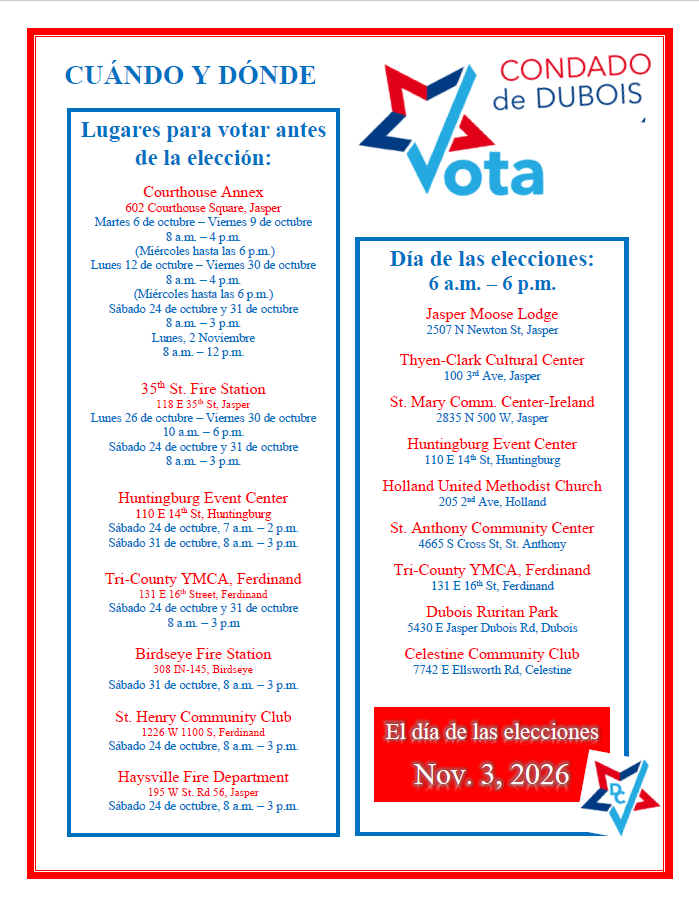
Polls are open 6 a.m. to 6 p.m. on Election Day. Dubois County uses vote centers, so any registered county voter can vote at any open location. Voters need a valid photo ID.
Early voting continues at the Courthouse Annex, 602 Courthouse Square in Jasper, weekdays from 8 a.m. to 4 p.m. See details in the flyers below.