
Indiana House Republicans OK massive local property, income tax plan that Democrats dub a ‘scam’
by Leslie Bonilla Muñiz, Indiana Capital Chronicle
April 11, 2025
A gargantuan local property and income tax plan — alternately dubbed a “great win” by Republicans and a “scam” by Democrats — cleared the Indiana House of Representatives on Thursday. The 65-29 vote was decided largely along party lines.
It came a day after lawmakers made sweeping edits with Gov. Mike Braun’s blessing. And the Senate appears poised to consent to the changes.
“SB1 offers meaningful tax relief for Hoosiers. The plan to CUT, CAP, and REFORM means relief now and systemic changes for the future to protect taxpayers,” Braun posted on social media. “Thank you to the House for their hard work and I look forward to the Senate sending this to my desk for signature next week!”
Senate Bill 1 would save homeowners a collective $1.2 billion in property taxes over three calendar years, from 2026 through 2028, according to a Thursday fiscal analysis. It does so largely by creating a credit for 10% off every homestead’s bill, up to $300 each.
Rep. Jeff Thompson, R-Lizton, dubbed it a “great win for Hoosier taxpayers” Thursday.
Thompson, the House GOP caucus’ tax and budget head, said about two-thirds of homeowners would pay less in 2026 than this year under the overhauled legislation.
But local units of government would lose a projected $1.5 billion over the three years, per the analysis. Public school corporations alone represent about half the loss, at $744 million — although Democrats contend other tax changes push that figure to almost $800 million.
“It’s a loser for schools,” Rep. Greg Porter, D-Indianapolis, told the chamber. House Speaker Todd Huston talks to reporters on Thursday, April 10, 2025, after his caucus overwhelmingly approved its take on a massive local tax plan. (Leslie Bonilla Muñiz/Indiana Capital Chronicle)
In comments to reporters Thursday, House Speaker Todd Huston, R-Fishers, noted that estimates for local government losses are based on projected revenue. He urged greater focus on year-over-year collections.
“I’m going to push back on everybody that says, ‘Well, we would have collected ‘x.” Before you say it’s a cut, what did you collect last year? And what are you collecting this year? And then tell me what the numbers are,” Huston concluded.
Local income tax turmoil entraps governor
House Democrats accused their GOP colleagues of strong-arming local units of governments into raising local income taxes to make up property tax revenue losses.
The legislation caps total local income tax rates for all counties to 2.9%, down from 3.75%. Municipalities would be authorized to impose rates up to 1.2% within that county total — a tool they have not had before. Under current law, they have to get county officials on board to nab a local income tax.
“This plan is a trick. It’s a scam. It presumes Hoosiers can’t understand that 2.9% of their income is a lot more money than a $300 property tax credit,” House Minority Leader Phil GiaQuinta, D-Fort Wayne, told reporters during a Thursday news conference.
“Statehouse Republicans are telling you they are cutting property taxes so they can score political points,” he continued. “But let me tell you the truth … They’re forcing our local servants to take the heat for raising your taxes.”
Rep. Mike Andrade, D-Munster, called the measure “a bait and switch” in which “local governments are left with no choice but to raise income taxes or slash critical services to subsidize the revenue loss.”
Thompson pushed back, noting the new, lower cap actually “slashes” untapped local income tax capacity from $5 billion to $3 billion. That didn’t satisfy Democrats.
Rep. Ed DeLaney, D-Indianapolis, said it still would allow local governments to hike income taxes by three times more than what homeowners would save in property taxes. Gov. Mike Braun holds a sign at a property tax rally on March 17, 2025. (Whitney Downard/Indiana Capital Chronicle)
“I don’t think that would happen,” he said of locals. “But, Braun math says (that) if I save you a nickel in your left pocket, I can take 15 nickels out of your right pocket.”
House Speaker Todd Huston offered vehement defense in a rare speech from the floor.
“The idea that this is a bait-and-switch is comical … because at the end of the day … we are providing taxpayer relief. We are,” Huston told his colleagues.
The local income tax furor appeared to trouble Braun.
“I have heard from several Hoosiers since my property tax deal was announced yesterday who are concerned about the local income tax provisions in the bill. Let me be clear,” he wrote in a Thursday morning social media post. “I agreed to a deal that delivers meaningful property tax cuts … and cuts the total local income tax rate by 23% from 3.75% to 2.9%.”
Although Braun wrote he “trust(ed)” that’s what was in the massive amendment approved Wednesday, his team was still examining the document “line by line to verify all of the language matches the deal.”
“If we find errors or it doesn’t do what I agreed to then I am confident the House and Senate will make needed edits to honor the deal before I allow it to become law,” he added.
Asked if there was confusion over what was in the deal, Huston told reporters, “There’s no confusion on my end. We’ve laid out all along what was in the bill.”
Accelerate Indiana Municipalities, representing cities and towns, indicated such hikes could come.
“We are glad there is targeted relief for property taxpayers, but this comes with the likelihood of significant cuts to the property tax base that will need to be evaluated in the coming years,” CEO Matt Greller said in a statement to the Capital Chronicle. “In communities where it makes sense, and the determination is made that additional local option income tax capacity would be adequate to recover lost funding, we are happy to see the decision to do so granted to municipal government.”
Other Hoosiers also save
Fixed-income seniors would get an additional $150 discount off their property tax bills stacked atop the $300 maximum available to the general population. Disabled veterans could also qualify for stackable credits of $150 and $250.
In exchange, lawmakers nixed assessed-value based deductions for both populations.
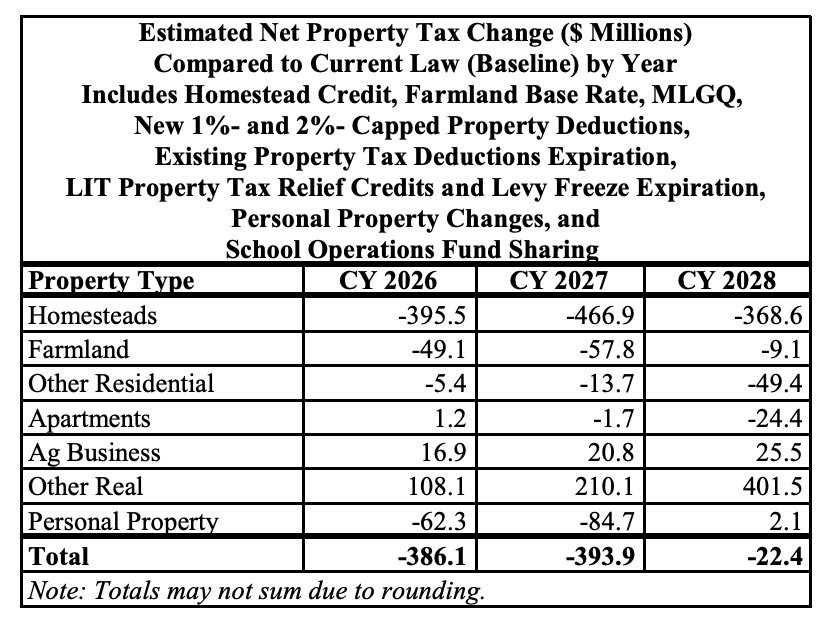
Here is how different types of property will be effected by Senate Bill 1 if it becomes law. (Fiscal analysis by the Legislative Services Agency)
“This is a win for disabled veterans, moving to a credit,” Huston told reporters. “There are a lot of people — if you’re at the cap, you don’t even get the benefit of the deduction. This gives you a credit right off the bottom of your tax bill.”
His colleagues also said that modest per-person savings are still meaningful.
“I have heard some people say that an extra $200 or $300, or $500 or $700, is not worth lowering property taxes,” said Rep. Becky Cash, R-Zionsville. “We know that’s not true,” she said, citing how hard public retirees have fought to win a pension benefit bonus that may be worth less.
“This bill may not go far enough, but it does offer some relief,” Cash added. “The people’s money belongs to the people, and I cannot, in good conscience, keep one extra dollar from a family.”
Democrats, however, critiqued the measure for not providing direct relief to tenants, who pay property taxes indirectly via rent.
“This $300 credit, they’re not going to get it. Their landlords may get it, but does anybody here think the landlords want to pass that on to their renters?” asked Rep. Sue Errington, D-Muncie.
Senate Bill 1 also commands the Indiana Department of Local Government Finance to develop a property tax transparency portal by 2026. The portal would let Hoosiers provide feedback and compare their current liabilities to what they’d owe “based on changes under a proposed tax rate.”
Other taxpayers would get relief too, according to the analysis.
Over three years, it would cut property taxes by about $25 million for apartments, almost $69 million for other residential properties, $116 million on farmland and $145 million on personal property. But bills for agricultural business and other real properties would rise by $63 million and $720 million, respectively. Senate President Pro Tempore Rodric Bray answers reporter questions on Thursday, April 10, 2025. (Casey Smith/Indiana Capital Chronicle)
That adds up to about $802 million in savings across other property types.
The overhauled legislation additionally phases in a major increase in the acquisition cost threshold for the business personal property tax exemption — from $80,000 to $2 million — and narrows application of the 30% depreciation floor. It previously would’ve phased the tax itself out by 2030 on anything purchased this year or later.
“This is a smart, pro-growth reform that will reduce compliance burdens and unlock investment across Indiana,” said Vanessa Green Sinders, the president and CEO of the Indiana Chamber of Commerce, in a news release. She added that the changes “directly benefits small- and medium-sized business owners in every corner of the state.”
Four lawmakers defected from their parties in the vote: Republican Reps. Craig Haggard, Andrew Ireland and Ethan Manning voted in opposition, while Democratic Rep. Wendy Dant Chesser voted in support.
Senate Bill 1 next returns to the Senate for either a tidy concurrence with the House overhaul — one was already filed Thursday — or to set up complex negotiations over a final version of the legislation. Senators could vote to approve the concurrence as soon as Monday, although they could also back choose to dissent instead.
“Our caucus members have (been) looking at some runs and making sure they understand how it affects their local communities, and so we’ll continue to talk about that over the weekend,” Senate President Pro Tempore Rodric Bray told reporters.
“But it is our strong hope that we’ll be able to concur on that,” Bray, R-Martinsville, added.
Senior Reporter Casey Smith contributed.
GET THE MORNING HEADLINES.
SUBSCRIBE
Indiana Capital Chronicle is part of States Newsroom, a nonprofit news network supported by grants and a coalition of donors as a 501c(3) public charity. Indiana Capital Chronicle maintains editorial independence. Contact Editor Niki Kelly for questions: info@indianacapitalchronicle.com.

