Indiana House District 74 Q&A
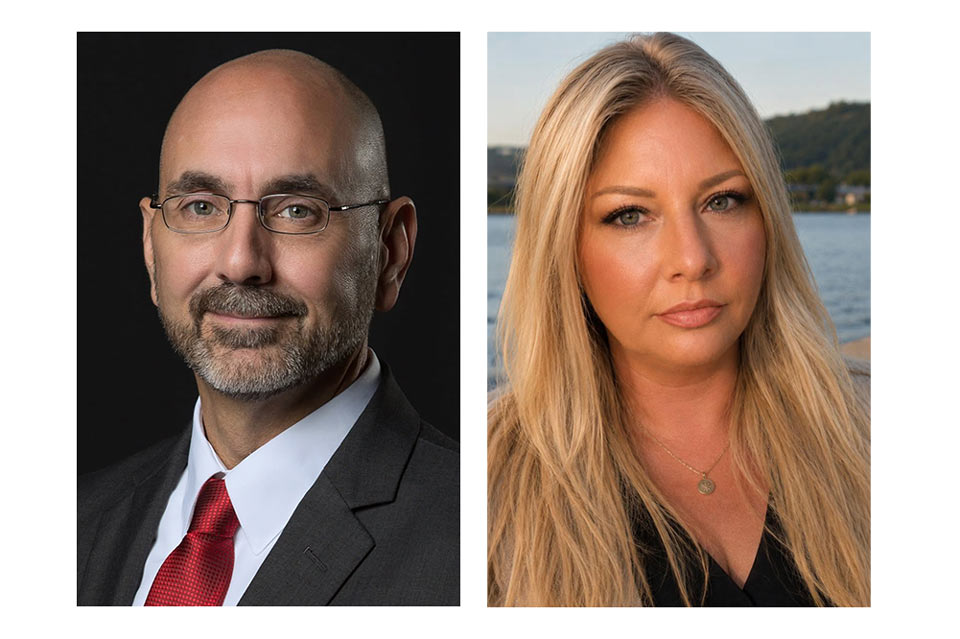
Voters in the southern portion of Dubois County have two candidates to choose from for Indiana House District 74. Republican incumbent Stephen Bartels of Eckerty is seeking reelection. Democrat Lena Goffinet of Tell City is challenging him.
Bartels has held the seat since November 2017, when a Republican caucus chose him to replace Lloyd Arnold. He chairs the House Veterans Affairs and Public Safety Committee. In May, Gov. Mike Braun picked him to chair the Indiana Defense Task Force. His campaign website lists about 22 years of military service, retiring as a major, and nine years as an Indiana police officer. It also lists ownership of Patoka Lake Marina and Patoka Lake Winery, and service as the Crawford County Council president.
Goffinet’s campaign website describes her as “a social worker, lifelong Hoosier.” She was born and raised in Perry County, lived for several years in Hamilton County, including Fishers, and moved back to Perry County in 2013. She holds a bachelor’s degree in psychology from Purdue University and a master’s in social work from Indiana University. The site says her career has included child welfare, mental health and outpatient therapy, home-based family services, correctional mental health and community resource advocacy. It also lists volunteer work with the American Red Cross. The site lists her priorities as working families, mental health access, public education, protecting vulnerable children and older adults, and helping rural communities.
What a state representative does
The Indiana House has 100 members. Representatives serve two-year terms with no term limits, so every seat is on the ballot every two years. Together with the 50-member Senate, the House makes up the General Assembly, which writes state law. The legislature meets every year starting in January: about four months in odd-numbered years and about two and a half months in even-numbered years.
District 74 covers all of Crawford, Perry and Spencer counties and parts of Dubois and Orange counties.
The Free Press sent the same eight questions to both candidates. They were the same questions sent to the District 63 candidates. Goffinet returned her answers. Bartels did not provide any answers despite several requests and a deadline extension to Friday, October 30, 2026.
The Free Press will publish his answers if he sends them before election day.
Goffinet’s answers appear below as submitted.
Question 1
If elected, what is your single top priority for this district, and what specifically would you do in your first year to deliver on it?
Lena Goffinet
My top priority for District 74 is ensuring access to quality healthcare in rural communities. That includes both physical and mental health services, which are equally important to our well-being and quality of life. Some rural hospitals are at risk of closing, while others face the possibility of being acquired by larger, for-profit healthcare systems.
While the broader issue of prioritizing patient care over profits requires a national conversation, Indiana can take meaningful steps by properly funding Medicaid and ensuring our most vulnerable populations, including children, people with disabilities, and older adults, can access the care they need.
We should also expand Medicaid coverage to help Hoosiers who cannot afford insurance through their employers or the marketplace. Families are facing skyrocketing premiums, sometimes exceeding $1,000 per month, along with thousands of dollars in out-of-pocket costs before their insurance provides substantial coverage. Wages are not keeping pace with rising costs, and families are telling me that maintaining health insurance is becoming increasingly unrealistic. Yet access to healthcare is essential to their well-being and financial security.
Let’s invest in keeping Hoosiers healthy.
Question 2
SEA 1 cut homeowners’ property taxes but has squeezed local governments and schools. What would you change in 2027 to protect police, fire, EMS and schools?
Lena Goffinet
The property tax changes under SEA 1 are being phased in over several years, with the full effects unfolding through 2031. The amount of relief homeowners experience will vary, and many may find that their savings are less significant than they expected.
At the same time, these changes reduce the property tax revenue available to local governments, which rely on those funds to support essential services such as public safety, education, and infrastructure. Those needs remain, even as local governments face funding challenges.
Indiana law allows local governments to use local income tax (LIT) revenue to help offset certain property tax revenue losses. Depending on local decisions, this could mean a greater reliance on income taxes rather than property taxes. We need to consider who ultimately bears the tax burden and whether working families are being asked to shoulder too much of it.
One possible solution worth examining is whether highly profitable commercial interests could contribute more toward funding essential public services. Any changes would require careful analysis to ensure they are fair and effective.
Hoosier families must be prioritized, and local governments must have the resources to provide essential services. Property tax relief should not come at the expense of the communities that depend on those services.
Question 3
A record 38 districts, including Southeast Dubois and Pike Central, are asking voters to raise property taxes to offset SEA 1. The state’s reserves are projected above $5 billion, per Gov. Braun’s office. Why should schools rely on local referendum votes to get funding?
[Editor’s note: The question should have made clear that Southeast Dubois is asking to renew an existing referendum, not seeking a new property tax increase.]
Lena Goffinet
Indiana should use its budget surplus responsibly to help address the growing affordability crisis facing Hoosier families. I am hearing from fellow citizens who are struggling with rising costs and worrying about how they will make ends meet.
The leaders elected in 2027 need to focus on using our available resources effectively and responsibly. That means protecting essential services, addressing pressing needs, and avoiding unnecessary additional financial burdens on families.
Maintaining responsible reserves is important, but we must also recognize that a budget surplus has little value to struggling Hoosiers if we fail to use our resources to address the challenges they face today. We need a balanced approach that protects the state’s financial stability while helping families through this difficult economic period.
Question 4
Should the state regulate the development of data centers? Should the state limit data center tax breaks/abatements and ban nondisclosure agreements? What should state versus local government decide?
Lena Goffinet
I am not in support of data centers with current information.
Indiana needs to stop offering new tax abatements and incentives for data centers until their long-term costs and benefits can be thoroughly evaluated. These facilities can create concerns about noise, pollution, water consumption, energy demand, and the potential effects on utility rates and property values. We need to understand how these projects will affect the communities expected to live with them for decades.
We must also examine the actual economic benefits. How many permanent jobs will these facilities create? How much public revenue will they generate after tax incentives? Who will pay for necessary infrastructure, and what happens when a facility becomes obsolete or closes?
I support a moratorium on new data center projects until independent studies can assess their environmental impacts, economic benefits, infrastructure costs, and potential effects on residents. We also need transparency regarding utility agreements and other commitments made on behalf of the public.
Residents deserve honest, complete information about projects that affect their communities. Government agencies and elected officials should be accountable for the decisions they make, and constituents should have a meaningful opportunity to be heard before those decisions are finalized.
Question 5
Do you support the Mid-States Corridor as currently proposed, yes or no? Why?
Lena Goffinet
I do not support the Mid-States Corridor as currently proposed. The project carries an enormous potential price tag, with estimates I have seen reaching approximately $2 billion, and I have concerns about the level of local support.
At a time when Hoosier families are struggling with affordability, we need to prioritize essential services and investments that directly improve people’s lives. Healthcare, education, public safety, and maintaining our existing infrastructure deserve serious attention.
We should carefully evaluate whether the proposed corridor’s costs, benefits, and long-term consequences justify such a significant public investment. Our transportation priorities should reflect the needs of the people who live and work in these communities, not simply the priorities of elected officials.
Question 6
If there is another push for congressional redistricting in 2027, would you vote for it, and why?
Lena Goffinet
I oppose mid-decade redistricting in 2027. I am concerned that this effort is being driven by partisan interests and could be an attempt to improve Republican electoral outcomes.
The current district boundaries were drawn under Republican leadership. More importantly, redistricting must follow the Indiana Constitution and applicable law. We should not change district boundaries simply because a political party believes doing so could improve its chances in an election.
Our constitutional requirements are not optional. If changes to the redistricting process are desired, they should be pursued through the appropriate legal and constitutional procedures. Hoosiers deserve fair representation and confidence that election rules are being followed consistently, regardless of which party benefits.
Question 7
Should the state set statewide rules for license-plate-reader cameras like Flock, such as requiring a warrant to search stored data, limiting retention, and requiring audits?
Lena Goffinet
I support a statewide moratorium on the use and expansion of Flock cameras until Indiana establishes clear legislation governing their use. Technology is advancing faster than the laws designed to protect our privacy and civil liberties.
Automated license plate readers can assist law enforcement in certain investigations, but they also raise serious concerns about surveillance, data retention, information sharing, and who can access the information collected. Without clear safeguards, oversight, and accountability, these systems risk infringing on Hoosiers’ privacy and constitutional rights.
Before these systems are widely deployed, Indiana should establish clear rules governing authorization and access, data retention and sharing, oversight, training, and meaningful penalties for misuse. We also need safeguards to ensure that access to information is documented and can be audited.
Public safety and constitutional rights are not mutually exclusive. We can give law enforcement appropriate tools while ensuring that government surveillance is subject to reasonable limits, transparency, and oversight.
Question 8
Many voters say politicians don’t listen. What specifically will you do in Dubois County to change that?
Lena Goffinet
If elected to represent District 74, I would make regular meetings and listening sessions in Dubois County a priority. The people who live and work in the county are the experts on their own communities. Effective representation requires listening to their experiences, understanding their concerns, and maintaining open, two-way communication.
I have priorities that I believe can improve our quality of life, including healthcare access, education, Medicaid, and affordability. However, I also recognize that every community has unique needs and challenges that deserve attention.
I want to develop a plan for representing Dubois County that includes input from as many residents as possible. Constituents should know what their representative is doing at the Statehouse, have opportunities to ask questions and provide feedback, and feel confident that their voices are being heard.
Representation should never be a one-way conversation. It should be an ongoing partnership focused on finding solutions and improving the lives of the people we serve.
How to vote
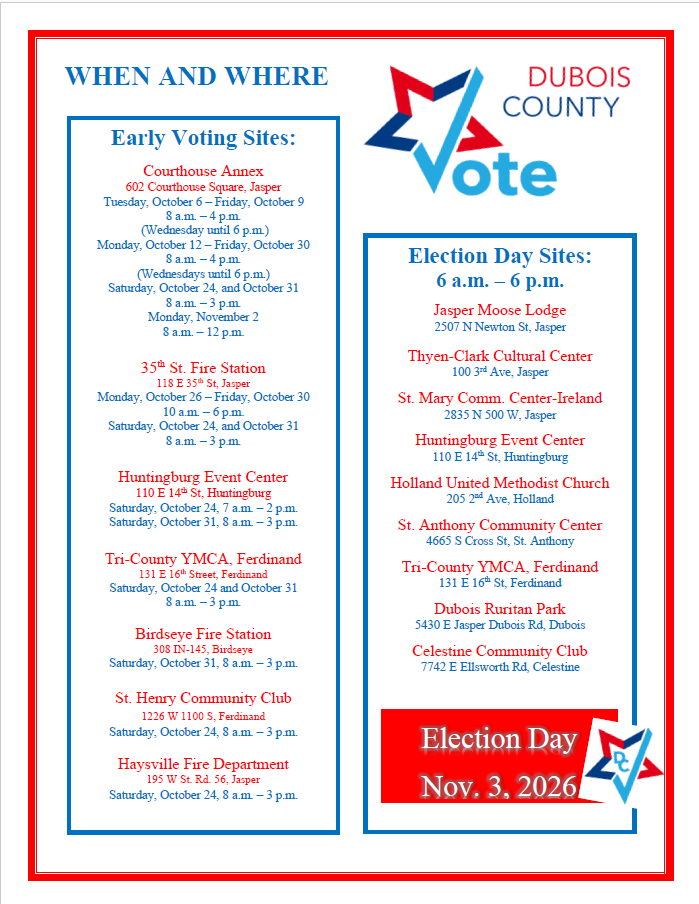
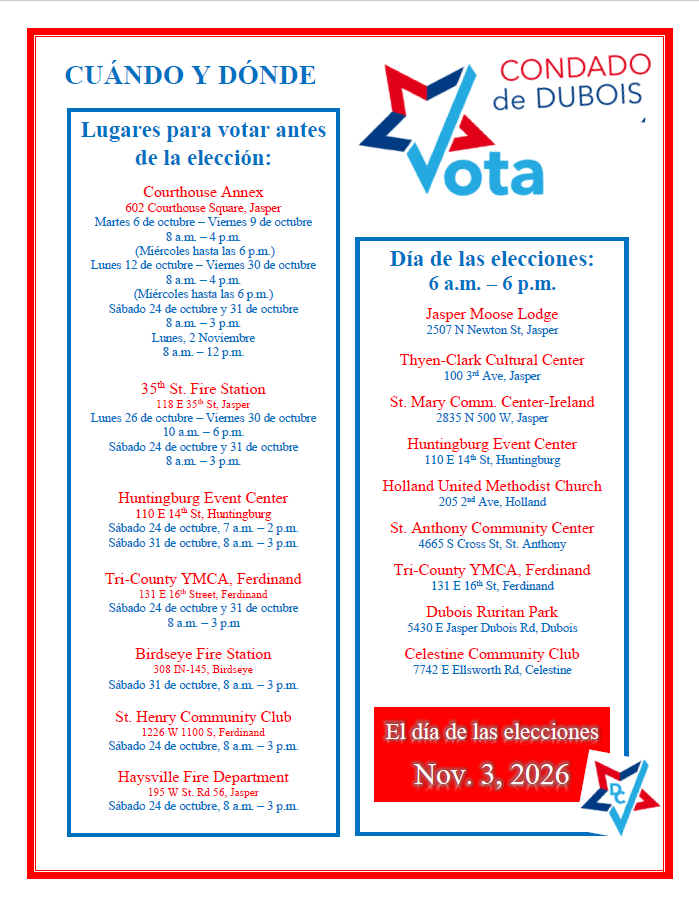
Polls are open 6 a.m. to 6 p.m. on Election Day. Dubois County uses vote centers, so any registered county voter can vote at any open location. Voters need a valid photo ID.