
In search of the lost
Some things are far too important to forget, while others may be too painful to remember
Barbara Mohr remembers it like it was yesterday.
Her father-in-law, by then an elderly wheelchair-bound gent, just needed to tell his story.
“You know Bob [Barb’s husband, Robert “Bobo” Mohr] was not our oldest,” he began.
He went on to tell of a harrowing experience. This was to be the couple’s first child. His wife had passed her ninth month of pregnancy and was into the tenth. By this time the infant, still in utero, weighed 17 pounds and by the time her labor began he was stillborn.
This was back in the early 1930s, before Cesarean sections became as common as May dandelions. Doc Backer had to remove the baby boy in pieces. He tasked Mr. Mohr with burying his son’s remains.
Mr. Mohr told Barb he wrapped the infant in a blanket, placed him in a box and carried his child to the west-facing hillside, down from the Chapel on the Hill but outside the bounds of St. Ferdinand Church Cemetery.
He chose a spot not far from the road and not far off the path that led straight up the hill to the chapel doors.
“He wanted to take me and show me the spot right then and there,” Barb recalls. But he was in tears and also in a wheelchair, so she changed the subject.
“I could kick myself for not having him show me,” Barb says today.
According to her sister-in-law, Vita [Mohr] Voegerl, their parents never mentioned this loss to their children, although they knew an elder brother had died.
Why, one might ask, did the father have to bury his son in an unmarked grave on a hillside outside the hallowed ground of the church cemetery?
It might be hard to believe in 2016, but prior to Vatican II, which formally opened under the pontificate of Pope John XXIII on October 11, 1962 and closed under Pope Paul VI on the Feast of the Immaculate Conception in 1965, stillborn or miscarried children and anyone who had not been baptized in the Catholic faith could not be buried in a Catholic cemetery.
On that fateful day so many years ago when sharing his story, Mr. Mohr rattled off ten other families who had buried children on the hillside. Other infants came before and after.
That was over 80 years ago and no markers nor flowers indicate the places where the innocents were laid to rest, their tiny bodies hardly disturbing the ground.
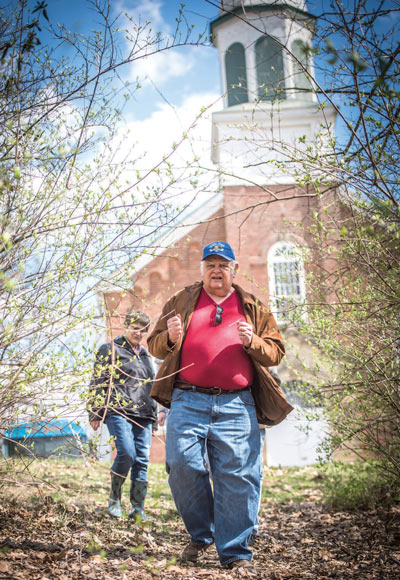
Duane Walter, an experienced professional “dowser” from Hatfield in Spencer County, visited Ferdinand with his “tool box” a couple of weeks ago to try and locate some of the burial sites. Unfortunately, the area is rather vast and covered in shrub so the outing was not a success.
Before a second attempt is made, the Ferdinand Historical Society, whose members are spearheading this effort, asks if anyone has more information that could help in the search.
This may seem like an odd project but Society members deemed it important to at least attempt to define the area where infants were buried and possibly mark it in some way.
If anyone has any information, feel free to contact me at 812-367-2041 during business hours, email me at ferdnews@psci.net or call Ann Weyer, Ferdinand Historical Society president, at 812-367-1266.
