
Huntingburg undertakes massive wastewater improvement project
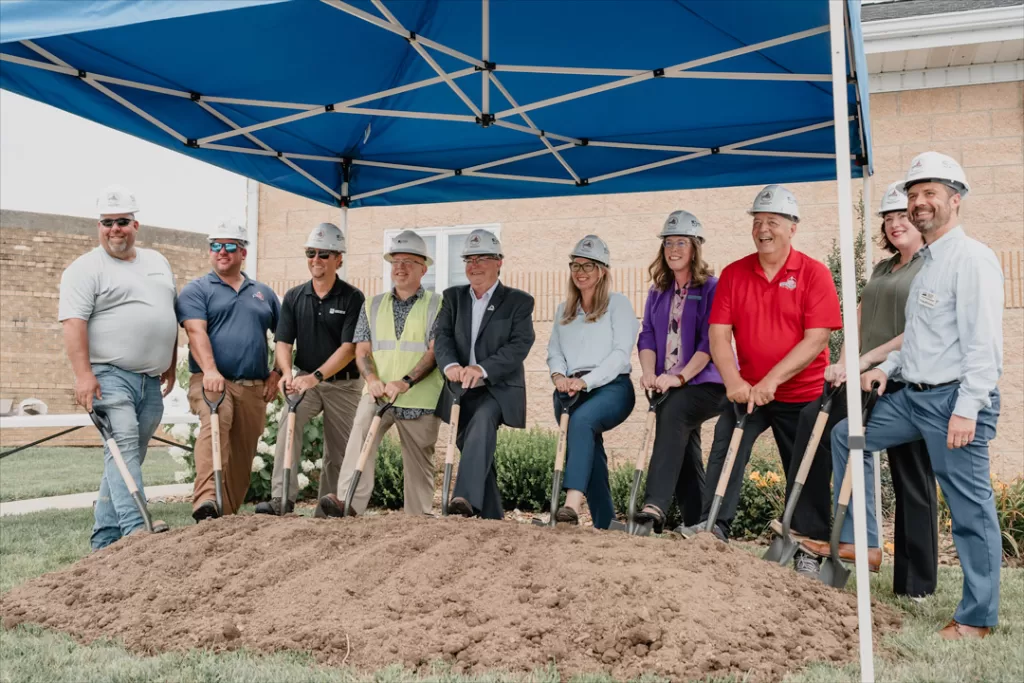
Tuesday, the City of Huntingburg celebrated the commencement of a major infrastructure project designed to support the city’s continued growth–a new wastewater treatment facility.
As part of its plan to update this important infrastructure component, the city is set to invest up to $50 million in the new treatment facility and make major updates to infrastructure along First Street.
“The project we’re here to celebrate today represents more than a series of pipes, tanks, gauges and pump stations,” said Huntingburg Mayor Neil Elkins. “I see this project as an important part of the greater effort to improve our community’s strategic infrastructure investment. The first step in stimulating the next level of community and economic development in our city.”
He commended the cooperation between the state and federal agencies and Commonwealth Engineering for bringing the project to this point. The project relies on funding and loans from the USDA Rural Development, the Economic Development Association (federal), the Indiana Bond Bank, and other organizations that helped the city complete the funding process, which includes grants, bonds and two low-interest loans.
You can read more about the funding mechanism here.
The project has been under consideration for about 20 years and spanned three mayors, as officials understood the need to plan for the needed upgrades to the system, which was initially built in 1957 and then updated in the 1990s.
Commonwealth Engineering Project Manager Eric Parsley has worked on the project since about 2018. He noted that the older plant, though well-maintained, operated at about 127 percent of its capacity; during rain events, it was over four times the amount the plant could handle, leading to mitigation processes like storing wastewater on site until it could be treated.
The new modern system will be contained in a building about 150 feet by 50 feet with three tanks standing 30 feet above ground near the front entrance of the wastewater facility. In a much smaller footprint, the sequential batch reactor will handle 3 to 3.5 million gallons of wastewater daily, more than three times the current plant’s capacity.
Not much of the existing wastewater infrastructure will remain when the project is completed. The existing clarifiers, oxidation ditch, lagoons and controls will be gone. One digester will remain, and they are keeping the original wastewater office that was built in 1957.
According to Wastewater Superintendent Brad Coomer, the updated facility will not only upgrade their capacity but also relieve some strain on the department, especially during heavy rainfall.
“Now, if we’re over 4 million gallons (capacity), we get an inch and a half of rain, we are going to be here all night long to monitor that,” he explained.
The new system will handle significant rain events because it can batch-process wastewater more quickly than the sludge system in the current facility.
Additionally, the new system won’t require them to have chlorine on-site to treat water exiting the plant. Chlorine is a dangerous gas and requires special handling and storage. With the current system, wastewater is treated with it in the final stage before it is released.
“The new plant will have UV (ultraviolet), which is a lot safer,” Coomer explained.
Other updated processes include adding a cascade aeration system on the outfall (where the water is released) to replace the blower and electrical process they currently use to oxygenate the water. They are also looking at adding solar power to offset power usage and provide power during outages.
Coomer said they take pride in maintaining the wastewater facility, which has components ranging from 65 to 30 years old. He said they plan to continue that commitment with the new system.
“I think we will be able to make the lifespan of the new facility a lot longer,” he explained. “They expect it to last 20 years. Hopefully, we can get 40 or 50 years.”
The construction of the new facility will take about two years. According to Parsley, this is due to the tremendous amount of concrete work and the installation of piles into the ground to support the structure to meet the stringent requirements for wastewater facilities. Not only is it better able to handle massive rain events, but Parsley said it will likely be the safest spot in town in case of earthquakes.
“The walls will actually be four feet thick at the lowest point to support the weight,” Parsley said.
Along with the new treatment facility, the city will be undertaking about $4 million in upgrades to more then 3,000 feet of wastewater infrastructure along First Street. When it rains, this infrastructure can be quickly overwhelmed, causing issues for homes in that area. “A lot of people have backflow preventers,” Coomer explained. “When it rains, those homes can only flush their toilets so many times, and they can’t really do laundry.”
Mayor Elkins pointed out during his remarks that this project was the city’s most significant capital investment in infrastructure ever. “We’re not bragging about a $40 to $50 million project. We would have liked to see $30 million,” he explained, adding that they continue to look at ways to save money on the project through value engineering. “We’ve already recognized some areas we can keep costs down.”
Elkins was pointing to the economic health of the community.
“Economically, it poises us for more growth for housing and continued expansion into the surrounding areas,” he said.
It also supports continued growth from local employers like Farbest Foods, OFS Brands, and others.
And it is important for the environment.
“Safety and the environment are important to me,” Elkins said. “We’ve passed every inspection (at the wastewater plant) with what is coming out, but there will be a time when that may not happen. We have to think ahead.”
He commended the plant operators and wastewater personnel for their dedication and professionalism in operating the older facility. “We even assist other communities in running their (wastewater) plants,” Elkins said. “It’s just the capacity of a place that was built in 1957.”
“I’d like to have ’57 Chevy, but I don’t want a ’57 wastewater treatment plant,” he joked.
To support the improvements, the city council, following recommendations from the rate advisory board and board of public works, approved a stairstep increase in wastewater rates.
The rate went up 17.5 percent to $7.40 per 100 cubic feet in June, payable in July with a $37.29 base rate. And is expected to increase by another 10 percent to $8.15 per 100 cubic feet with a $41 base rate.
Mayor Elkins said they plan on reconsidering the recommended increase in January depending on the progress of the project. He hopes they can reduce that amount.
Huntingburg WWTP Groundbreaking – July 16, 2024 from commonwealthengineers on Vimeo.
