
Huntingburg appoints new water superintendent

Gregg Miller was appointed as Huntingburg’s new Water Superintendent Tuesday evening.
Miller was appointed as the chief operator at the Huntingburg Water Plant over 27 years ago by then Utility Superintendent Loma Hartke.
“I am honored to have been selected as Water Superintendent for the City of Huntingburg,” says Miller. “It is very busy for us with all of the projects going on, but I look forward to the challenges ahead and working with a great crew, utility board and mayor.”
The 54-year-old is a lifelong resident of Huntingburg who attended Nashville Auto Diesel College after graduating high school. He then joined the U.S. Navy and served as a machinist mate for four years active duty before returning to the area. After working in factories for a couple years, he was hired by the city for the water department in 1989 and has been there since.
Miller and his wife Lorrie live in Huntingburg.
According to Mayor Denny Spinner, the committee tasked with the replacing Todd Williams, who resigned to pursue mission work, had two very good candidates apply from within the department.
“Through his many years of service with the city, Gregg has proven himself to be a dedicated employee,” says Mayor Spinner. “I have no doubt he is qualified to take this next step in his career and continue to serve the residents of Huntingburg.”
Miller gave his first utility report Tuesday evening.
Among the items discussed was a clarification of the city’s susceptibility to lead in its water. The clarification comes as the Flint, Mich. water issue has continued to make national headlines.
In the case of Flint, the corrosiveness caused by the chloride content of the water source, the Flint River, was not properly treated by the water plant and it leached the lead from old pipes in the poverty-stricken city as the water flowed through. This was determined through an independent study by a Virginia Tech expert on water treatment and corrosion.
According to Miller, Utility Superintendent Loma Hartke led an initiative to remove lead lines about 28 years ago. “Hartke worked really hard about getting all the lead lines out of here because of the potential for trouble down the road,” he said.
Through Hartke’s direction, the water utility would inspect and replaced any lead water lines when road work or maintenance was completed.
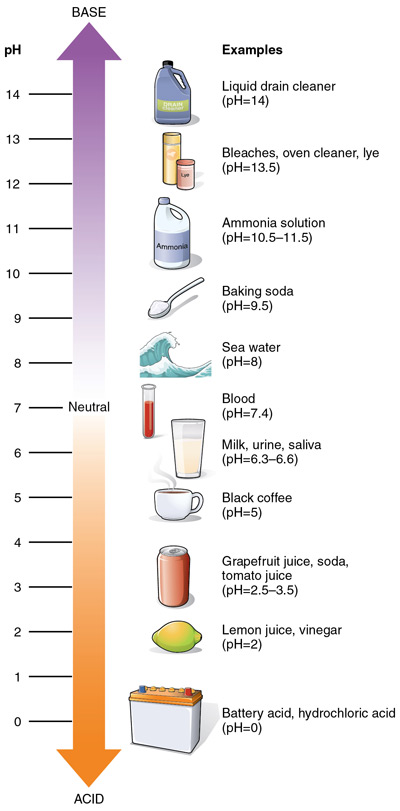
Additionally, Miller explained the water utility watches the pH of the water at the plant very closely. pH is a scale used to tell how acidic or alkaline the water is. It ranges from 0 to 14 with 7 being neutral. Anything above 7 is considered alkaline while anything under 7 is considered acidic. The chart on the right indicates the acidity and base of various liquids.
The computation required to determine the amount of chemicals necessary to clean the water from Huntingburg Lake was created by Loma Hartke on the city’s first computer. “He typed it in by hand,” Miller said. “We still use it to this day and you can’t find it on the internet anywhere.”
The Council also took the following actions:
-Heard from Miller the water utility is continuing the work on a new trailer to use to respond to water emergencies and maintenance issues. The trailer is being built by the department.
-Heard an update from Mayor Spinner on the High Speed Huntingburg fiber internet upgrade for the city. Last week the city had a pre-engineering meeting with Perry Spencer Communications and Midstate Consultants. The pre-engineering work has already been completed by PSC and Midstate is working with them on the pre-staking work to map the fiber system. After that is complete in about three months, they will begin construction of the first phases of High Speed Huntingburg. The priority installation areas will be around Stellar projects, namely Hunters Crossing and Fourth Street.
-Approved the annual bad debt write-off debt for unpaid utilities. The city approved writing off $22,987.23 in unpaid receivables. This is a small amount compared to the $18 million the city collects in utility payments annually. According to City Attorney Phil Schneider, the Indiana State Board of Accounts requires the city to take unpaid bills off their receivables each year but his office still pursues those bad debts. Annual collections average between $20,000 and $25,000.
