
Greater Jasper School board discusses ILEARN results under new test; sets 2027 budget
Greater Jasper students in grades three through eight beat the state benchmark in nearly every tested area on this year’s ILEARN, the first results under Indiana’s new testing model, district officials told the Greater Jasper Consolidated Schools board of trustees Monday.
Tina Fauks, Assistant Superintendent of Instruction, said last year was the first full rollout of the state’s new “through-year” assessment, and the state and its testing vendor had to set new cut scores for each proficiency level. Because of that, she said, the results are a new baseline. She did not compare them with prior years, and said the state does not intend them to be compared that way.
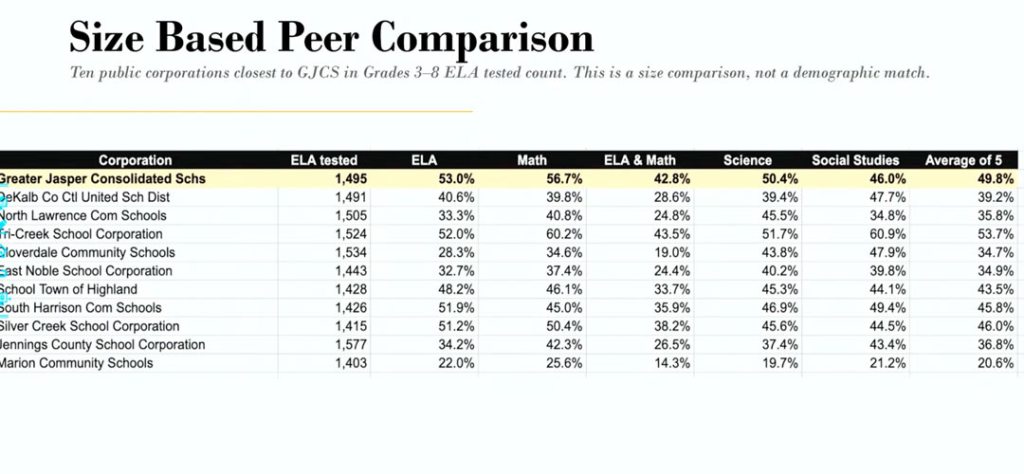
Across grades three through eight, 53% of Greater Jasper students passed English/language arts, 56.7% passed math, and 42.8% passed both. Among the 267 Indiana districts that gave both tests, Greater Jasper ranked in the 85th percentile.
Fauks said the district also compares itself with corporations of similar size, since nearby districts differ from Greater Jasper in size and demographics. Averaged across five categories, Greater Jasper ranked first in that group.
Looking at strong successes within the corporation, Fauks pointed to Ireland Elementary, where 72% of students passed math, and third graders recorded an 89.9% proficiency, outscoring the state average by 38.5 percentage points.
Overall, the weakest spot was fifth-grade social studies, which was overall 0.2 percent below the state benchmark of 46.2 percent, with Jasper Elementary reporting 5.5 percent below the benchmark and Ireland reporting 10.3 percent above the benchmark. Board member Steve Lukemeyer asked whether the district would report back on how it was addressing the performance.
Fauks said it would and noted social studies is tested in only one grade, so the problem is “bigger than a fifth grade social studies conversation.” She explained they will look at what is taught in third and fourth grade to build toward fifth-grade standards.
The district is also reviewing social studies curriculum materials this year. “That might be part of the conversation as well,” she told the board.
Superintendent Dr. Tracy Lorey added that staff will match the state’s test blueprint against the district’s sequence of standards to find where students were collectively strong or weak. “We just have to dig in a little deeper to understand where those gaps are,” she said.
Board members questioned how much the benchmark comparison means, as board member Dr. Judy Englert pointed out, the state’s benchmarks being low across the board. Lukemeyer agreed, saying the district shouldn’t be too proud of beating them.
Dr. Lorey told the board that ILEARN is “one data point” and said teachers rely on progress monitoring and other assessments during the year. “I would say we have better measures of our students’ progress that help to inform what is happening on the daily in our students’ classrooms,” she said.
She said, though ILEARN is an important data point in the eyes of the state, it is only one measure of performance.
Board president Greg Eckerle asked if the state’s testing has improved with this iteration.
Fauks said she has a “love-hate relationship” with testing but called the new data far more useful for teachers. She agreed with Dr. Lorey, though, that the summative data was not as useful as what teachers see in classrooms daily. However, she added that the checkpoint testing that occurs three times a year is more helpful, though they don’t impact the ILEARN scores.
The first checkpoint test of this year is expected around fall break in October. Unlike the old end-of-year results, checkpoint scores come back almost right away, so teachers can regroup students quickly.
“I think overall we are very pleased with our proficiency rates, but that is really the highest level of information we receive,” Fauks said. “I don’t know that we hang our hat on just that one data point. We look at the bigger picture and the education we provide for them.”
Budget and extra spending authority
The board held two public hearings. No one from the public spoke at either.
The first was on the 2027 budget. The advertised total is $50,628,930, with an advertised tax rate of $1.9501 per $100 of assessed value. Lorey said the district advertises a higher rate each year to protect the maximum levy for its operations fund, and the state Department of Local Government Finance lowers it in the final budget order. For example, for 2026, the district advertised a rate of $1.8382, and the final approved tax rate was $1.10 per $100 of assessed value.
The second hearing was on additional appropriations: $2,575,000 for the education fund and $192,000 for the debt service fund. The board approved both.
The district’s 2026 budget notice authorized $24,88,150 in education fund spending and $11,244,875 from debt service. As of the end of August, two-thirds of the way through the year, the district had spent about 71.36% of its education fund appropriation and 54.7% of its debt service appropriation. Lorey said projected spending through December could exceed the original amounts. She said the extra appropriation gives the district legal authority to spend money it has, not new money.
Estimated 2026 revenue is $27,559,274 for the education fund and about $10.75 million for debt service.
Natatorium roof
The board approved hiring Moisture Management to prepare bid documents and inspect the 25-year-old roof over the Jasper High School natatorium and its chemical room. According to the corporation’s Clerk of the Works, Todd Hopf of the Stenftenagel Group, the roof has shown fatigue over the past eight months and needs to be replaced due to “possible blowoff with fatigue that’s been shown.”
The firm will cut into the roof to see how it is built and use infrared scanning to look for other problems. Moisture Management is designing the project, not bidding to do the work. Hopf said they have two proposed fixes:
- A base bid to replace the roof with the exact same roof, estimated at $475,000.
- An alternate bid for a membrane roof with a coating for longer life, estimated at $556,000.
Hopf said the district would prefer the alternate but wants both prices to stay within budget. Bids go out in December and are due back Jan. 25, with work starting next summer.
Moisture Management also designed last summer’s emergency TPO re-roof of the auxiliary gym.
Homeroom becomes CCD
Jasper High School no longer has homeroom. In its place is College and Career Development, a daily course students and staff call CCD.
College and career counselor Erin Jocum told the board the change grew out of Indiana’s new diploma and the new school accountability model tied to it.
The administration chose homeroom because it did not want to take instructional time from teachers who are “already strapped for time.”
CCD meets every day for about 30 minutes. On Tuesdays, Wednesdays and Thursdays, students get an assignment that takes 5 to 15 minutes, according to Jocum.
Topics include SAT prep in English and math, ILEARN, military readiness, resume building and employability skills such as work ethic, communication and collaboration; tracking new diploma requirements, such as having no grade below a C for one diploma seal, or no more than three unexcused absences in a class for the military seal; setting up College Board accounts starting in 10th grade for the PSAT, and Ivy Tech accounts for dual credit; for seniors, how to fill out the FAFSA.
By the end of senior year, every student will create a LinkedIn profile so employers can find them.
CCD is pass/no pass and carries no credit. Jocum said attaching a state course title would have required teachers licensed in that subject, such as business. “We don’t have 65 people that are able to do that,” she said.
Freshmen are fine with it, she said, since much of it continues the Preparing for College and Careers class they took in eighth grade. Seniors miss their 30 minutes of free time, but as Jocum noted, they still get some time if they get the work done quickly.
The CCD work is required for students to take part in commencement.
Dr. Lorey said the courses will help create more well-rounded students beyond academic performance.
