Frosty Jones Terminal opens at Huntingburg Regional Airport, honoring aviation pioneer
Nearly 90 years after Forrest “Frosty” Jones founded Huntingburg’s original airport, his grandson stood inside a $7.2 million terminal built in his honor and called the moment “a source of pride and humbleness.”
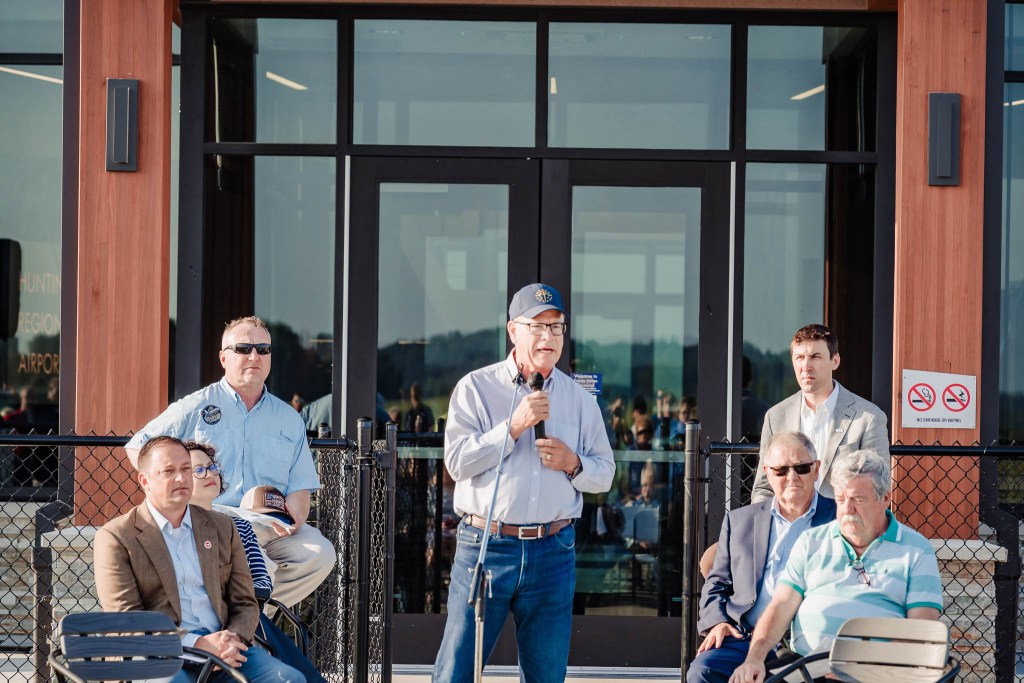
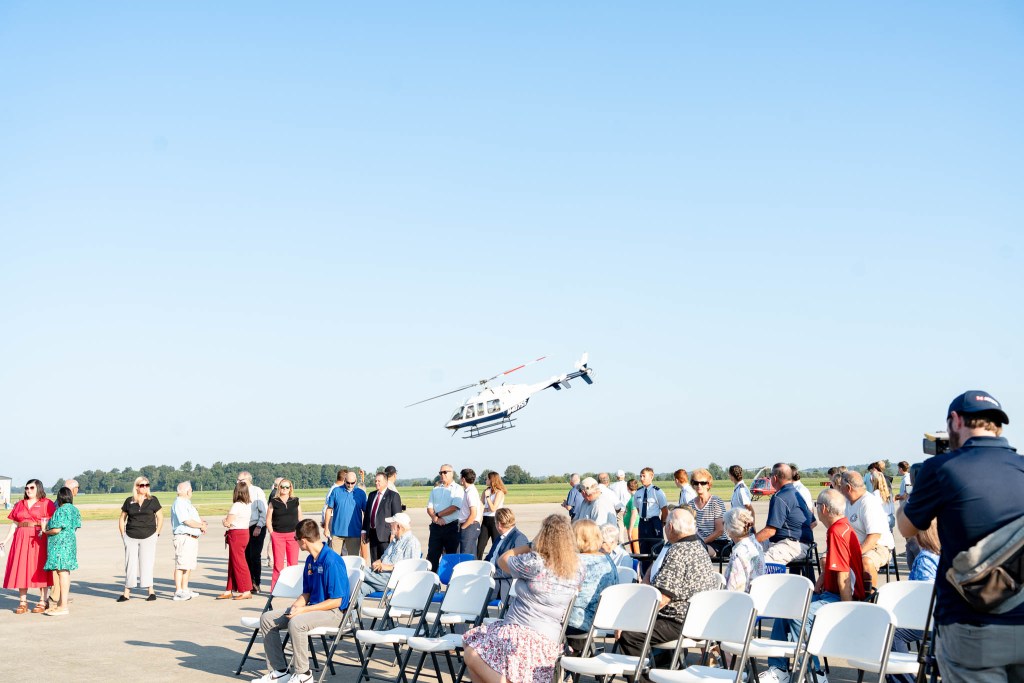
The Dubois County Airport Authority marked the opening of the new Frosty Jones Terminal Building Monday with a ribbon-cutting ceremony that drew Gov. Mike Braun, state and local officials, project partners, and Jones’ grandson, Forrest “Craig” Sloan, who traveled from Atlanta for the occasion.
Airport Authority Board President Ken Schnaus told the crowd the terminal’s role extends well beyond passenger travel. “It’s the front door to the county,” Schnaus said. “When people come in and they’re doing business, it’s the first thing they see.”
He noted the airport’s original terminal had simply outlived its usefulness. “We hope it’s very welcoming,” he said of the new building, adding that whether visitors are business people or tourists, “we hope they say, ‘Hey, this is somewhere we either want to live or we want to do business.'”
The terminal replaces a facility built in the early 1960s that had outlived its usefulness. Fifteen years in the planning, the project was funded through a coalition of federal, state, local, and private sources: roughly $3.8 million from the Federal Aviation Administration, $1.6 million from the Airport Authority, $1 million through a Dubois County EDIT loan, $500,000 from the County Council, $187,000 from INDOT, and additional support from regional and private donors.
Gov. Braun credited the project’s long timeline and broad coalition of support for getting it across the finish line as well as its impact on the future of many local students. “When you look at the germination of it — 15 years ago — and all the entities that came into play… it’s going to be used in many different ways, but most importantly, to actually create a nucleus for creating future aviators,” he said.
INDOT Office of Aviation Manager Marcus Dial detailed how the airport secured more than $3 million through a competitive federal terminal grant program. He credited the board’s proactiveness for being awarded the funding.
“This competitive grant was the crucial point to making this project happen. Huntingburg was successful in seeking this grant because the airport was so proactive in funding the design portion up front, so it was ready to be constructed,” Dial said. “When the FAA is reviewing projects, especially for competitive grants, these are the type of programs and projects that the FAA looks for–ones that are pretty much ready to go to construction.
During his comments, he also pointed to the airport’s important role in the local economy. He cited the most recent economic impact study completed in 2022 on airports in Indiana, which found Huntingburg Regional Airport generates roughly $20 million annually in direct and indirect economic impact while supporting about 74 jobs.
Airport Manager Travis McQueen understands the front-facing impact of the many corporate jets that use the facility for flying customers and sales reps into Dubois County and the region. “We had three corporate jets land here the other day and passengers and pilots from each one had comments on the design and the quality and beauty of our new terminal,” he said in an interview after the event.
This highlights the importance of first impressions for local corporations as they build their business in markets across the country.
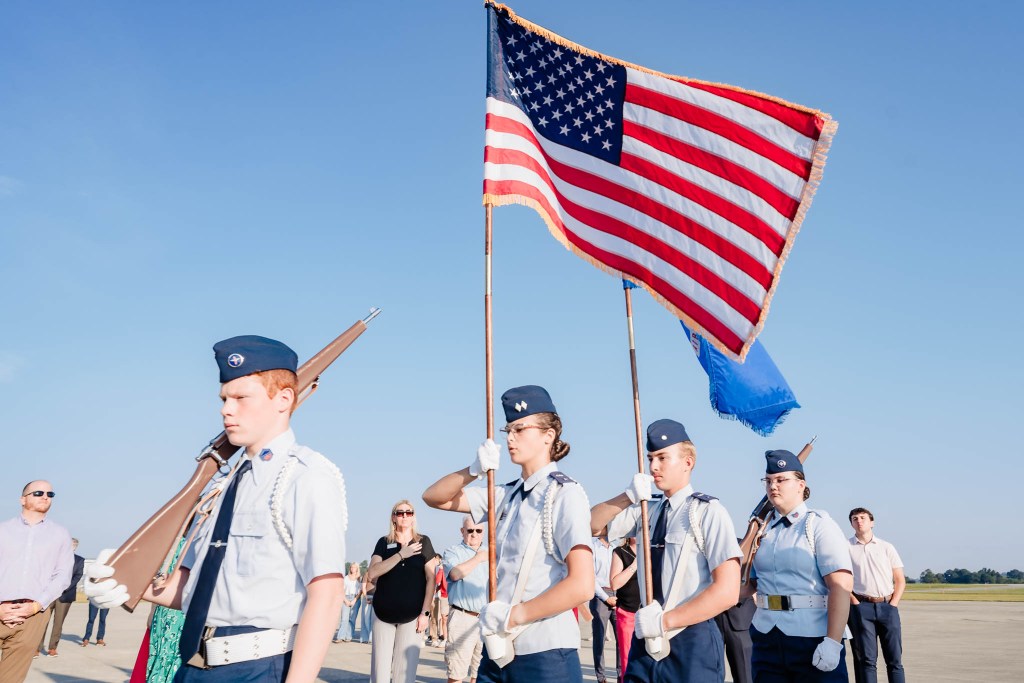
While ensuring this entry point into the region is welcoming, professional and impressive, McQueen is passionate about introducing the region’s students to aviation as a career. “I’m more proud of that aviation class and the Civil Air Patrol kids that are here,” he said. “I’m more proud of changing the lives of those students.”
The new facility expands classroom and meeting space for the Patoka Valley Career and Technical Education Center’s aviation program, which airport officials said directly impacts more than 175 high school students across nine school corporations and five counties. Twenty-eight students currently take part in the program on-site, earning college credit toward careers not just as pilots, but as mechanics, terminal workers, and weather personnel.

Aviation is a resilient and successful career path for the forseeable future, according to McQueen, so hosting students in courses that could build that interest or support that goal is the most rewarding aspect of his job.
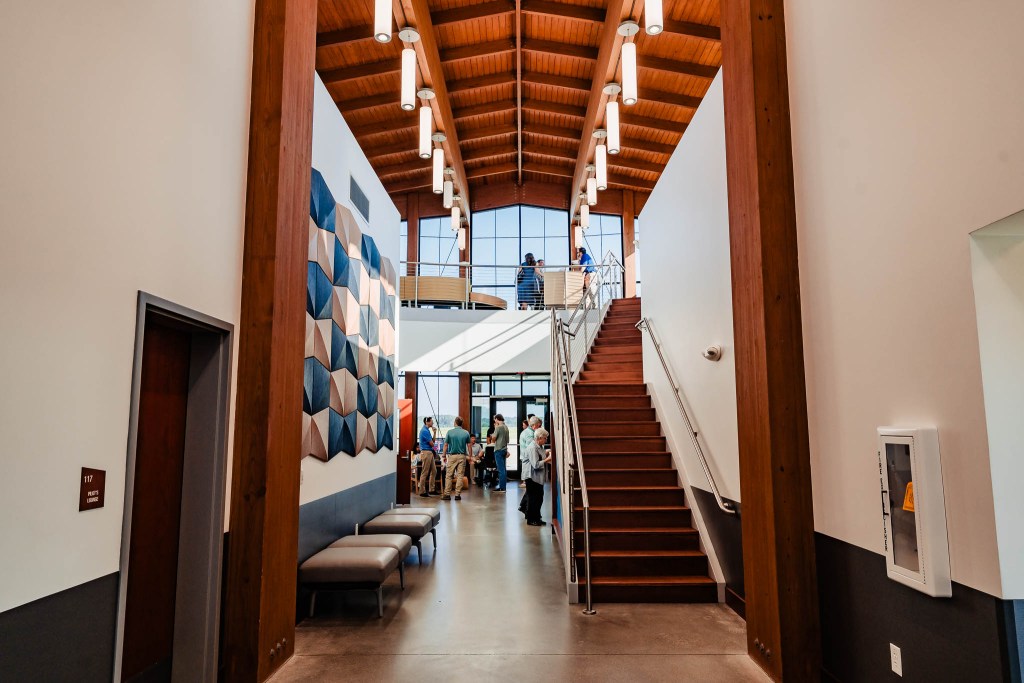
This is the first year students in the program have a dedicated classroom with modern furniture and desks. Previously, they met in the 1960s-era building, filled with garage-sale office chairs and a boardroom desk that may have also come from the 60s. While that block building epitomized a bare-bones, utilitarian terminal in the middle of a cornfield, the new Frosty Jones Terminal is a nod to the future that highlights the history of craftspeople in Dubois County through its architectural artisanship — one passenger commented it reminded them of flying into Aspen.
Being out of the squat block building has more benefits than new furniture. Southridge Senior Noah DeKemper commented that being able to see the activity on the flightline, including the incoming and outgoing aircraft, was a welcome change. And, he and his classmates have felt a bump in enthusiasm for learning in the new space that reflects how serious the airport is about its role in their education as well as the continued success of the county.

During his comments, Mr. Sloan spoke of his own journey into aviation inspired by his grandfather, Frosty Jones. He pointed out that Jones only had a third-grade formal education and became a pioneering figure in American aviation almost by accident. He told the crowd his grandfather witnessed an emergency landing by an exhibition pilot at age 10—an experience that helped chart the course of his life and love for aviation, which began as a barnstormer in the Midwest.
“If I had seen an emergency landing, I don’t know if I would want to become a pilot,” Sloan joked.
Jones was instrumental in creating Huntingburg Airport, as he and others purchased the land and cleared it for the airfield. Sloan said that after Jones cleared a stump-riddled field in 1938 to found the original Huntingburg airport, his wife, Sloan’s grandmother, would stand near the remaining stumps as landing markers so he wouldn’t strike them on approach.

Soon after establishing the airfield, Jones moved to Florida and opened two flight schools to train British and American aviators ahead of World War II. During the war, he flew DC-3 supply runs between Florida and Africa, sometimes facing German U-boat fire while crossing the Atlantic.
His favorite aircraft throughout his life was the Lockheed Electra — a detail that carried forward in his family. Sloan went on to become an aeronautical engineer at Lockheed, working on the P-3 Orion, an aircraft derived from that same Electra airframe.
“It is an honor to be invited to share a few memories about my grandfather,” Sloan told the crowd, calling him “a true pioneer in many of his endeavors, including aviation.”