
Flooding leads to spidery phenomenon

The spiders were everywhere.
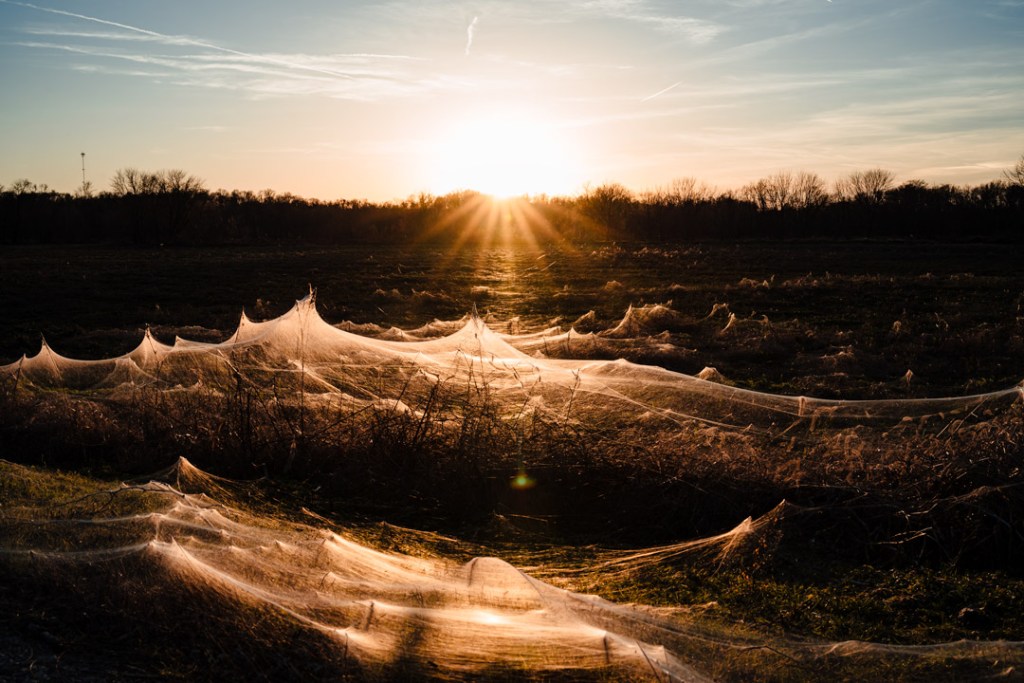
Driving on South Meridian Road Tuesday in the waning light of the early sunset of Daylight Savings Time, I noticed something strange running along the sides of the road ahead. Both sides appeared covered in layers of plastic wrap, white in the golden hour light.
As we crossed the bridge over the Straight River, my wife and I realized it was actually thick sheets of spider silk that flanked the roadway for quite a distance on both sides.
We stopped and discovered thousands of spiders milling around on the layers of spiderwebs. Spiders were clumped together and had covered the weight-limit sign leading up to the bridge, and they were launching into the air from the top of a nearby utility pole. We could see some floating on long, gossamer strands of silk, ballooning.
They were everywhere.
As we were investigating, several people stopped and asked what we were looking at before driving off, shaking their heads. I mentioned “Arachnophobia” to one passerby, but the joke didn’t seem to land.
A van drove up, and the surprised driver exclaimed, “It’s spiders!” as they went by with the windows down. A few moments later, he returned and climbed out of the van wearing a Spiderman t-shirt. He and a passenger checked the phenomenon out before saying they had a play to get to and left.
My wife and I stayed until the sun dropped below the horizon–thousands of floating spiders all around us in the dark, no thank you. We felt the random ghost tickles of the spiders crawling on us as we drove home, wondering what we had witnessed.
I think these photos can help you better understand what we found.

What we saw as we approached the bridge on South Meridian. 
The weight limit sign. 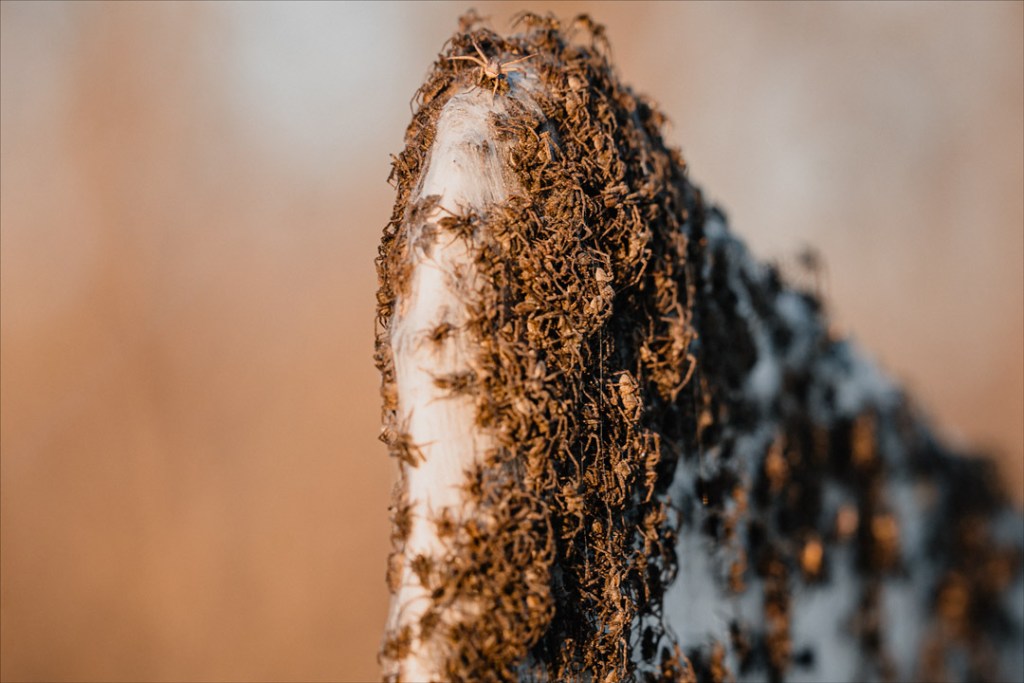
The biologist said spiders are typically aggressive towards each other but for some reason they are not. 
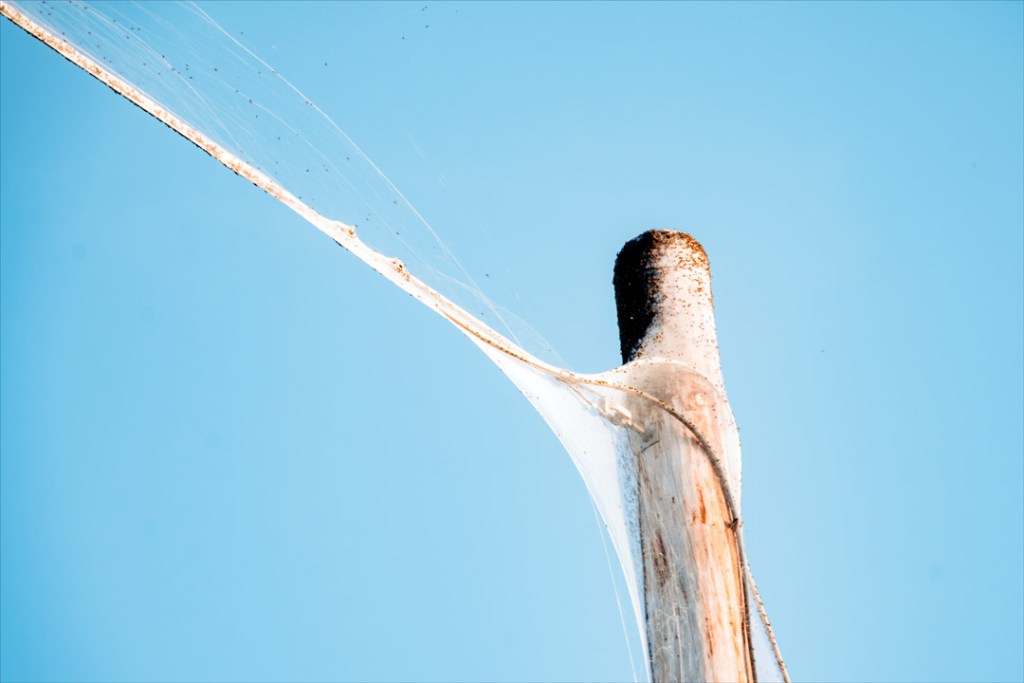
The dots in the air are spiders floating on air and electrical currents 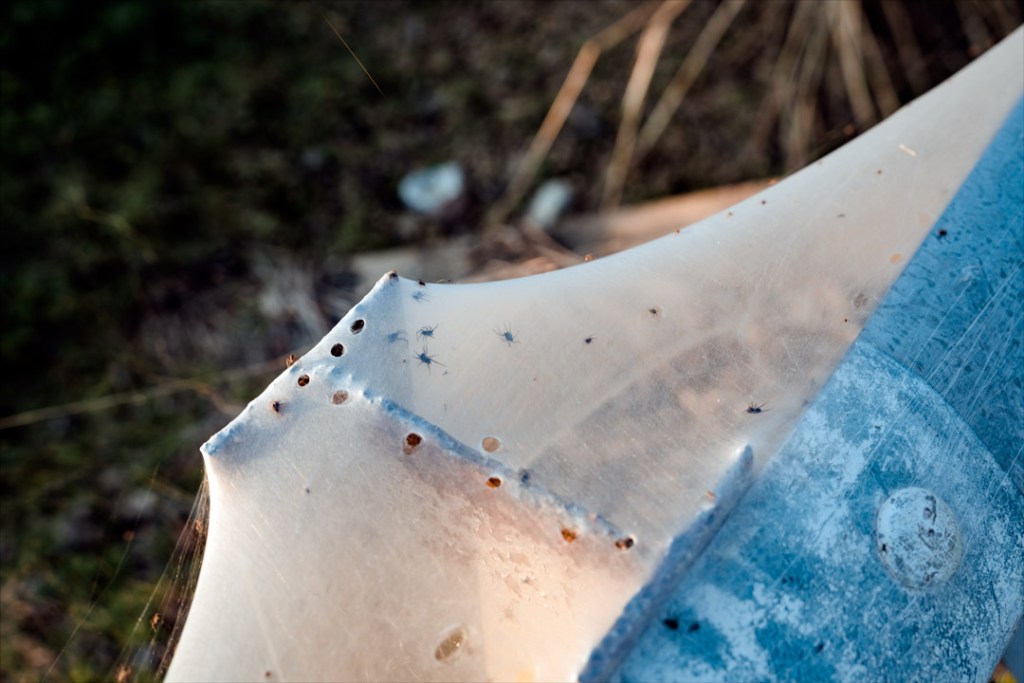
The bridge was covered in these sheets of webs.
That evening, I sent the images to a local conservation officer who said he had never seen anything like it and had reached out to the state entomologist. On Wednesday, I contacted Megan Abraham, the state entomologist, who said these occurrences had been documented in Australia. She likened it to the high water, causing them to seek out high ground to avoid drowning.
Though waters have receded, this week’s rain had 19 roads underwater, and 10 remain underwater.
Abraham said spiders weren’t her specialty, and unfortunately, the state’s spider biologist was unavailable to speak with, so I had to look around for another spider specialist to find out what was going on.
A quick Google search for Indiana arachnologists sent me to a paper on several new species of spiders found in Indiana with a list of contributing biologists. At the top of the list was Dr. Marc Milne with the University of Indianapolis. He’s a professor of biology and an arachnologist with a knack for finding new species of spiders. Here’s an article about finding a translucent spider in an Indiana cave.
I emailed Dr. Milne wondering if he was available over what was likely a Christmas break for him and crossed my fingers hoping he would actually check his email. I attached some of the photos, thinking it would be an enticement for him to explain what we found in Southern Indiana.
He didn’t disappoint. Within an hour, I had a response. Dr. Milne was available to answer any questions over email.
Here is what I found out.
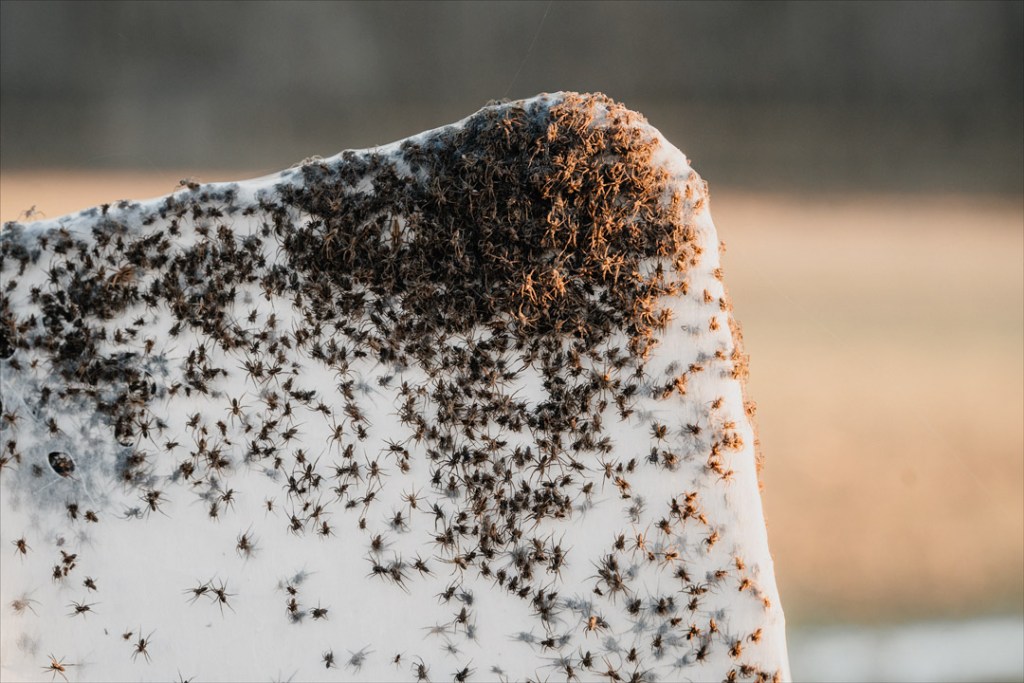
Q: What could we be seeing here? The spiders were ballooning off the telephone pole and electric wire, but many were massed together under layers of spider webbing along the ground.
A: This is a mass ballooning event due to the spiders attempting to escape the floods in the field. The strands of silk are likely a combination of ballooning threads and webbing made by spiders.
Q: Have you seen or heard of other similar occurrences?
A: Yes, there are multiple scientific studies that have documented such cases of mass ballooning. Here’s a good one that is probably a similar situation to what we’re seeing in southern Indiana: https://www.researchgate.net/profile/Carlos-Toscano-Gadea/publication/354059807_Massive_spider_web_aggregations_in_South_American_grasslands_after_flooding/links/6123f410a8348b1a46ff16be/Massive-spider-web-aggregations-in-South-American-grasslands-after-flooding.pdf
Q: What could cause it this time of year?
A: This is likely due to the heavy rains, which caused flooding. Most spiders cannot survive underwater so they often climb up to taller structures to escape floods (this is what happens in cranberry bogs when they are flooded to harvest the cranberries – the spiders start climbing up anything tall they can find, including the workers!). In this case, the spiders seem to have climbed to higher structures, but that wasn’t tall enough to escape the water, so they started to balloon – letting out a thin strand of silk and flying on the wind / electric currents to escape the water.
Q: What created all the sheets of webbing along the roadway?
A: I hypothesize that the sheets of webs are either the strands of silk used to balloon and/or sheet webs of spiders in the family Linyphiidae. These spiders are called sheet web spiders and build horizontal webs across low vegetation. However, without closer inspection, I couldn’t say for sure which one, if not both. I suspect the former, though, because these are much larger than sheet webs. I didn’t see any linyphiids in your photographs, and most of the spiders shown don’t build sheet webs but probably balloons.
Q: So, does that mean a lot of spiders were likely involved?
A: Yes, this indicates that tens of thousands of spiders were escaping the water.
Q: Can you tell what type of spider this is? (I can see if I have a clearer photo, but these were smaller than a dime. Some larger spiders with different markings were also in the mix)
A: I can tell a few families from the photos, but nothing too specific. I see crab spiders and wolf spiders in the photos. What’s probably happened is that all of the spiders in those fields have climbed up and are attempting to either crawl or balloon away. Not all spiders balloon, so the ones that can likely do and the ones that can’t likely crawl up and out. Oftentimes, immature spiders balloon, but mature ones don’t, unless they’re something naturally tiny like sheet web weaving spiders (linyphiids) – adults and immatures can balloon in that family. So, we probably have many different types of spiders here.
What’s unusual is that spiders are commonly aggressive towards each other and will eat each other quickly, but here, they don’t do that. It seems that they have temporarily become less aggressive and more aggregate – probably a product of extreme environmental circumstances.
Q: How do these spiders usually spend the winter?
A: Most spiders will overwinter in egg sacs and then hatch in the spring. But some will be crawling around looking for food – oftentimes under the leaves and among the grass.
Q: Do you feel environmental factors have a role in this occurrence, like the warmer weather we have had recently?
A: It’s possible that the warmer weather has made it so that more spiders survive than usual, leading to a greater abundance as we move into what has historically been the “colder” months of the year. But the main culprit here is likely the unusually high flooding.
Q: What happens next?
A: The spiders will likely return to their original habitat once the waters recede. This is where most of their prey are, and they will likely return there to feed and live out their lives.
The article originally stated the bridge was over Jahn Creek, but a reader pointed out that Jahn Creek crossed Meridian further north. The bridge actually crosses the Straight River. The error has been corrected.
