
Facing uncertain cancer future, Jasper woman hopes her decisions help others

Laurelin Doty’s body has gone through some changes over the past six months; parts removed, parts reconstructed.
Two voluntary surgical procedures with a couple complications designed to hopefully keep her from facing cancer in the future.
Sometimes the 33-year-old wonders if the decisions she’s made have been less than brave. The doctors told her the cancer gun was likely loaded and ready to fire — may have already fired. But she still wonders if she can stand in the same room with the cancer survivors, those that didn’t have the blessing of knowing and being able to dodge their bullets.
“I felt guilty talking to people about this at first,” Laurelin said. “There’s this whole community of cancer survivors, and I’m not part of that, but I’m going through some of the procedures they go through. I mean, I’m not sick, but I’m going to have these procedures done that sick people have done.”
It wasn’t an easy decision to have those procedures done, but about two years ago, Laurelin had a genetic test completed to see if she had a higher propensity for developing cancer. The rogue gene doctors look for is called the BRCA gene, or the BReast CAncer susceptibility gene. Its presence greatly increases the likelihood of the occurrence of breast cancer if it mutates.
Laurelin had plenty of reason for the test based on her family history with the disease. Her mother, Sue Weiss, has battled breast cancer twice. When she was 42, doctors located a tumor in one of Sue’s breasts and they weren’t sure she would survive the cancer due to its aggressive invasiveness. However, after a long battle that included the removal of the breast and multiple forms of chemotherapy, Sue’s cancer was in remission.
It was a grueling process, and when, 16 months after being declared cancer-free, cancer was found in her other breast, Sue didn’t want to do it again.
“It (chemotherapy) made me very sick,” Sue said recalling moments when she couldn’t breathe because she was so sick.
Laurelin, eight years old at the time, overheard her parents talking about Sue considering optional therapies rather than the chemotherapy.
“In her sweet little voice, she came up to me and said, ‘Mommy, I don’t know for sure, but I think if you do the chemo you might live,'” Sue explained.
So Sue opted for the chemo again, and now at 66, she is enjoying time with her grandchildren.
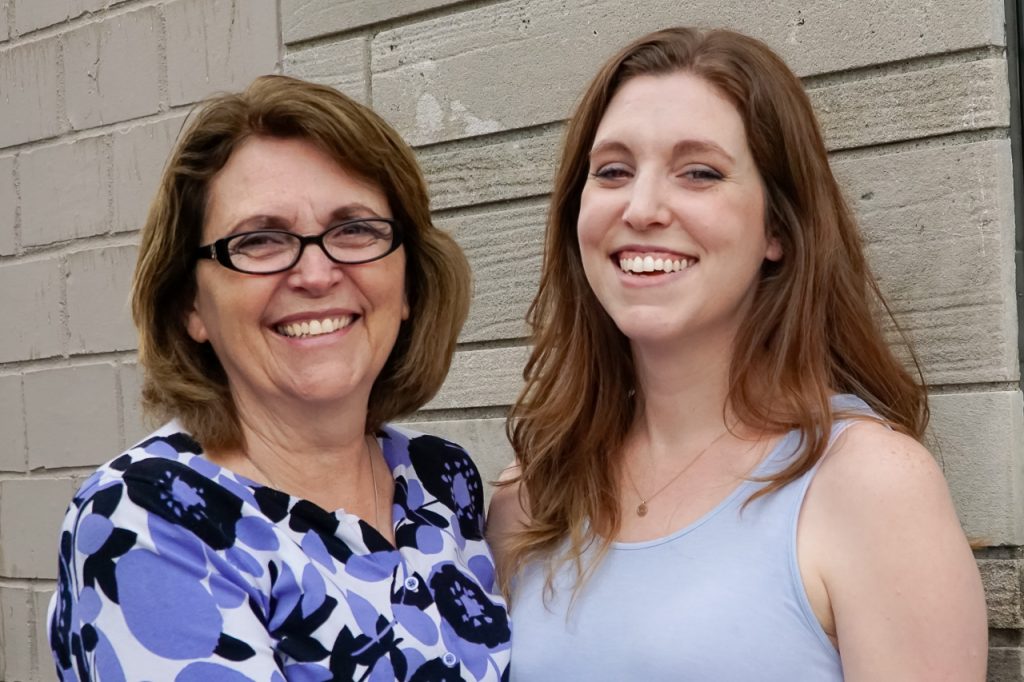
The propensity for breast cancer seems rampant on that side of the family. Among Sues other sisters — Christine Neff, Martha Beeks and Colleen Kotlowski — one has waged her own battle against breast cancer, one died from breast cancer (Christine) and one avoided it by going through a mastectomy and reconstruction about 20 years ago.
So, coming out of Dr. Steven Hopf’s office at the Jasper Obstetrics and Gynecology office after the test, Laurelin knew the odds were heavily stacked against her with her family history of cancer and her mom having the BRCA gene.
“Normal risk for breast cancer is 12 to 13 percent, but with the genetic (BRCA) marker, that risk rises to 35 to 80 percent with other factors like family history,” she said.
If the gene is present, patients have a choice of playing the odds and upping their screenings to every six months until cancer shows up — because it probably will — or going through with a double mastectomy and hysterectomy to remove all of the tissue where the cancers can form.
Similar to her eight-year-old self, Laurelin was pragmatic about the decision to have both procedures done. She still had some apprehension but felt for the sake of her family as well as her own health, she would take the more drastic route.
“I was actually okay with the mastectomy,” Laurelin said feeling that with the reconstruction, she wouldn’t likely have any issues.
The hysterectomy was a more difficult decision. Laurelin and Nick would have three children by the time the surgeries occurred but to permanently close the door to having more children was a hard choice to make.
But, according to her doctor, the hysterectomy was maybe an even more important part of the process. While breast cancer is the elephant in the room, ovarian cancer is also linked to the BRCA gene as well, and it carries a higher mortality rate. According to the CDC, five-year survival rates for breast cancer are about 99 percent while five-year survival rates for ovarian cancer are about 47 percent.
A few weeks later, unsurprisingly, she got the positive results for the presence of the BRCA gene. When she got home and told Nick, he echoed the decision she had already been leaning toward. “I gave him the rundown, and he knew a little about my family history,” she said. “So, when I came home from the meeting with Dr. Hopf, he was like, ‘well, it’s a done deal.'”
For Nick, it was an easy decision. “Any problem needs to be met head-on,” he explained. “The hard things are the things you go at first.”
But this wasn’t his battle. He knew Laurelin could handle the decisions and the surgeries without his help, but his love pulled him to want to step into her place. “If something is going to harm my wife, I am going to get in the way. If something is heavy, I move it. If something costs a lot, I work hard to pay for it.” he said. “But in this, I can only do things behind the scenes.”
[quote] “I’m envious of how strong she is and flabbergasted by how strong she thinks I am,” Nick said about Laurelin.[/quote]
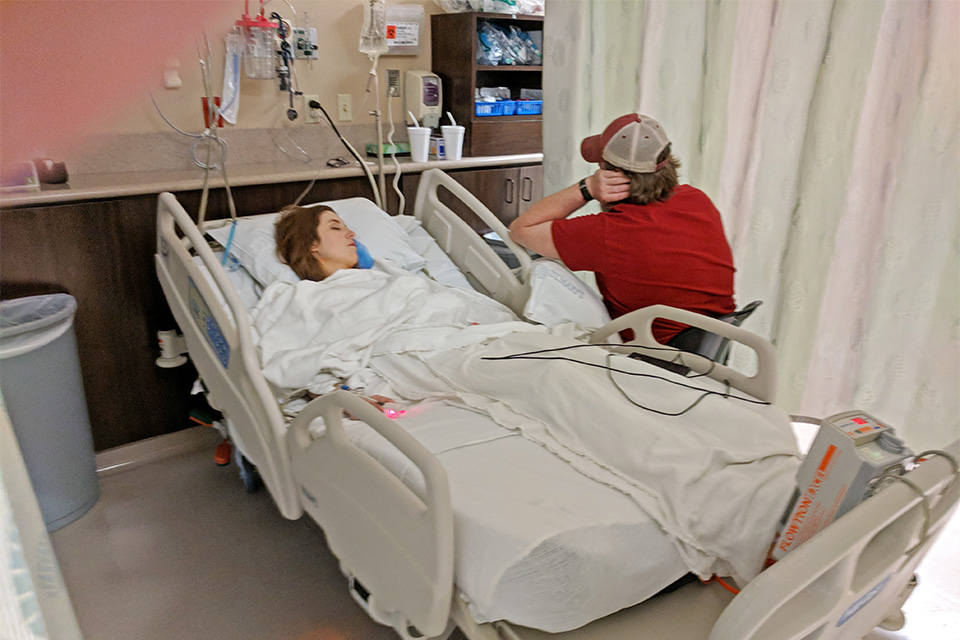
In April, Laurelin went through with the mastectomy. Things went well, but there were some issues with the reconstruction that required doctors to go in and make some adjustments.
In October, Laurelin had the hysterectomy completed.
Looking back, she has mixed feelings about everything. She’s wondering how the hysterectomy and hormone replacement therapy will impact her.
“Every once in a while I still think it was all pretty drastic, but I’m also relieved to be done with the surgeries,” she said adding that avoiding the biannual biopsies and screenings was also a relief.
As her mother before her, Laurelin is facing the potential that her three daughters – Isabelle (5), Gwendolyn (4) and Piper (2) – may have to make a similar decision. It’s too early to screen for the gene but Laurelin hopes her decision will help them with theirs if it comes to that.
“With having three girls, I wanted to be able to make a strong decision so that if they are faced with that at some point, they will have my decision to look back on,” Laurelin said.
She’s hoping her story will help other women facing similar circumstances as well.
