
Dubois County natives stress high-tech job opportunities in Indiana
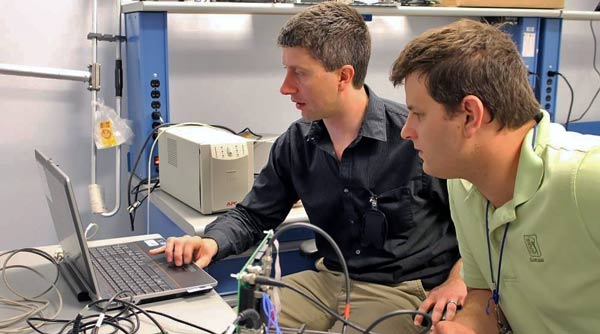
Two Dubois County natives are stressing the opportunities in technological fields in Indiana.
Scientist Matt Kay, who graduated from Jasper High School, and electrical engineer Matthew Gadlage, who graduated from Northeast Dubois, are part of a group making a difference on national and local levels. The two are work at the Global Deterrence and Defense Department’s cutting-edge SPECTRA lab. This month, Naval Surface Warfare Center, Crane Division (NSWC Crane) hosted a ribbon cutting to celebrate its one-year anniversary.
Dr. Gadlage, who received his doctorate from Vanderbilt University, was the first graduate of NSWC Crane’s PhD Fellowship Program, which helps employees complete doctoral studies in technical knowledge and advanced theories and techniques.
Kay is currently enrolled in the same program, completing his degree through Purdue University.
“In southern Indiana, we’re typically seen as an agricultural, rural community but Crane’s motto is ‘Harnessing the Power of Technology for the Warfighter,'” Kay said. “Our division works with microelectronics — it’s like a micro Silicon Valley.”
The new lab’s arsenal of equipment includes Advanced Scanning Optical Microscope (ASOM) technology used to ensure the integrity of microelectronics, which is essential for optimal functionality and reliability in weapons systems.
“Let’s say you buy a cell phone or a laptop. The electronics in it have to last maybe two or three years, but when you put electronics in a military or space system, it could have to last 40 or 50 years in extreme environments,” Gadlage noted. “We want to take the latest and greatest commercial technology that you find in cell phones or laptops and see if we can use those in defense systems.”
Kay added that before a satellite is put into space, experts must ensure the system’s parts will function correctly every time.
“Microelectronic devices that are smaller than postage stamps have billions of transistors on them. In an ideal world, we want to make sure that every single transistor is reliable,” he said, also pointing out that the most important focus of their work is ensuring the security of the men and women fighting for their nation.
“I like that I’m helping our country while working on the latest technology and interacting with scientists and engineers across the country,” stressed Gadlage.
Kay agreed, noting that local youths don’t need to relocate to the east or west coasts in order to have satisfying careers working with cutting-edge technologies.
“There’s a huge opportunity here! Crane is always looking for young, intelligent individuals who are interested in science and technology and want to make a real impact on their communities and their country,” he said. “One of the things I really enjoy about Crane is the potential — if you’re willing to work hard and you want to make a difference, the sky is the limit at Crane.”
Located on the third largest naval installation in the world, NSWC Crane’s $1.5B business base supports the Navy by leveraging its technical capabilities to support the warfighter in this rapidly changing combat environment.
Employees provide comprehensive support for complex military systems spanning design, development, deployment and sustainment. Find out more about the warfare center and its employment opportunities at http://www.navsea.navy.mil/nswc/crane/default.aspx and www.usajobs.gov.
