
Dubois County Council hears from opponents to the corridor, asked to leave RDA

At its regular meeting on Monday, the Dubois County Council heard from several representatives of the groups opposing the Mid-States Corridor, asking the council to withdraw its support for the Mid-States Corridor Regional Development Authority (RDA).
The Mid-States RDA was created to provide a financial path for the Tier 1 study of the proposed Mid-States Corridor. Funded through public and private investment, the $7 million study was used to determine multiple alternative routes and to demonstrate the need for the road to obtain Federal Highway Administration project approval.
Since the completion of the Tier 1 study, the Mid-States Corridor RDA is a stakeholder in the corridor’s development, along with the Property Rights Alliance. Both groups are represented in Community Advisory Committee meetings held with INDOT.
The RDA was given the opportunity to speak to the council in December, and the council granted the same opportunity to the groups opposing the corridor, Property Rights Alliance and Midstates Update, to make presentations as well.
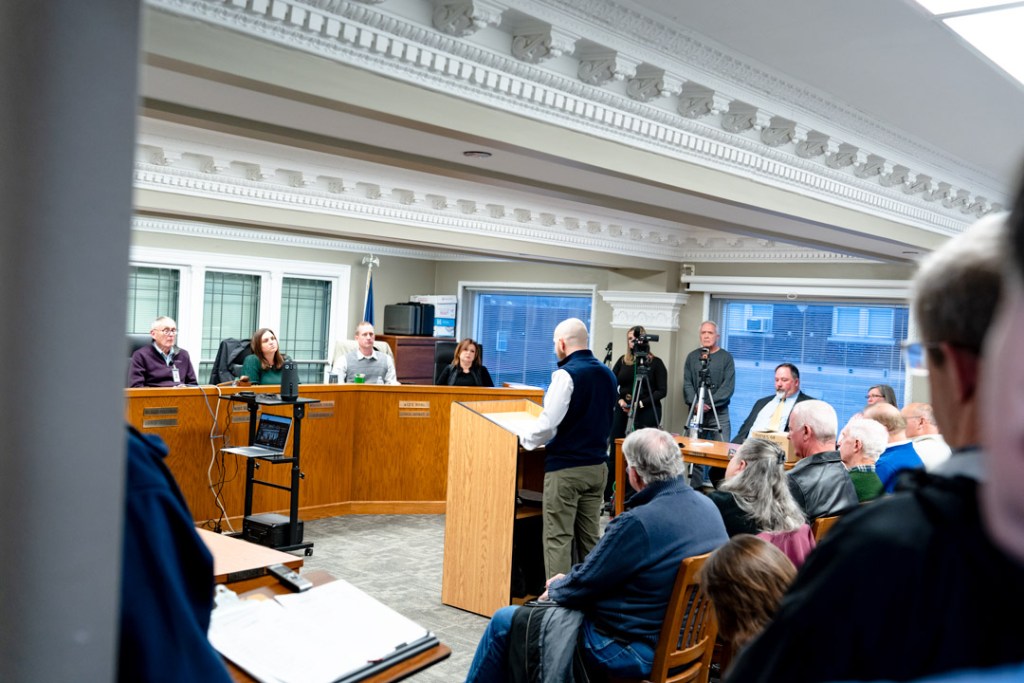
In a standing-room-only crowd that stretched into the hallway at the county annex, those groups spoke on Monday.
Brad Hochgesang, a candidate for State Senate and co-founder of Midstates Update, told the council that 81% of Dubois County’s registered voters oppose the Midstates Corridor, according to a December poll. The poll, conducted by Public Policy Polling, included 636 Dubois County respondents and had a 4-point margin of error.
He explained that an even more recent statewide poll of Indiana voters showed that 74% of the 554 respondents want the project canceled, with 41% strongly opposing it. This poll also had about a 4 percent margin of error. You can view the poll results at the end of the story.
Though the number of respondents in both polls appears low, scientific sampling and statistical averaging can yield accurate indicators. For example, a large election prediction can be calculated with a sample size of 500 to 1,000 voters, according to the Pew Research Center. The Raleigh, N.C.-based Public Policy Polling has a history of accurately forecasting sentiment in elections, including the recent New York City mayoral race.
“The project is dying, and everyone in this room knows it,” Hochgesang said during the meeting. “I’m here about one thing. Voting to withdraw Dubois County from the Regional Development Authority. And I want to tell you up front, this should be the easiest vote you ever take.”
Hochgesang referenced statements made by RDA representatives at the December meeting, noting that legal counsel Bill Kaiser said there’s “virtually nothing left for the RDA to do,” that the authority has no revenue source or taxing authority, and that its powers are “a paper tiger.”
He presented the council with a resolution to withdraw from the Mid-States Corridor RDA. He also asked the council for a roll call vote on the resolution, but Council President Mike Kluesner did not call for the vote, stating they would have a formal discussion during the regular March meeting.
Councilman Doug Uebelhor attempted to start a conversation about the issue, but no other council members joined him.
Pointing to potential legislation that could affect funding for the corridor, Hochgesang told the board be proactive in their support of stopping the project rather than making a decision based on the passage of the legislation.
(Hochgesang’s statements were supported by an announced amendment to Senate Bill 27, the Chicago Bears bills. The amendment announced on Tuesday would create oversight of INDOT projects costing more than $250 million. That bill is back in the Senate for final approval before heading to the governor.)
Inferring public sentiment from the polling results, Hochgesang pushed them to support the resolution to end support for the RDA.
“If you vote yes tonight, we can work together. We can fix real problems. We move on,” he said. “If you don’t, we’re still here at every meeting. In every district talking to your voters. Not because we’re vindictive, but because this is personal for us. This is about our homes. It’s about our families. It’s about our county and our quality of life. We’re not going anywhere.”

Resident and member of the Property Rights Alliance, Mark Nowotarski, criticized the RDA’s lack of transparency over the past few years and reiterated that it was no longer needed.
“Once accomplished, there was no other role to be fulfilled,” Nowotarski said regarding the RDA’s purpose after completing the Tier 1 study. “The reason for our request to no longer support the RDA goes beyond the fact that the responsibility should have been terminated after the completion of the Tier 1 study. It is because of the lack of transparency that has taken place over the past few years.”
Nowotarski also presented a box he claims contained more than 8,000 petition signatures opposing the project, disputing the RDA’s claim that only 2,959 signatures exist. He said an additional 2,000 signatures were collected during COVID-19 when copies weren’t made, and an online petition launched this past Sunday had already gathered more than 1,200 signatures.
Nowotarski also challenged several claims made by RDA representatives, including assertions about safety and congestion. He cited the Federal Highway Administration’s findings that safety and congestion were not qualifying issues for the project, with data in the final Tier 1 study validating that conclusion.
The project’s purpose and need statement was changed to focus on connectivity, which Nowotarski described as a common practice for these types of projects to help them qualify.
He also disputed the economic development justification for the highway, sharing information from a 2019 Federal Highway Administration seminar. The seminar materials state that “making a change to the transportation system cannot guarantee a better economic situation” and that “investing in transportation for the primary purpose of creating jobs is not good grounds for policy.”
In closing, Nowotarski posed three questions to the council: Where is the true cost-benefit analysis to justify the project? Where is the cost-benefit analysis for environmental and public health impacts? And what is the justification for continuing to support the Regional Development Authority?
“There is none,” he concluded.
Jason McCoy, president of the Property Rights Alliance, expressed frustration with the council’s handling of the issue and questioned whether members understand their role as the RDA.
“You are the RDA,” McCoy told the council.
He told them they have the power to begin the process of disbanding the Mid-States RDA and pushed back on their inaction.
“You’re not supposed to be relying on Bill Kaiser and Hank Menke and Mark Schroeder to tell you what it is,” he said about the RDA. “You are it.”
During public comment at the end of the meeting, Bill Kaiser told the council that if they resolved to leave the Mid-States RDA, it would not disband it. He also said the council didn’t have to take any action now and could remain part of the RDA with the option to leave later.
The council also heard an update on the Tier 2 study from Kyanna Wheeler, project manager for the Indiana Department of Transportation (INDOT), and Jason Dupont with Lochmueller Group during the meeting.
Wheeler said INDOT will seek proposals for construction inspection services in the spring or summer of 2026, with plans to have a design-build contractor under contract by mid-2026. Construction will be broken up into multiple contracts. INDOT plans to award four separate construction contracts between 2026 and 2029, procuring one contract per year.
Contract one would run from State Road 162 near the county garage north to U.S. 231 in the Opal Bottoms area.
The project uses a progressive design-build delivery method for the first contract, bringing a contractor on board earlier to help with design decisions and potentially reduce costs. INDOT has hired HNTB as its technical procurement advisor to manage the procurement process.
According to Wheeler, right-of-way acquisition begins later this fall after officials announce the preferred alternative. The department will initially focus on acquiring the property needed for the first construction contract rather than purchasing all right-of-way at once.
A formal public hearing takes place this fall, opening a public comment period. INDOT expects Federal Highway Administration approval of the final environmental document in summer 2027.
The project timeline includes:
- Mid-2026: Contractor procurement for construction contract one
- Fall 2026: Preferred alternative announcement and public hearing
- Fall 2026: Right-of-way acquisition begins
- 2027: Procurement of construction contract two
- Summer 2027: Final environmental document approval
- Fall 2027: Construction begins on contract one
- 2028: Procurement of construction contract three
- 2029: Procurement of construction contract four
During her segment, Wheeler was asked about the status of the local match requirement by Dubois County Council President Mike Kluesner, since the county has maintained it would not provide a local match.
Seemingly supporting the continued existence of the Mid-States Corridor RDA, Wheeler told the council that INDOT was no longer seeking a local match from Dubois County taxing units but would instead negotiate the local match with the Mid-States Corridor RDA. The Mid-States Corridor RDA lacks taxing authority and was initially funded by private-sector donations and public funding from Dubois County, Jasper, and Huntingburg.
Dupont gave a rundown of the continued Tier 2 study and outlined the intersections they were currently studying. They have received significant public and local official pushback over the predominance of J-turns in the design, with one design featuring up to 9 such turns. He reiterated that these are safer intersections and result in fewer fatalities than standard two-way stop sign intersections, but didn’t elaborate on whether they were being reduced.
Dupont also said that traffic studies of indicated heavy truck traffic would be diverted from U.S. 231 to the corridor. He said they project 1,700 semi tractor-trailers a day will be coming off U.S. 231 onto the Mid-States Corridor on average by 2050.
“That’s about 88% diversion. We’ve got that broken out by various segments of the existing highway, but if you aggregate them, average that out, 88% of the trucks are moving from the existing highway to the Mid-States Corridor, which is going to be a big relief to the existing 231 through town without having those trucks on there,” he explained.
In December, the council heard from representatives from INDOT and the Mid-States Corridor Regional Development Authority.
